

📑 Table of Contents
- Loading headings…
Compliance is the most boring topic in startups right up until it blocks your funding round, your GST invoice or your bank account. The good news: the basics fit on one page, and 2026 is the easiest year yet to get them done. The government recognised a record 55,200+ startups in FY 2025-26 alone, taking the total past 2.23 lakh, according to the Press Information Bureau. Here is what those founders all had to sort out.
Step one: incorporate, then stay incorporated
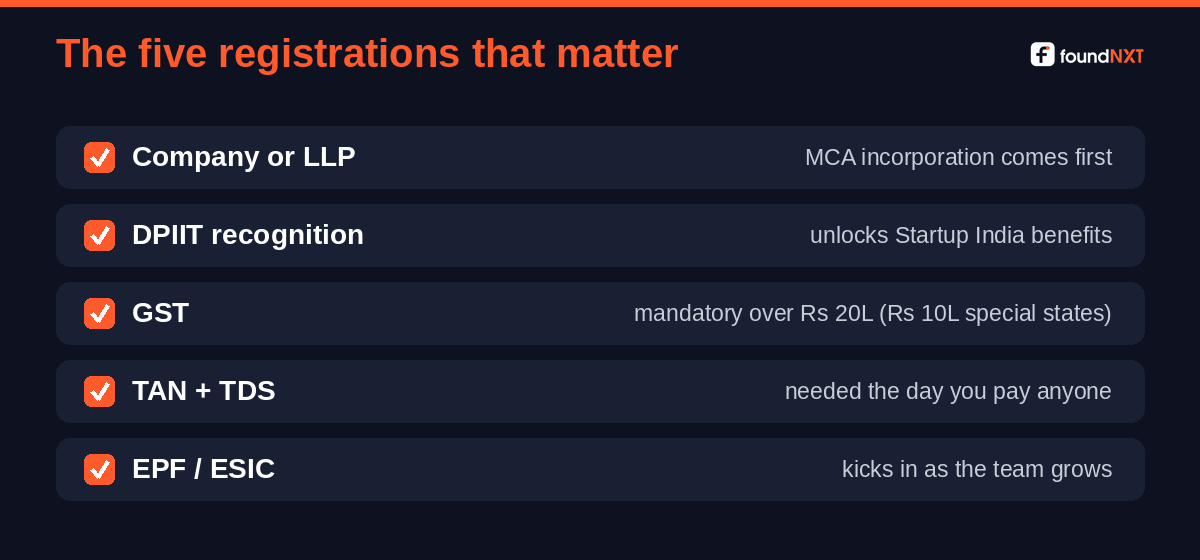
Most funded startups register as a private limited company; smaller services businesses often choose an LLP. Whichever you pick, incorporation is not a one-time event. Under the Companies Act, 2013 you must hold board meetings, maintain statutory registers and file annual returns with the MCA, as the Startup India legal checklist spells out.
Important: skipping MCA annual filings (AOC-4 and MGT-7) is the classic silent killer. Late fees run ₹100 per day per form with no upper cap, and a non-compliant company cannot close a funding round or even shut down cleanly. Put the filing dates in a calendar the day you incorporate.
DPIIT recognition: free benefits most founders skip
Registering your company is not the same as getting it recognised as a startup by DPIIT. Recognition is a separate, free application on the National Single Window System, and it unlocks the real Startup India benefits:
- Tax holiday: eligible recognised startups can claim a 3-year income tax exemption under Section 80-IAC.
- Angel tax shield: exemption from the Section 56(2)(viib) tax on share premiums, the old “angel tax” headache.
- Self-certification: reduced inspections under key labour and environment laws.
- Faster patents: fast-track examination plus an 80% rebate on patent filing fees.
- Easier government sales: relaxed prior-experience and turnover norms in public procurement.
The application runs entirely online: register on NSWS with your PAN and entity details, then file the startup recognition form with a short note on what is innovative about your business. Most clean applications clear in days.
GST: know your threshold before it knows you
GST registration becomes mandatory once annual turnover crosses ₹20 lakh (₹10 lakh in special category states), per the Startup India checklist. Two traps: businesses selling through e-commerce platforms generally need registration regardless of turnover, and voluntary registration can actually make sense earlier because it lets you claim input tax credit on your costs. Check the current thresholds for your category and state on the GST portal before you invoice your first customer.
The quiet killers: TDS, EPF and ESIC
- TDS: the day you pay salaries, rent or contractors above the threshold, you must deduct tax at source and deposit it. You need a TAN for this.
- EPF and ESIC: these kick in as your team grows; registration is mandatory once you cross the employee thresholds.
- Shops and Establishments: a state-level registration most founders discover only when a bank asks for it.
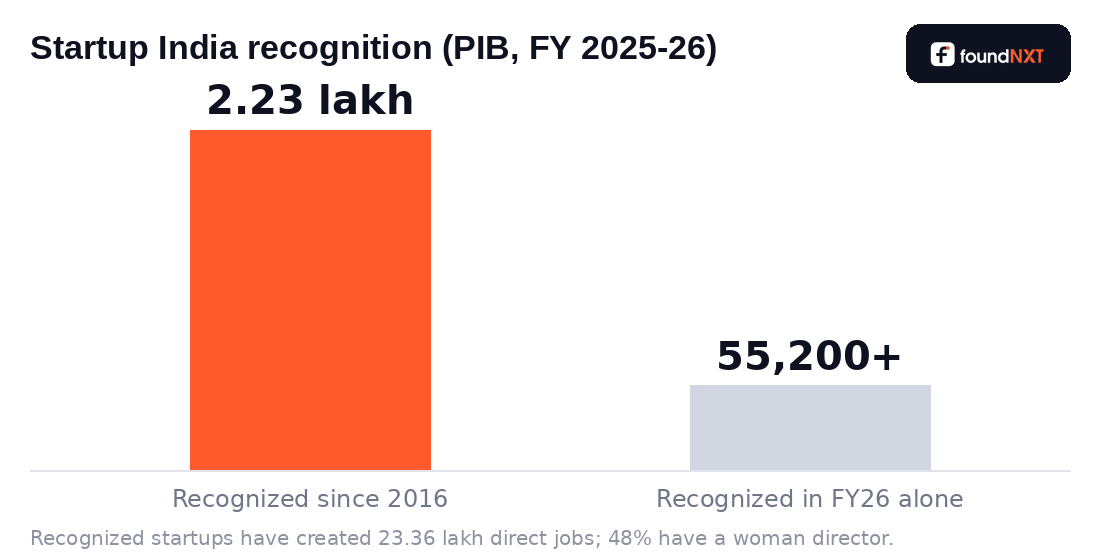
The Government has recognized more than 55,200 startups during Financial Year 2025-26, the highest number recognized in a single year since the launch of the Startup India initiative.
Press Information Bureau, 2026
Those 2.23 lakh recognised startups have created 23.36 lakh direct jobs, and 48% have at least one woman director or partner. Compliance done early is also what lets you tap the schemes we listed in Free Government Money and survive the paperwork in The First 90 Days After Incorporation. Do it once, do it right, and go back to building.
Worked example: crossing the GST line
Meet a fictional but typical founder: Asha runs a two-person design studio in Nagpur, incorporated as a private limited company. In year one her billings are ₹17 lakh, so GST registration is optional. In October of year two she signs a big client and her rolling annual turnover crosses ₹20 lakh. From that point she must register, charge 18% GST on her invoices and file returns. The upside she did not expect: with a GSTIN she now claims input tax credit. The ₹1.2 lakh (plus GST) laptop and the software subscriptions she already paid for now offset her tax bill. Plenty of small businesses register voluntarily before the threshold for exactly this reason, and because B2B clients prefer vendors who can issue GST invoices.
Worked example: what DPIIT recognition is worth in rupees
Suppose Asha’s company gets DPIIT-recognised and later posts a taxable profit of ₹40 lakh in a year. With the Section 80-IAC holiday (available for any three of its first ten years, subject to conditions), the income tax on that profit, roughly ₹10 lakh at corporate rates, drops to zero for the chosen year. And when she raises her first angel round at a premium valuation, the recognition certificate is what keeps the share premium from being taxed as income under the old angel tax provision. Two benefits, one free application.
The global parallel: Singapore and the US run similar recognition regimes, but India’s is unusual in stacking tax relief, self-certification and procurement access into a single certificate.
Want one plain-words brief on Indian startups every week? Subscribe to the Weekly Founder Brief on foundNXT.
Sources
FoundNXT publishes independent business intelligence, valuation frameworks, and startup teardowns. Nothing in this article constitutes financial, investment, legal, or tax advice. Company figures, market projections, and valuation metrics represent editorial estimates and regulatory filings. Always consult qualified legal counsel and certified financial advisors before executing investment rounds or financial agreements.