

📑 Table of Contents
- Loading headings…
You have a great idea for a product. The old advice says: build it, launch it, and hope people come. That advice has cost founders years and lakhs of rupees.
Here is a cheaper way. Before you build anything, spend one afternoon making a single web page that describes your product as if it already exists, put a clear button on it, and see who clicks. It is called a landing page test. A landing page is simply a one-page website built for one purpose, like a shop window with a single sign that says “come in.”
By the end of this guide you will know what goes on the page, how to build it in about four hours with free tools, how to get the first visitors, and how to read the result without fooling yourself.
Why a page can tell you more than a prototype
Building a product answers the question “can I make this?” A landing page answers a different and more important one: “does anyone want this?” Those are not the same. Many founders build for months, then discover the answer to the second question is no.
Think of a restaurant owner who wants to open a new kind of café. She could rent a space, buy equipment, and hire staff. Or she could put up a menu board at a pop-up stall for a weekend and count how many people line up. The stall costs a fraction and tells her most of what she needs to know.
That is exactly what the page does. It is your pop-up stall, and the visitors are the people walking by.
A real example: Buffer’s two-page test
Buffer, the social media scheduling tool, started this way. Its founder Joel Gascoigne wrote that his first test was a simple two-page site. The first page explained what Buffer would do and had a button. Clicking it led to a second page that said the product was not ready yet and invited visitors to leave an email.
When people kept leaving emails, he added a page showing pricing plans between the two, so he could see whether people would still click when they saw a price. A small number clicked on paid plans. Only then did he start building the real product. He reported having his first paying customer within four days of launching that first working version, and about 4% of people upgrading to a paid plan a couple of months in.
Notice what he did not do. He did not build a dashboard, handle payments, or write complicated code. He tested one belief at a time.
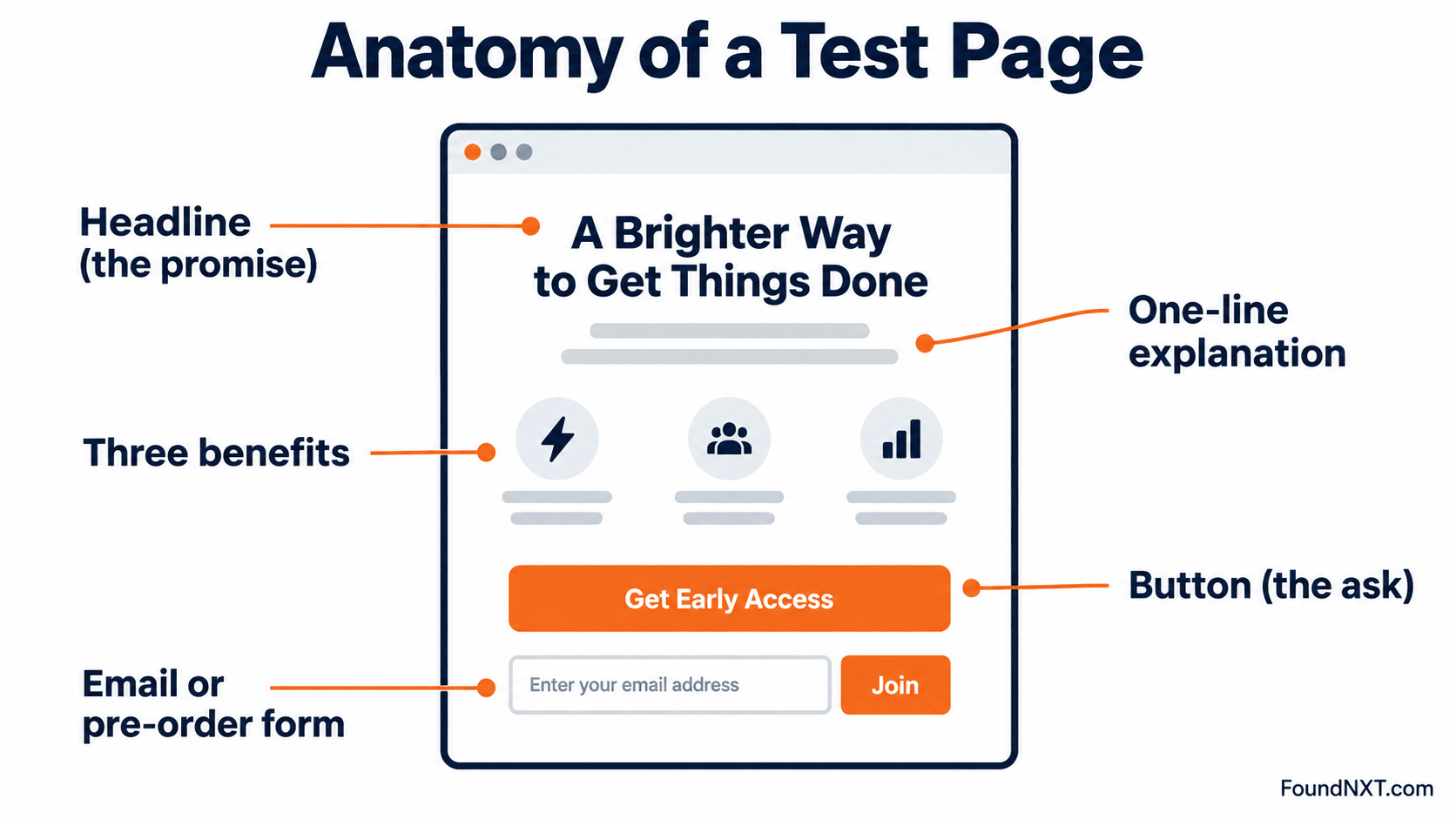
What goes on your page: the six parts
You do not need design skills. You need clarity. A good test page has six simple parts.
1. A headline that states the promise. Say what the person gets, not what you built. “Home-cooked lunch at your desk by 1 pm” beats “A smart meal logistics platform.”
2. One line of explanation. Say how it works in a sentence a ten-year-old could follow.
3. Three benefits. Write what changes in the customer’s day. Keep each to a short line.
4. A picture or mockup. A simple photo, a sketch, or a screenshot from a free design tool is enough. Be honest if it is a mockup.
5. One button. This is the ask. It might say “Join the waiting list,” “Reserve for Rs 199,” or “Book a free trial.” Use only one button, because two choices split attention and blur your results.
6. A simple form. Ask for an email, and if you can, a phone number. The less you ask, the more people will give.
Building it in one afternoon: a simple schedule
Here is a realistic plan for four hours. Spend the first hour writing: the headline, the explanation, the benefits, and the button text. Write the words first because a page is mostly words. Spend the second hour building the page using a free builder or a simple website tool. Many offer free plans, and you can use a basic template. Spend the third hour adding a form that collects emails and checking the page on your phone, because most visitors in India will see it on mobile. Use the fourth hour to send it to your first few visitors.
If you want to go a step further, add a payment link or a pre-order option for a small amount. Money is the strongest signal, as we explain in how to validate a business idea in 7 days. If you take money, be clear about what you will deliver and when, and be ready to refund if you do not build it.
Getting visitors without a big budget
A page nobody sees proves nothing. You need people who match your target customer, not just random traffic. A few simple routes work well. Share the page in the communities where your customers already gather, such as relevant WhatsApp groups, forums, or LinkedIn posts, and say clearly that you are testing an idea and would like feedback. Message a list of twenty to fifty people who fit your customer description and send them the link. If you can spare a small amount, a few hundred rupees on a targeted social ad can bring visitors who match your audience.
Drew Houston of Dropbox used the power of the right audience. According to TechCrunch, a video made for the Digg community led to 75,000 people joining the waiting list within 24 hours. The lesson is not to copy the video. It is to show your idea to people who are already looking for something like it.
How to read the numbers without fooling yourself
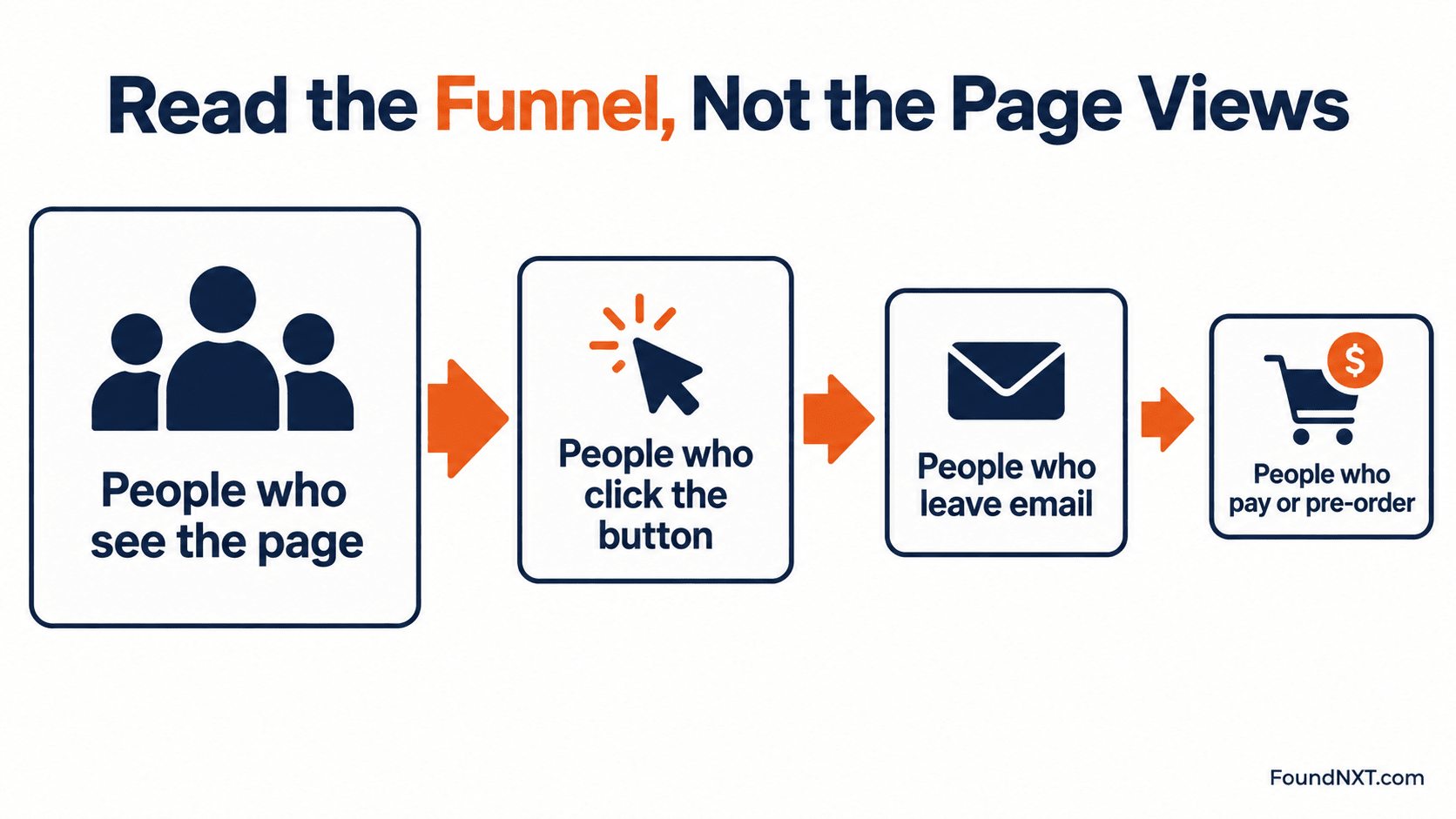
Do not celebrate page views. Many visitors who glance at your page and leave are normal. What matters is the funnel: of the people who saw it, how many clicked the button, how many left their details, and how many paid or pre-ordered?
The percentage that counts as good depends on your audience, your offer, and where the traffic came from, so be wary of any article that gives a magic number. Instead, decide your bar before you launch. For example: “If at least 30 out of 200 targeted visitors leave their email and five agree to a call, I will keep going.” Writing the bar down first stops you from moving the goalposts after you see the result.
Then follow up personally. Email the people who signed up and ask one question: “What made you sign up?” Their answers are often more valuable than the numbers.
Common mistakes
The biggest mistake is making the page too clever. If a stranger cannot explain your offer after five seconds, simplify it. The second mistake is testing with the wrong audience, like sharing only with friends who will click to be kind. The third is treating interest as demand. An email sign-up is a small signal. A payment is a big one. Use both, but know the difference. The last mistake is not defining what success means before you start.
If your results are weak, do not give up on the whole idea straight away. Change one thing, like the headline or the audience, and test again. If they are weak after two or three honest tries, our post on when to pivot will help.
A short example headline test
Headlines carry most of the weight on a test page, so it is worth trying two. Let’s imagine, as a made-up example, that you want to offer weekend cooking classes for beginners. Headline A says “Learn to cook in 4 weekends.” Headline B says “Stop ordering in. Cook five dinners you’re proud of.” You can show A to half of your visitors and B to the other half, using a simple free tool or two separate links shared with two groups.
After a few days, compare the sign-ups. If one gets clearly more, you have learned something about what your audience cares about: the skill, or the pride and savings. Keep the sample size in mind. With very few visitors, small differences can be luck, so do not make big decisions from ten clicks.
What to do with the emails after the test
The people who sign up are your first conversation partners. Within two days, send a short, human message. Thank them. Say what you are building. Ask one question, such as “What were you hoping this would help you do?” Offer a quick call to those who reply. This is where a landing page turns from a test into a relationship.
If you collect phone numbers or emails, handle them with care. Tell people how you will use their details, and do not add them to lists they did not ask for. Respecting that trust early is a good habit for the long run.
Key takeaways
- A landing page tests demand, which is a different question from whether you can build the product.
- Six parts are enough: promise, explanation, benefits, picture, one button, and a simple form.
- Be honest that the product is coming soon. You can test interest without pretending.
- Bring the right visitors, then watch the funnel from click to sign-up to payment.
- Set your success bar before launch and follow up with the people who sign up.
You do not need permission, funding, or a developer to start. You need a free afternoon and one clear sentence. Pick an idea, write the headline, and publish the page before the weekend ends.
If you try this, tell us your headline and what happened. And for one practical founder lesson in your inbox every week, subscribe to the Weekly Founder Brief from FoundNXT.