
📑 Table of Contents
- Loading headings…
Picture a bakery that wants to know if people will buy eggless birthday cakes. The owner puts a new item on the menu board, “Eggless Chocolate Truffle, order now,” and waits. Whenever a customer asks for it, she says, “That one is coming next week, shall I put your name down?”
She has not baked a single cake. But in one week she knows how many people asked, and how many gave their name. That is a fake-door test in its simplest form.
The name sounds sneaky, so let’s be clear. A fake-door test shows people a door to something that does not fully exist yet, then counts how many try to walk through. It measures demand before you spend time and money building. Done honestly, it is a respectful way to ask, “Do you want this?” with an action instead of an opinion.
How a fake-door test works
The structure is always the same. First, you create something people can see, like an ad, a social post, a page, or a menu entry. Second, it describes the product and has a button, such as “Get early access” or “Order now.” Third, when someone clicks, they land on a message that explains the truth: it is not ready yet, and they can join a waiting list.
You count the people at each step. How many saw it? How many clicked? How many joined the list? The click is your signal. A person who clicked a button that promised something specific is telling you the idea matters to them.

Is it ethical? Yes, if you are honest at the end
This is the question many founders worry about, and it is a fair one. The test becomes unfair when you take payment for something you cannot deliver, or when you leave people hanging with a dead page. It stays fair when you follow three simple rules.
First, tell the truth on the next screen. Something like “Thanks for your interest. We are still building this. Leave your email and we will tell you the moment it is ready” respects the visitor. Second, never take money unless you are ready to deliver or refund. Third, keep your promise to follow up. If you collect emails, write to those people, even if the answer is “we changed our mind.”
Three real examples of faking it the smart way
The idea of testing before building is not new. Here are three well-known cases.
Zappos. In 1999, Nick Swinmurn wanted to sell shoes online but did not want to buy stock for a business nobody had proven. As one retelling puts it, he photographed shoes in local stores, posted them on a website, and bought a pair from the store when someone ordered. He tested whether people would buy shoes online before building a warehouse. This is closer to a manual service than a pure fake door, but the spirit is the same.
Dropbox. Drew Houston released a demo video before the product was polished. A TechCrunch interview describes how a later video aimed at Digg users brought 75,000 sign-ups to the waiting list in a day, far above the 15,000 the team expected. The video was the test.
Buffer. Joel Gascoigne used a page with a button, and then a pricing page, to see if people were interested and whether they would click on paid plans. He wrote about it in his account of going from idea to paying customers in seven weeks.
Four ways to run a test, from cheap to strong
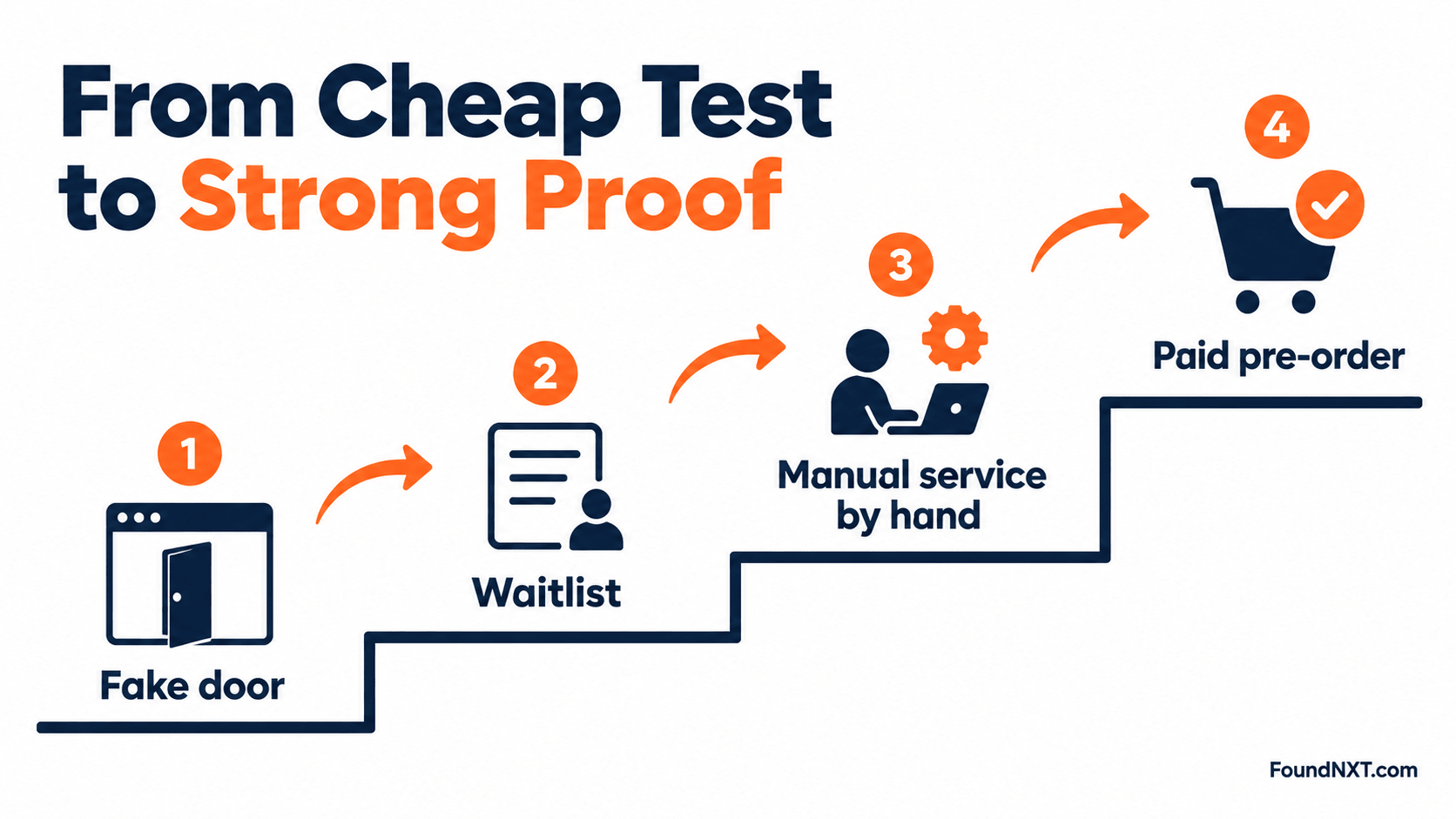
You can think of demand tests as a staircase. Each step costs a bit more effort and gives stronger evidence.
Step 1: The fake door. A button or ad that measures clicks. It is cheap and fast, but a click is a light signal.
Step 2: The waiting list. You collect emails or phone numbers. A person who gives contact details cares a little more than a person who only clicks.
Step 3: The manual service. You deliver the result by hand for a few people, like Swinmurn buying shoes from a store. People who receive the service and come back are telling you something deeper. The cost is your time.
Step 4: The paid pre-order. Someone pays in advance. This is the strongest signal, but it needs the most care, because you must deliver or refund.
A hypothetical walkthrough
Let’s imagine, purely as an example, that you want to start a weekend tool-rental service for apartment residents, offering drills, ladders, and pressure washers. Here is how you might run a test.
On Monday, write a short post for your building’s WhatsApp group: “Planning a tool rental for residents. Drill, ladder, pressure washer. Rs 150 for 24 hours. Would this help?” with a link to a simple form. On Tuesday, check the count. If forty people see it and two reply, that is weak. If ten fill in the form with the tool they need, that is a decent signal. On Wednesday, message those ten and ask what they last needed a tool for, and what they did. On Thursday, offer to lend a drill to three of them for the weekend at the planned price. If two of them pay, you have moved up the staircase.
No shop, no inventory, no website. Yet you have learned the real demand, the price range, and which tool people want most.
How to decide your success bar before you start
The most common error is deciding what counts as success after you see the numbers. Instead, write it down first. For example: “If at least 20 out of 100 people from the target group click the button and at least 5 leave a phone number, I will move to a manual test.” The numbers are just examples, and the right ones depend on your market and audience. What matters is that you set the bar in advance and stick to it.
Also write down what you will do if the answer is no. It might be changing the audience, changing the offer, or dropping the idea. If you need help judging that moment, read our guide on when to pivot.
Mistakes to avoid
Do not run a test with an audience that has nothing to do with your customer. Do not count clicks from friends as demand. Do not hide the truth on the final screen. Do not keep a test running forever, give it a clear window, such as one week. And do not treat a click as a purchase. Clicks tell you about curiosity. Money tells you about need.
If you want a complete plan around these tests, our post on validating an idea in seven days shows how to combine them with customer conversations.
What a good result looks like, and what a bad one tells you
Suppose your test brings in many clicks but few waiting-list sign-ups. That often means the promise is attractive but the next step feels risky or unclear. Try simplifying the form or explaining what happens after sign-up. Suppose it brings few clicks from the start. That might mean the audience is wrong, the headline is weak, or the problem is not that important. Change one thing and run it again.
Suppose you get many sign-ups but nobody replies when you write to them. That is a warning. The idea may sound nice but not matter enough for a conversation. Real demand usually produces replies, questions, and even complaints about how long it will take.
Fake-door tests in India: a few practical notes
Most of your first audience will be on mobile, often on WhatsApp, so test your page or form on a phone first. Short forms with a phone number often work better than long email forms for local services. Keep prices in rupees, and be clear about delivery area, since a service that only works in one city should say so on the first screen. If you promise anything about price or delivery, keep to it, because word travels fast in small communities.
Key takeaways
- A fake-door test shows a door to a product that does not fully exist, then counts who walks through.
- It stays honest if you tell people the truth on the next screen and never take money you cannot deliver on.
- Demand tests climb a staircase: fake door, waiting list, manual service, paid pre-order.
- Set your success bar and your next move before you see the numbers.
- Follow up with everyone who signed up. They are your first customers and your best teachers.
Before you spend months building, spend a week knocking on the door yourself. If nobody opens it, you have saved time. If a crowd shows up, you know where to build.
What would you test first? Tell us. And if you like practical founder lessons, subscribe to the Weekly Founder Brief from FoundNXT.