

📑 Table of Contents
- Loading headings…
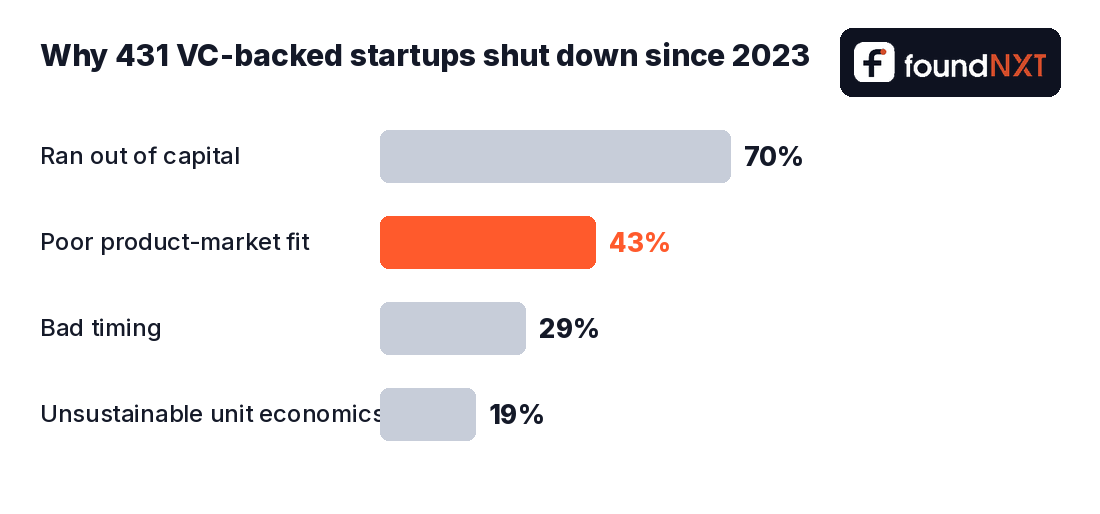
CB Insights analysed 431 VC-backed startups that shut down since 2023 and found that 43% cited poor product-market fit as a reason for failure – second only to running out of capital, which is usually just the final symptom. In other words, the single most common way startups die is by building something the market does not want, for too long.
The founders who avoid that fate usually share one skill: they know when to pivot – to change direction on the product, the customer or the business model while keeping what they have learned. This post covers five signals that it is time, with the stories of companies that read them correctly.
First, a pivot is not a failure
Some of the biggest companies in the world are pivots. Slack began as Tiny Speck, a gaming company building a game called Glitch – the internal chat tool the team built for itself became the product. Instagram started as Burbn, a cluttered check-in app, before Kevin Systrom and Mike Krieger stripped it down to photos, comments and likes. YouTube began as a video dating site. Shopify began as an online store selling snowboarding gear.
India has its own canon. Swiggy’s founders first built Bundl, a logistics aggregator connecting small and medium businesses with courier companies. Bundl shut down in June 2014 when the founders realised the product was a non-starter – and the same team relaunched as a food delivery platform the following month. Meesho started as Fashnear, a “Swiggy for fashion” delivering from local boutiques, before pivoting to the social commerce reselling model that took it to millions of entrepreneurs. None of these teams failed at their first idea. They listened to it.

The 5 signals it is time to pivot
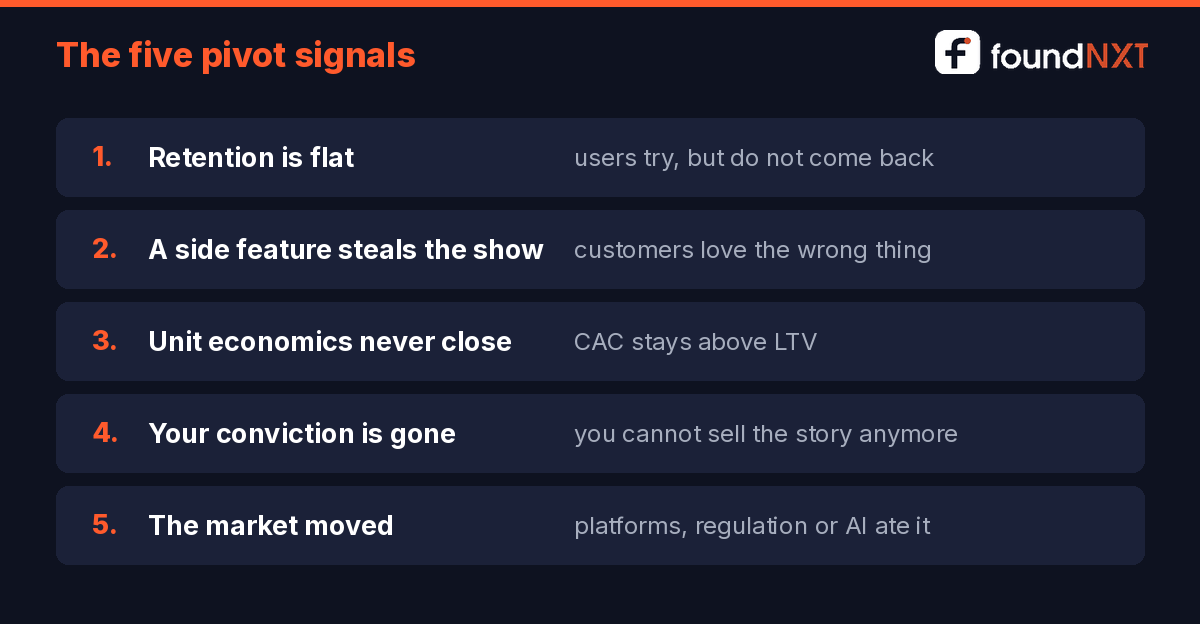
1. Retention is flat, and you have stopped pretending otherwise
Growth can be bought with ads; retention cannot. If people try your product and do not come back – and months of tweaks have not moved the curve – the market is voting. CB Insights’ post-mortem data shows this clearly: two-thirds of product-market-fit failures were early-stage companies that simply never found a market.
2. Customers love a side feature more than the main product
This is the happiest signal on the list. Tiny Speck’s team noticed their internal chat tool was more valuable than their game. Burbn’s users ignored everything except photo-sharing. If your users keep pulling you toward one corner of your product, follow them – that pull is the market telling you where the value actually lives.
3. The unit economics never close
If acquiring a customer costs Rs 5,000 and they will never pay you more than Rs 3,000 in their lifetime, no amount of scale fixes it – 19% of the startups in CB Insights’ shutdown analysis cited unsustainable unit economics. Bundl’s founders reached the same conclusion about courier aggregation. When the maths cannot work, the model has to change, not the marketing budget.
4. You no longer believe the story you are selling
This one is internal, and founders discount it because it feels like weakness. But conviction is fuel: you need it to sell to customers, recruit talent and raise money. If you catch yourself unable to explain – to yourself, honestly – why this product wins, either you have lost information you once had, or you never had it. Both are pivot signals.
5. The market moved under you
Odeo was a podcasting platform until Apple built podcasting into iTunes and made the whole category a feature. That is when its team pivoted into what became Twitter. Regulation, platform shifts and new technology (ask anyone whose product just became an AI feature) can delete a market overnight. Bad timing was behind 29% of the shutdowns CB Insights analysed.
Pivot or persevere?
Not every rough patch is a pivot signal – quitting too early kills as many startups as quitting too late. Three checks before you change direction:
- Talk to the customers who left. Ten honest churn conversations will tell you more than a month of dashboards.
- Run the cheapest test of the new direction first. Swiggy did not rebuild Bundl’s logistics network and hope; it pointed the same capability at a hungrier market. Test the pivot as a small experiment with a date and a metric.
- Check your runway honestly. A pivot is a restart. If you have six months of cash, you have time for roughly one serious attempt – our 18-month runway math explains how to think about it, and patient capital is what makes a real second act possible.
Two-thirds of product-market fit failures were early-stage companies that never found a market.
CB Insights, analysis of 431 VC-backed startup shutdowns
Important: a pivot spends trust – with your team, your customers and your investors. Do it once, with evidence, and communicate it as a decision with data behind it, not a panic move. Serial pivoting every quarter is not agility; it is noise.
Most of the reasons startups fail come down to ignoring a signal for too long. The founders of Slack, Swiggy and Meesho were not smarter than the founders who shut down. They were just more honest, sooner. Which of the five signals have you been quietly explaining away?
Making the hard calls on your startup? The Weekly Founder Brief breaks down one big move every week in plain words. Subscribe on foundNXT.
Sources
FoundNXT publishes independent business intelligence, valuation frameworks, and startup teardowns. Nothing in this article constitutes financial, investment, legal, or tax advice. Company figures, market projections, and valuation metrics represent editorial estimates and regulatory filings. Always consult qualified legal counsel and certified financial advisors before executing investment rounds or financial agreements.