

📑 Table of Contents
- Loading headings…
On May 18, 2010, an employee named Girish Mathrubootham was at his desk in Chennai when he read a post on Hacker News: Zendesk, a popular customer-support tool, had raised its prices sharply, and its users were furious in the comments. Girish knew this product. He worked at Zoho, a software company. He knew exactly what those angry customers wanted and what it would cost to serve them.
He left and started Freshdesk from Chennai. Eleven years later, Freshworks listed on the NASDAQ. The billion-dollar idea was not invented in a brainstorm. It was sitting inside his job the whole time, wearing a name tag.
This article is about finding your version of that idea, without quitting first.
Your job is paid market research
Most people hunt for business ideas on the internet, in lists like the ones we publish (guilty). But lists tell you what everyone already knows. Your job tells you what outsiders cannot see: which tasks make the whole office groan, which supplier is always late, which Excel sheet secretly runs the company, and which customer complaint lands every single week.
A founder starting from outside an industry must spend months learning these things. You already know them. You are being paid, right now, to study a market from the inside. The only step left is to start noticing.
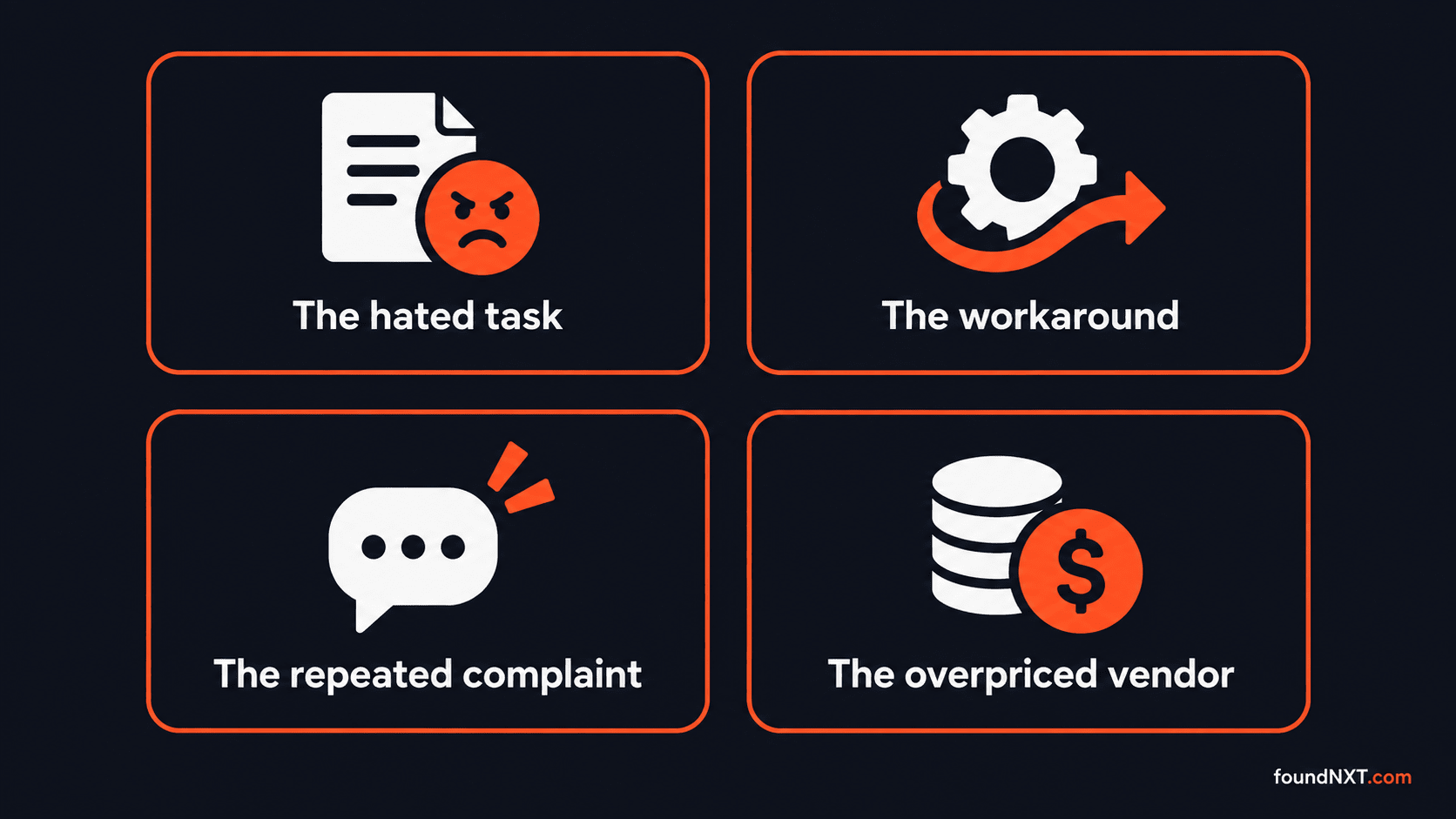
The four places ideas hide at work
1. The task everyone hates. Every office has one: the weekly report nobody wants to compile, the data someone copies by hand, the reconciliation that eats a Friday. When smart people keep doing something slow and painful, a product is waiting to be born. Stewart Butterfield’s team at Tiny Speck was building an online game called Glitch, and they wrote a little internal chat tool so the team could talk while working. The game failed and shut down. The chat tool became Slack.
2. The workaround everyone relies on. When the official system does not fit, people invent jugaad: a shared spreadsheet, a WhatsApp group, a personal diary that six people photograph. A workaround is a product specification written by its users, for free. If your office would panic when that one Excel file is deleted, you are looking at an idea.
3. The complaint that repeats. Listen to what customers, vendors, and auditors keep saying. One complaint is noise. The same complaint every month is demand with a voice. Nithin Kamath spent years as a trader listening to traders, including himself, complain about high brokerage fees and clunky platforms. He started Zerodha in 2010 with no outside investors and built it into one of India’s largest brokers (we told that story here).
4. The vendor your company overpays. Look at what your employer buys from outside companies, especially anything that seems expensive for what it is. The web design firm 37signals built a small tool in 2004 just to manage its own client projects. Clients started asking for the tool more than for websites. That tool became Basecamp, and the design firm became a software company. Sometimes the business you should start is the one your company is already paying someone else for.
Turning an observation into an actual idea
An observation becomes an idea with one question: who else has this problem? If your company struggles with it, and your industry has five hundred similar companies, you are not looking at an annoyance anymore. You are looking at a market.
This is why the safest first business is usually one step away from your desk, not a leap into a stranger’s world. You already speak your industry’s language. You know who signs the cheques, what a fair price sounds like, and which promises are empty. Girish did not leave Zoho to sell yoga mats. He left to build the thing his own industry was begging for.
Tally, the accounting software used by lakhs of Indian businesses, began the same way in 1986, when Bharat Goenka in Bangalore wrote a program to handle the accounts of his family’s small business and realised every small business around him needed the same thing. Razorpay’s founders hit the pain of accepting online payments in India while working on other projects, and turned that frustration into a payments company in 2014. The pattern repeats because it works: live the problem, then solve it for everyone like you.
Do a quiet audit of what your job taught you
Before you pick the idea, list what your years at work actually gave you. There are three assets. First, skills: the things colleagues ask for your help with. Second, knowledge: how your industry really works, who buys, who pays, what things cost, where the bodies are buried. Third, relationships: the customers, vendors, and colleagues who would take your call on day one of your business.
The strongest employee-founded businesses sit where all three overlap. A sales manager who starts a lead-research service for the industry she already knows begins with all three. A sales manager who opens a cafe begins with none. Same person, completely different odds.
Write your three lists this week, honestly. The idea you are looking for is usually hiding in the overlap, and it has been waving at you from your desk for years.
A warning before the exciting part
Check your employment contract first. Many contracts say work created during employment, especially using company time, data, or equipment, belongs to the employer. And taking confidential data, code, or client lists is not research; it is theft. Learn the problem at work. Build the solution on your own time, with your own tools, after checking what you signed.
There is a clean way to do this. Your insight, “this industry has this painful problem,” is yours. The company’s confidential information is not. Keep that line bright and you will never have a conversation with a lawyer about it.
Test it quietly before you leap
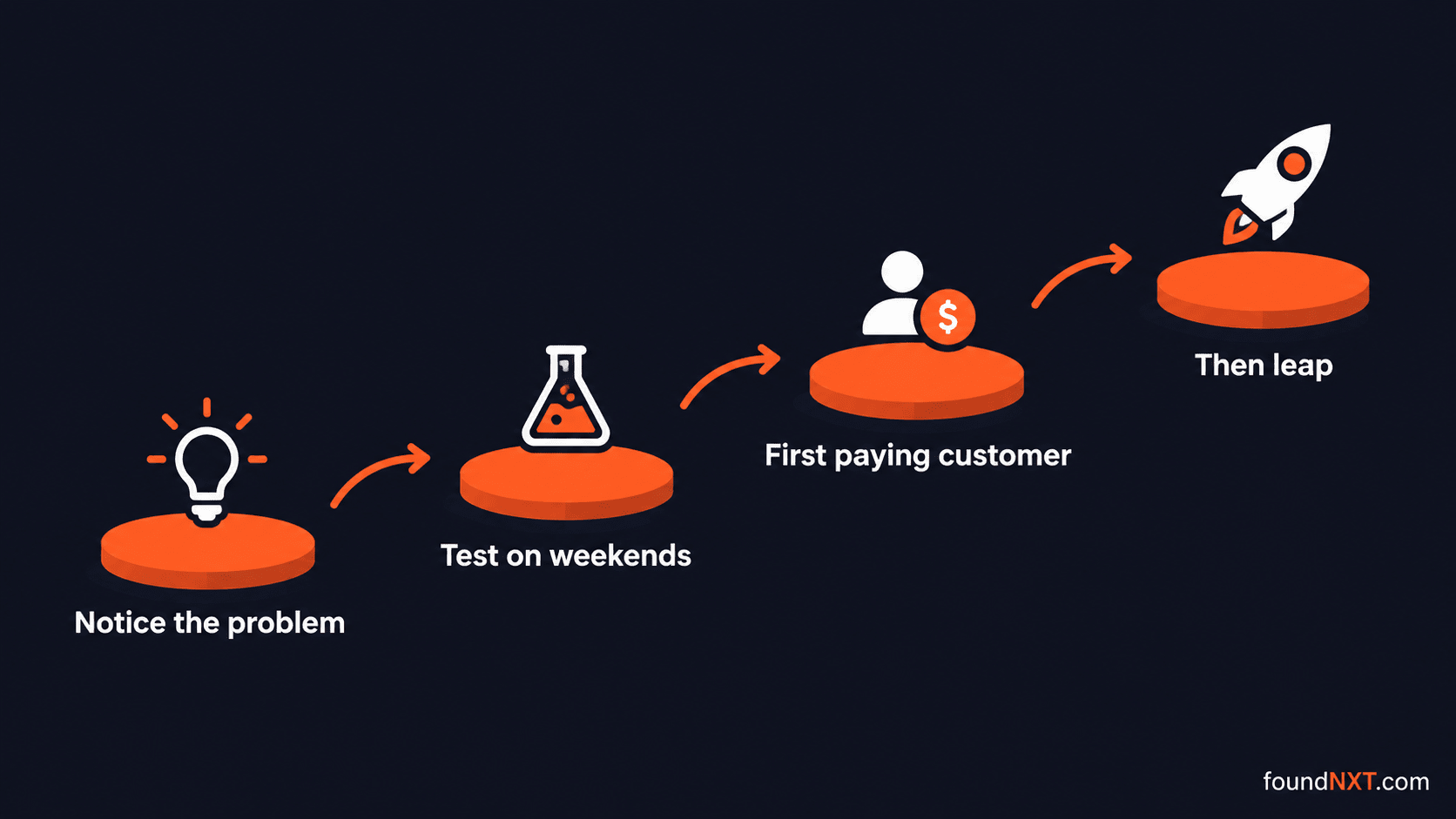
You do not need to resign to find out if the idea is real. Have ten conversations with people in the industry who are not your colleagues. Describe the headache in one sentence and watch their faces. If they say “wait, you can fix that?”, you have something. If they say “hmm, interesting,” and change the subject, you have information too.
Then run a small pilot on evenings and weekends: solve the problem manually for one customer, or build the smallest possible version. The goal is one paying customer before you quit, not a perfect product. Our guide to validating an idea for ₹0 has the full method, and five signals your idea needs a new direction will help you read what the market tells you back.
The one-sentence test. If you cannot describe the headache and who has it in one plain sentence, you are not ready to build. “Factory owners lose lakhs when licence renewals slip” is an idea. “An AI platform for operational excellence” is a fog.
Key takeaways
- Your job is paid market research: you see problems outsiders cannot see.
- Ideas hide in four places: the hated task, the workaround, the repeated complaint, and the overpriced vendor.
- Slack, Basecamp, Freshworks, Zerodha, Tally and Razorpay all began as problems their founders met at work.
- Never take your employer’s data or clients. Learn the problem, then build separately and check your contract.
- Get one paying customer before you quit. The leap comes last.
The thought to leave with
Tomorrow at work, when someone groans about a task, or a customer complains for the third time, or a colleague says “there has to be a better way,” pay attention. That is what an idea sounds like before anyone builds it. Most people hear it and go back to work. Founders write it down.
What is the most annoying part of your job? Sit with that question this week; it might be your business. And if you want company while you think, the Weekly Founder Brief lands every week with exactly this kind of thinking.