

📑 Table of Contents
- Loading headings…
At 8 PM on November 8, 2016, the Prime Minister announced on live television that ₹500 and ₹1,000 notes would stop being legal tender by midnight. By the next morning, Paytm had a full-page newspaper ad ready. Within months, QR codes appeared at chai stalls, paan shops, and auto rickshaws across the country. One policy announcement rewired how a billion people pay, and the businesses that read it early collected nearly all of the new demand.
That is the pattern most people miss. When the government changes a rule, thousands or lakhs of businesses are suddenly forced to do something new: file a new form, buy a new machine, get a new licence, handle data differently. Forced demand is the best kind of demand, because the customer does not get to say “maybe next year.”
This article shows you how to spot that pattern, with real examples of businesses born from policy changes in India and abroad, plus the honest warnings nobody gives you about building on government decisions.
Why a rule change is a starting gun
Think of a policy change like a sudden rule change in cricket. The day the bouncer rule changes, every team needs new practice plans, and the coach who understands the new rule first becomes very popular. Businesses are the same. A new rule means every affected company needs help, all at once, all before a deadline.
Before you chase any policy wave, ask five plain questions: Who exactly must comply? By when? What is the penalty for ignoring it? How many businesses are affected? And what will they struggle to do alone? The last question is where your business idea lives.
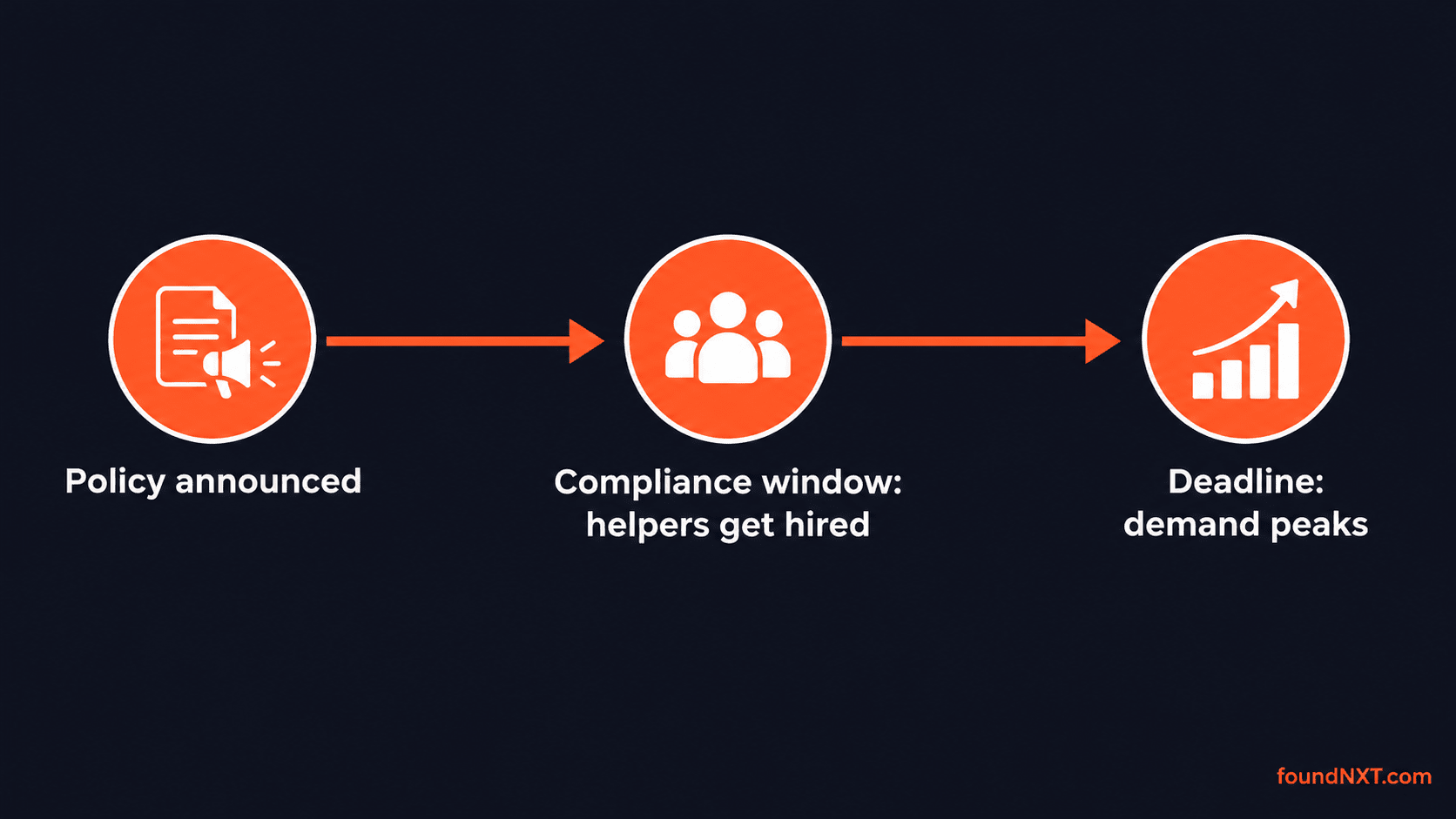
The window that matters. The money is made in the gap between “announced” and “enforced.” That gap is when everyone is confused, help is scarce, and a person who simply understands the new rule becomes instantly valuable.
GST, 2017: one tax created an industry of helpers
On July 1, 2017, India replaced a pile of state and central taxes with a single Goods and Services Tax. Overnight, every registered business had to issue new-style invoices and file returns online, regularly, with no exceptions for “I don’t understand computers.”
What got built: GST compliance software companies grew fast (ClearTax built much of its early business on this wave), lakhs of small accountants gained entirely new client lists, and an army of “GST practitioners” appeared to file on behalf of shop owners. The lesson: when compliance becomes mandatory, helping people comply becomes a business. Our primer on GST and startup compliance basics covers the founder side of this.
UPI, 2016: free payments built paid businesses
The National Payments Corporation of India launched UPI in April 2016: instant, free bank-to-bank transfers from any phone. Demonetization later that year poured fuel on it. The transfers themselves were free, so where was the business?
Everywhere around the free thing. PhonePe and BharatPe built companies on merchant QR codes. Someone manufactures those little soundboxes that announce “₹50 received” at every kirana counter, and merchants pay a monthly rent for them. Payment gateway and aggregator services handle online stores. When infrastructure becomes free, the money moves to everything built on top of it.
RERA, 2017: real estate had to grow up
The Real Estate (Regulation and Development) Act took full effect on May 1, 2017. Builders now had to register projects with a state authority, keep most of the buyer’s money in a separate account, and advertise honestly, with penalties for getting it wrong.
Thousands of small builders had never filed anything like this. RERA consultants appeared to handle registrations and quarterly filings, lawyers built practices on RERA disputes, and training firms taught builder staff the new rules. A confusing new obligation, plus a deadline, equals a service business.
Ayushman Bharat, 2018: a health cover created a back office
Launched on September 23, 2018, PM-JAY gives eligible families a health cover of ₹5 lakh per year for hospital treatment. For hospitals, this meant a brand-new process: get empaneled, verify patients, submit claims in a specific format, and follow up for payment.
That friction created work: consultants who shepherd hospitals through empanelment, companies that process claims, and third-party administrators who sit between hospitals and the scheme. When the government becomes a large paying customer, entire back-office industries appear to serve the people serving it.
PLI, 2020: paying factories to make more
In November 2020, the cabinet approved Production Linked Incentive schemes that now cover 14 sectors, with a total outlay of ₹1.97 lakh crore, according to the Press Information Bureau. The idea is simple: make more in India, sell more, and the government pays you a bonus on the extra sales.
What got built: consultants who prepare PLI applications (the paperwork is genuinely hard), reporting and audit services that keep companies eligible, and whole supplier ecosystems around the new factories in electronics, pharma, and textiles. Every new phone-assembly plant needs local vendors for packaging, logistics, tooling, and staffing. The subsidy gets the headline; the supply chain is the business.
ONDC, 2022: opening online shopping to the corner shop
On April 29, 2022, India launched the pilot of the Open Network for Digital Commerce, an attempt to let any seller appear in many buyer apps instead of living inside one marketplace (Reuters covered the launch). We have a full explainer on how ONDC lets you sell without Amazon or Flipkart.
Every new open network needs businesses that connect the small guys to it: seller apps, cataloguing services, onboarding agencies, logistics players. When a platform is open by design, the gatekeeping business disappears and the helper business appears.
DPDP Act, 2023: privacy becomes everyone’s problem
India’s Digital Personal Data Protection Act was enacted on August 11, 2023 (read it in the Gazette), and the detailed rules were notified in November 2025. In plain words: companies that collect your data must take proper consent, tell you what they do with it, and protect it, or face large penalties.
Here is the part founders should notice: the Act itself creates a registered business category called a “Consent Manager,” a company whose entire job is helping people give, manage, and withdraw consent. The law literally names a new business. Around it are growing privacy audit firms, data-mapping tools, and consultants teaching companies what the rules demand.
PM E-DRIVE, 2024: the EV subsidy wave
In September 2024, the cabinet approved the PM E-DRIVE scheme with an outlay of ₹10,900 crore over two years to push electric vehicles and charging infrastructure, replacing the earlier FAME schemes (PM India’s announcement).
Subsidies make buyers say yes faster, and that pulls businesses into existence: charging station installers, fleet electrification consultants, battery-swapping operators, EV financing and maintenance services. But this one comes with a warning label, which we will get to below.
It is not just India: GDPR and PSD2 in Europe
When Europe’s GDPR privacy law became enforceable on May 25, 2018, with fines of up to 4% of a company’s global revenue, companies worldwide panicked politely and started spending. OneTrust, founded in 2016 ahead of the wave, was valued at $1.3 billion by 2019. “Data Protection Officer as a service” became a real job description.
Earlier that same year, on January 13, 2018, the PSD2 directive forced European banks to share account data with licensed apps through official channels. That single rule created the “open banking” industry: companies like Tink built the plumbing, and in 2021 Visa agreed to buy Tink for €1.8 billion. Two paragraphs of regulation, an entire industry.
The wave forming right now: AI rules
The European Union’s AI Act entered into force on August 1, 2024, with its main obligations phasing in through 2026 and beyond, according to the European Commission. Companies using AI in hiring, lending, education, or other sensitive areas will have to document, test, and monitor their systems.
Watch what is already forming: AI audit firms, compliance software for AI systems, consultants who translate the law into checklists. The pattern from GST and GDPR is repeating in real time, in a market that did not exist three years ago. India’s own AI rules are still being debated, which means the window is open here too.
The honest warnings nobody gives you
First, subsidies end. When FAME II expired on March 31, 2024, EV sales wobbled, a small bridge scheme filled the gap, and only in September did PM E-DRIVE arrive. Businesses built on the subsidy alone had a frightening few months. Build on the headache the policy creates, not on the free money, because free money always has an expiry date.
Second, deadlines slip. The DPDP Act passed in 2023, but its detailed rules arrived only in late 2025. If you build for a deadline that moves two years, you need cash to survive the wait. Third, government-linked customers pay slowly; a healthy policy business keeps private-sector clients too.
A subsidy is a wave, not a floor. Ride it while it is there, but make sure your business still stands when the scheme ends: real demand, real customers, real value after the free money stops.
How to catch the next one early
You do not need inside information. You need to read public things that most people skip. The Union Budget speech every February announces schemes months before details arrive. The Press Information Bureau publishes every cabinet decision the same evening. Ministries release draft rules for public comment, and that draft stage, before anything is final, is your earliest signal.
When you spot a change touching your industry, ask the five questions from the top of this article. If the answers point to thousands of confused businesses and a deadline, you are early to a real market. Our guide to government schemes founders ignore is a good companion read.

Key takeaways
- A rule change forces thousands of businesses to act by a deadline. Forced demand is the best demand.
- The money is made in the window between announcement and enforcement, while confusion is high.
- GST, UPI, RERA, Ayushman Bharat, PLI, ONDC, DPDP and EV subsidies each created whole service industries in India; GDPR and PSD2 did the same in Europe.
- Never build on the subsidy alone. Build on the headache, because subsidies always expire.
- Budget speeches, PIB releases, and draft rules open for comment are your free early-warning system.
The thought to leave with
Most people read policy news and feel bored or annoyed. Founders read it and ask: who is now forced to do something new, and can I help them do it? The next Paytm-sized opening will not announce itself as a business idea. It will arrive dressed as a boring press release.
So: which recent rule change touches your industry? That answer might be your business. We unpack waves like this every week in the Weekly Founder Brief, so stay close.