

📑 Table of Contents
- Loading headings…
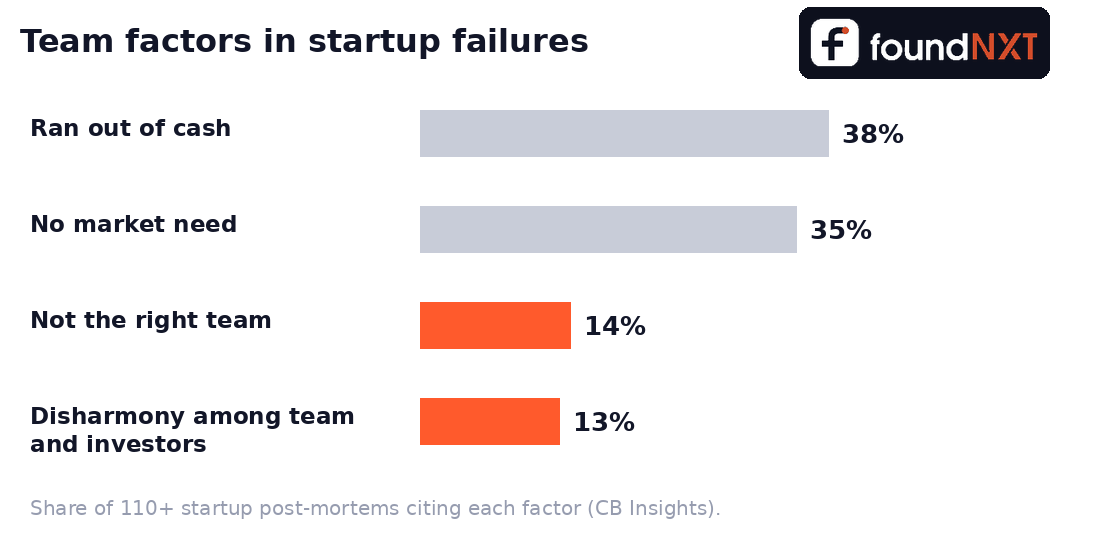
When CB Insights sifted through more than a hundred startup failure post-mortems, the product and the market got most of the blame. But look further down the list: “not the right team” appears in 14% of post-mortems, and “disharmony among team and investors” in another 13%. Roughly one failed startup in four points a finger at the people at the top.
Paul Graham is blunter. In his classic essay on the mistakes that kill startups, mistake number one is “Single Founder”. His argument: starting a company is too heavy for one pair of shoulders, and the low points are survivable mostly because someone else is in them with you.
So you need a co-founder. Where do you find one, and how do you know they are the right one before you have split equity and signed documents?
Where co-founders actually come from
The mythology says co-founders meet in a flash of destiny. The reality is boring, and that is good news, because boring is repeatable:
- Former colleagues. You have already seen each other under deadline pressure. Deepinder Goyal and Pankaj Chaddah worked together at Bain before starting Zomato. Sachin and Binny Bansal (not related, despite the surname) were colleagues at Amazon before Flipkart.
- Classmates. Ola’s Bhavish Aggarwal and Ankit Bhati came out of IIT Bombay. Shared years in a hostel teach you more about a person’s character than any interview.
- Family. Zerodha’s Nithin and Nikhil Kamath are brothers. It can work beautifully, but it raises the stakes: a co-founder fight can cost you a company and a relationship.
- Communities and matching platforms. Startup events, hackathons, founder meetups in your city, and structured platforms like Y Combinator’s co-founder matching exist precisely because enough founders meet this way.
Notice the pattern: in the strongest pairings, the founders had a shared history of working together, not just knowing each other. Friendship is a weak signal. Working together is a strong one.
What you are actually looking for
The obvious answer is complementary skills: one builds, one sells. That is true but incomplete. The fuller checklist:
- Complementary skills, so you are not two people fighting for the same chair.
- Similar intensity. The most common co-founder breakup is not about ability; it is about one person sprinting while the other strolls.
- Similar risk tolerance. If one of you has six months of savings and the other has six years, the first hard winter will crack the partnership.
- Aligned ambition. One founder dreaming of a unicorn while the other wants a calm, profitable Rs 5-crore business is a slow-motion explosion.
- Trust you have already tested. Not assumed. Tested.
The ten questions to ask before you say yes
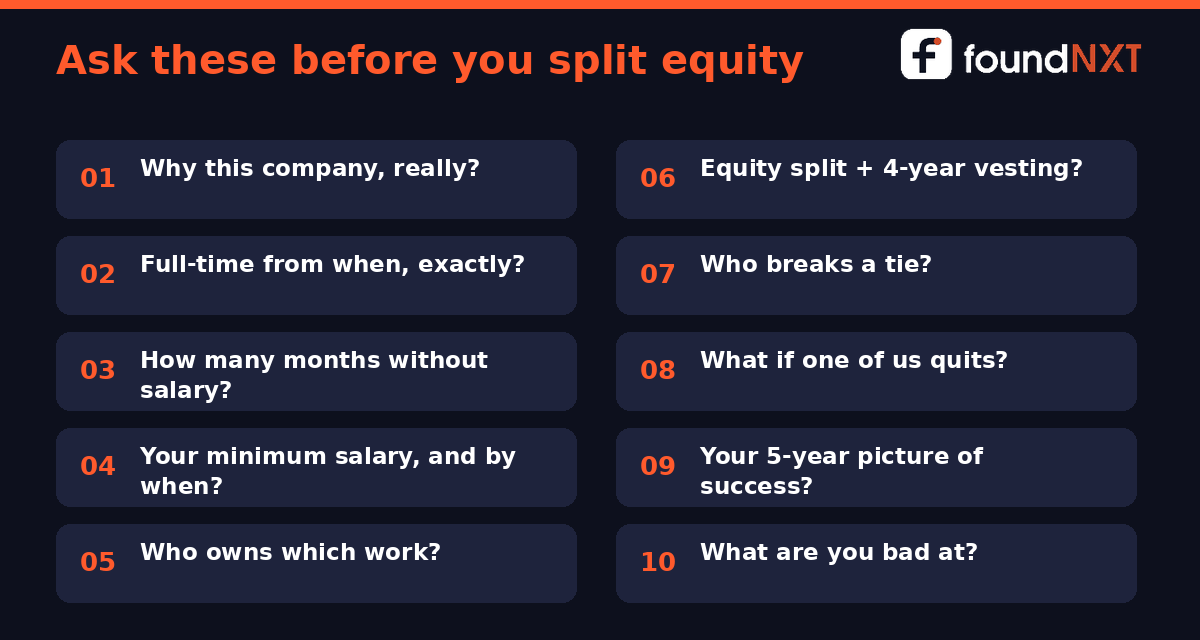
Y Combinator recommends hashing out hard questions with a potential co-founder before committing. Adapted for Indian realities, here is the list to work through, ideally over several conversations, in writing:
- Why do you want to build this company? (Wrong answers: it sounds fun, my friends are doing it.)
- Are you going full-time, and from when? “Soon” is not an answer.
- How many months can you survive without a salary? Be honest about the number.
- What is your financial floor – the minimum salary you eventually need, and by when?
- How do we split the work? Who owns product, tech, sales, ops?
- How do we split the equity – and are we both okay putting it on a four-year vesting schedule with a one-year cliff?
- When we disagree on something big, how do we decide? Who breaks ties?
- What happens if one of us wants to leave in year two?
- What does success look like for you in five years – personally, not just for the company?
- What are you bad at? (If they cannot answer, run.)
The answers matter less than the willingness to answer. A person who refuses to discuss equity, vesting, or exit scenarios before joining will not discuss them gracefully during a crisis either.
Have you noticed how few successful startups were founded by just one person? Even companies you think of as having one founder, like Oracle, usually turn out to have more.
Paul Graham, The 18 Mistakes That Kill Startups
Important: never split equity without vesting. Four-year vesting with a one-year cliff is the global standard for a reason: if a co-founder walks away in month eight, they should not take half the company with them. Put the founders’ agreement in writing from day one.
Date before you marry
The single best test of a co-founder is a small, real project with a deadline. Build a landing page together. Run a weekend pilot. Try to get five paying users for something scrappy. Four to six weeks of working together will tell you more than ten “co-founder dating” coffees: how they handle stress, whether they do what they said, how they argue.
And remember why this matters so much. Investors fund teams as much as ideas; when we analysed what seed investors actually want to see in 2026, a credible founding team sat at the top of the list. Choose your co-founder like your company depends on it, because as the failure data shows, it does.
Figuring out the founder journey? The Weekly Founder Brief breaks down one big move every week in plain words. Subscribe on foundNXT.
Sources
FoundNXT publishes independent business intelligence, valuation frameworks, and startup teardowns. Nothing in this article constitutes financial, investment, legal, or tax advice. Company figures, market projections, and valuation metrics represent editorial estimates and regulatory filings. Always consult qualified legal counsel and certified financial advisors before executing investment rounds or financial agreements.