

Startup failure is rarely mysterious: 90% of failures stem from building without market demand, burning cash ahead of unit economics, or team misalignment. Each has a known fix.
📑 Table of Contents
- Loading headings…
Around 9 out of 10 startups fail. An IBM and Oxford Economics study found that more than 90% of Indian startups shut down within their first five years. That sounds scary, but here is the good news: startup failure is not random. The same few mistakes show up again and again in post-mortems, and each one has a known fix.
Let’s look at the five biggest reasons, with real examples, and what you can do differently.
Startup failure is not random. The same few mistakes show up again and again, and each one has a known fix.

1. Building something nobody wants (42%)
The most common killer is simple: founders build a product first and check whether anyone wants it later. In CB Insights’ classic study, 42% of failed startups said there was no market need for what they made.
Examples:
Quibi raised about $1.75 billion to make short, premium 10-minute shows for phones. It launched in 2020 and shut down in about six months. People already had YouTube and Netflix for free, and never felt the need Quibi was solving.
TinyOwl, a Mumbai food-delivery app, raised around $27 million and scaled fast before proving that customers would keep ordering and that each order could make money. It shut down in 2016, before Swiggy and Zomato proved the model could work with tighter execution.
The fix: sell before you build. Talk to 20-30 real potential users. Ask what they do today about the problem, not whether they “like” your idea. If possible, take pre-orders or run a simple landing page. Real payments are the only feedback you can fully trust.
2. Running out of cash (29%)
Money running out is where most failure stories end. In CB Insights’ 2026 update covering 431 VC-backed startups that shut down since 2023, “ran out of capital” was cited in 70% of cases – but it is usually the final symptom, not the root cause. The cash dried up because of the other problems on this list.
Example: Stayzilla, a homestay platform often called “India’s Airbnb,” raised about $33 million. Heavy spending on marketing and discounts burned through the money faster than revenue grew, and it shut down in 2017. More recently: Dunzo, the Google-backed pioneer of quick commerce in India, burned cash on delivery-heavy operations for years and finally shut down in 2025, after Reliance Retail wrote off its investment.
The fix: know your burn (what you spend each month) and your runway (how many months of cash are left) at all times. Review them weekly. Aim to always see 12 or more months of runway ahead, and cut costs early while you still have options.
3. Not the right team (23%)
A startup is a small group of people under extreme pressure. If co-founders have the same skills, unclear roles, or different goals, the company cracks from the inside. Governance failures are the grown-up version of the same problem.
Example: Housing.com had a strong product and big funding, but public fights between its founder and investors led to the founder being pushed out. The company never regained its early lead and was eventually merged into a rival. More recently: Byju’s, once India’s most valued startup at $22 billion, lost its auditor and three board members in 2023 amid governance criticism, and lenders began insolvency proceedings in 2024.
The fix: pick co-founders for complementary skills, not friendship alone. Put roles, decision rights, and equity in writing, and use standard four-year vesting so everyone earns their share over time. As you scale, build a board you actually answer to.
4. Getting outcompeted (19%)
Many startups die because they try to fight everyone at once, or copy a leader with no clear reason for customers to switch.
Example: AskMe tried to be a search engine, e-commerce store, and classifieds site all at once, competing with focused giants in every category. Spread too thin, it shut down in 2016. More recently: Koo, India’s homegrown alternative to X, grew fast but never found a working revenue model against global network effects, and shut down in 2024. Global example: Google tried to take on Facebook with Google+, a social network with no clear reason to exist. Despite Google’s size, it never won users and was closed for consumers in 2019.
The fix: pick one narrow wedge and be ten times better at it than anyone else. Win a small market completely before expanding.
5. Pricing and cost problems (18%)
Growth that loses money on every sale is not growth – it is a countdown. If serving one more customer costs more than that customer pays, scaling only makes you fail faster.
Example: PepperTap, a grocery delivery startup, used deep discounts to buy growth, effectively selling groceries below cost. It raised about $51 million but lost money on every order and shut down in 2016. Global example: WeWork grew into a $47 billion valuation while losing money on its core leases, and its valuation collapsed before a painful restructuring.
The fix: track your unit economics from day one. Each order should earn more than it costs to serve (positive contribution margin), or you should know exactly when and how it will.
How to avoid it: 5 habits of surviving startups
Every reason above has an antidote. Here they are together, as a checklist you can keep:
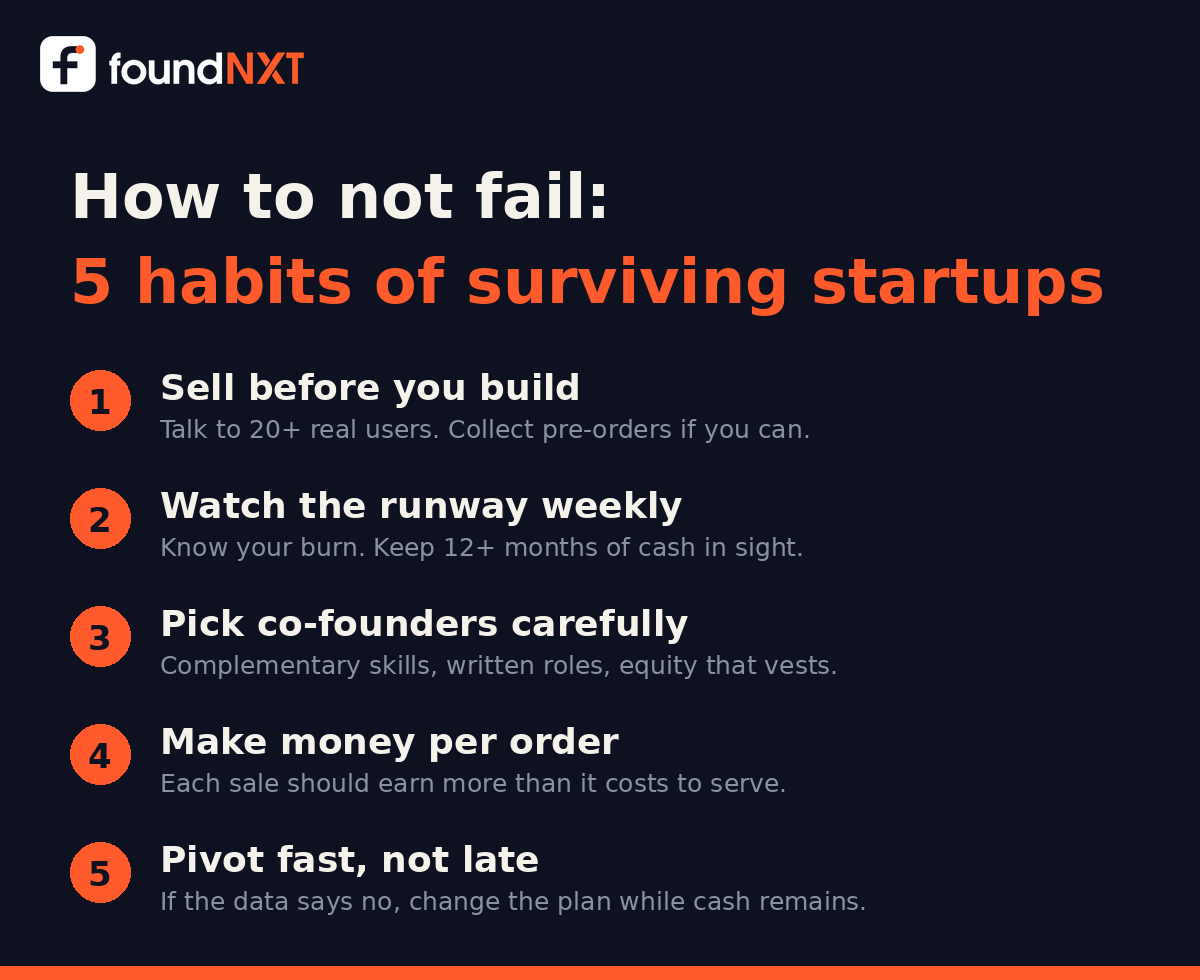
- Sell before you build: pre-orders and customer deposits over hypothetical feedback.
- Track runway weekly: keep at least 12+ months of runway in view at all times.
- Complementary co-founders: formalize equity vesting (4-year standard) and roles early.
- Positive unit economics: ensure a healthy contribution margin before pouring capital into scaling.
- Pivot fast, not late: cut dead-end features before cash forces the decision.
The bottom line
Most startups fail, but rarely for mysterious reasons. They build before listening, spend before counting, hire before aligning, fight everyone at once, or sell below cost. Do the opposite of each, and you are already ahead of most founders. Failure is common; repeating these five mistakes is optional.
Over to you: which of these five mistakes worries you most as a founder? Share your view in the comments below. And if you want more founder teardowns like this, join The FoundNXT Weekly Founder & Leader Intelligence Brief – free, weekly, no spam.
Sources: CB Insights – Why Startups Fail: Top 9 Reasons (2026), CB Insights – The Top 20 Reasons Startups Fail, The Hindu BusinessLine – 90% of start-ups in India fail within 5 years (IBM/Oxford Economics), Reuters – How India’s Byju’s went from startup star to facing insolvency, Rest of World – Dunzo shuts down, Reuters – Koo to shut down.
FoundNXT publishes independent business intelligence, valuation frameworks, and startup teardowns. Nothing in this article constitutes financial, investment, legal, or tax advice. Company figures, market projections, and valuation metrics represent editorial estimates and regulatory filings. Always consult qualified legal counsel and certified financial advisors before executing investment rounds or financial agreements.