📑 Table of Contents
- Loading headings…
In 2008, Drew Houston had a problem: he wanted to build Dropbox, but the product needed a small army of engineers and months of work. So instead of building it, he made a three-minute video showing what the product would do and posted it on Hacker News. The waiting list jumped from 5,000 people to 75,000 overnight. The product still did not exist.
That is validation: proof that strangers want the thing before you spend months and lakhs building it. And the good news for an Indian founder without funding is that the most convincing validation methods cost exactly Rs 0.
What validation actually means
Validation is not people saying “great idea!” Your friends will say that. Your family will say that. Strangers being polite will say that. Rob Fitzpatrick, in his book The Mom Test, explains why: people lie to spare your feelings, especially when you ask questions that invite compliments (“Would you use an app that…?”).
Real validation is commitment: someone gives you their time, their money, or their reputation (a referral). A compliment costs the giver nothing, so it tells you nothing.
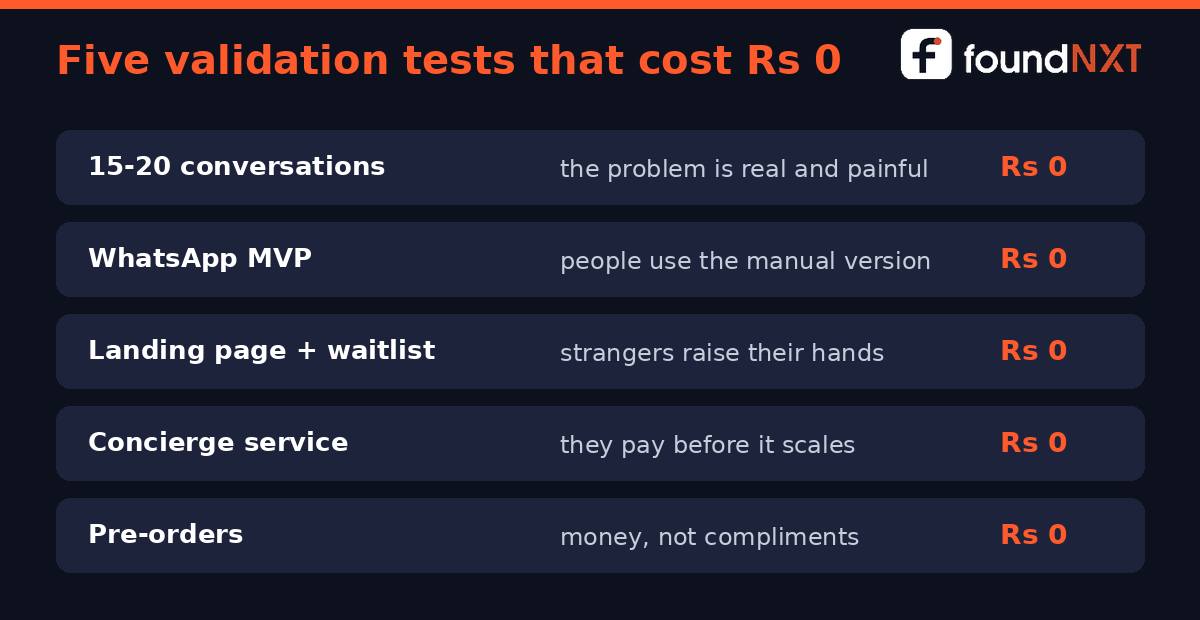
Test 1: Have 15-20 real conversations
Before you build anything, talk to 15-20 people who should have the problem you want to solve. The Mom Test rules keep it honest:
- Ask about the past, not the future. “When did you last face this problem? What did you do?” beats “Would you use…?”
- Ask about behaviour, not opinions. “How much did you spend fixing this last year?” is a fact. “Sounds cool!” is not.
- Never pitch in these conversations. The moment you pitch, people switch from telling the truth to being nice.
If, unprompted, most of your 20 people describe the problem as painful and say they have already tried to solve it, you are onto something. If they shrug, the idea needs work, and you just saved yourself a year.
Test 2: The WhatsApp MVP
You do not need an app to run an app-based business. In 2014, Kabeer Biswas started Dunzo as a WhatsApp group in Bengaluru: people messaged what they needed picked up or delivered, and he personally coordinated it. No app, no funding, no tech team. The WhatsApp group was the product until the demand was undeniable.
Whatever your startup does, ask: can I deliver the core value manually through WhatsApp, Google Sheets, or plain email? A meal-plan service can be a WhatsApp broadcast. A tutoring marketplace can be a group and a spreadsheet. If people love the manual version, they will love the automated one. If they will not use the free manual version, automation will not save it.
Test 3: A landing page and a waitlist
Build a one-page site describing the product as if it exists, with a single call to action: “Join the waitlist” or “Get early access”. Free tools (Carrd’s free tier, Framer, even a Google Form) get this done in a weekend. Share the link in the communities where your users live and watch the conversion rate.
Buffer did exactly this before writing a line of code: a simple page describing the product and a signup box. When people clicked the pricing plans, Joel Gascoigne knew not just that they wanted it, but that some were willing to pay. Dropbox’s video was the same test at a bigger scale.
Test 4: The concierge version
Deliver the service by hand to your first handful of customers. When Nick Swinmurn wanted to test whether people would buy shoes online, he did not build a warehouse. He photographed shoes in local stores and posted them online; when someone ordered, he bought the pair at full price and shipped it himself. Every order was a small loss, and every loss was tuition: the experiment became Zappos.
Doing it manually is slow and unprofitable by design. That is the point: you are buying information, not revenue.
Test 5: Ask for money early
The strongest validation is a pre-order. Offer the first 20 customers a founding-member price or a lifetime deal. You will learn more from five people paying Rs 500 than from five hundred people saying “nice idea”. If strangers in India, where everyone loves a bargain, will pay you for something that barely exists, you have signal.

The only way to win is to learn faster than anyone else.
Eric Ries, The Lean Startup
Important: compliments are not validation. “I would use that” is worthless. An email address is better. A pre-order is gold. Measure commitment, not enthusiasm.
What a pass looks like
Set the bar before you run the test, so you cannot move it afterwards. Reasonable pass marks: 10 of 20 interviewees describe the problem as painful without prompting; 10% or more of landing-page visitors join the waitlist; even five pre-orders from strangers. Fail the bar? That is not a wasted month. It is a cheap education, and cheaper than any failed launch. Once you have real validation, investors take you seriously: it is exactly what they look for, as we covered in Your First Angel Cheque: Raising Without a Network and Seed Round in 2026: What Investors Actually Want to See.
And if you need free tools to run these experiments, start with our list of 10 AI tools that let a 5-person startup run like 50.
Testing an idea right now? The Weekly Founder Brief breaks down one big move every week in plain words. Subscribe on foundNXT.
Sources
FoundNXT publishes independent business intelligence, valuation frameworks, and startup teardowns. Nothing in this article constitutes financial, investment, legal, or tax advice. Company figures, market projections, and valuation metrics represent editorial estimates and regulatory filings. Always consult qualified legal counsel and certified financial advisors before executing investment rounds or financial agreements.