

📑 Table of Contents
- Loading headings…
As of October 2026, a five-person startup can buy, for roughly the price of one junior hire, software that covers customer support, coding, design, sales prospecting, meetings and busywork automation. That is not a slogan – it is a shopping list. Here are the ten tools that let a tiny team punch like a company ten times its size, what each one actually does, and what it costs.
One warning before the list: tools multiply output only when a human owns the outcome. Every tool below still needs someone checking its work.
The goal is not to replace people. The goal is to make your next five hires optional until you can afford the right ones.
The stack
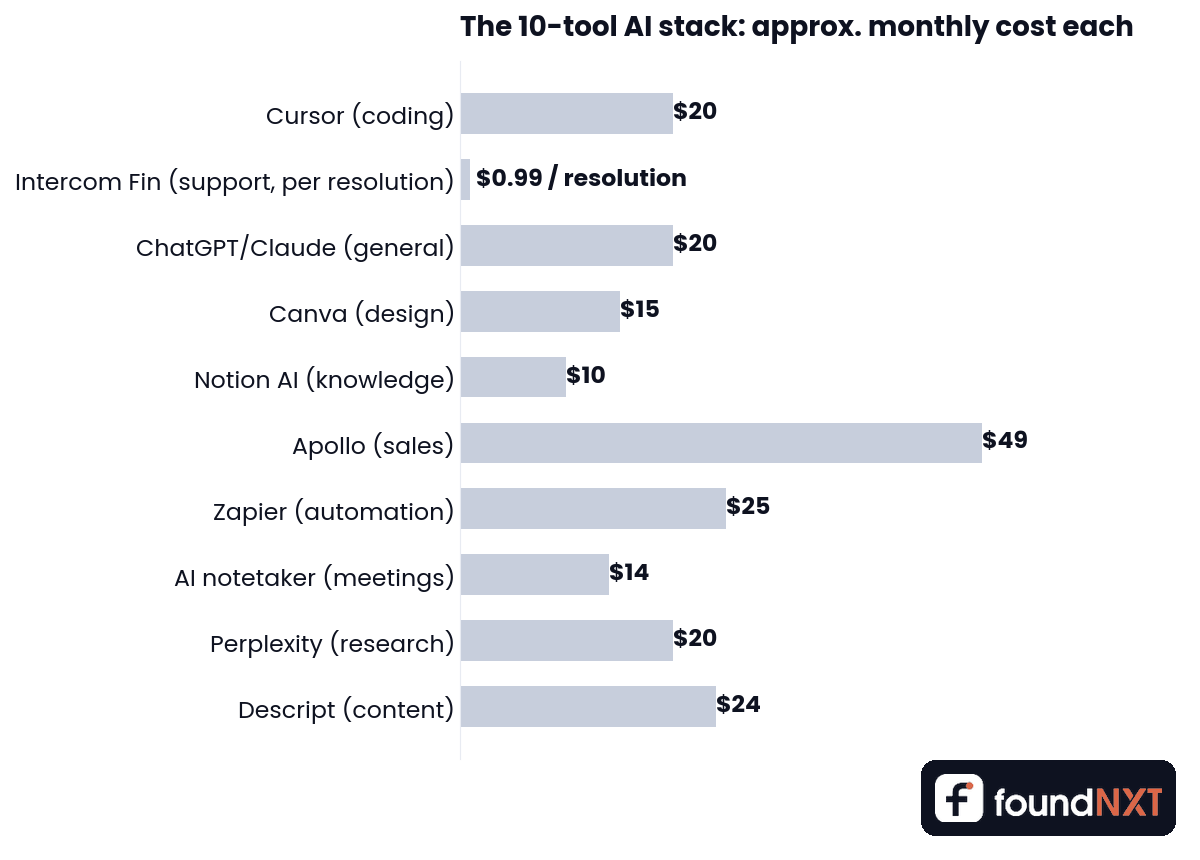
1. Coding – Cursor (about $20/user/month). An AI-first code editor that writes, edits and debugs alongside your developers. Small teams report shipping features in days that used to take sprints. GitHub Copilot (about $10/user/month) is the lighter alternative inside VS Code.
2. Customer support – Intercom Fin (about $0.99 per resolution). An AI agent that answers customer questions from your help docs and only charges when it actually resolves the ticket. A five-person team cannot offer 24/7 support; Fin can.
3. A general brain – ChatGPT or Claude (about $20/user/month). Drafts, rewrites, analysis, naming, customer emails, grant applications. The default thinking partner for everyone on the team.
4. Design – Canva Magic Studio (about $15/month). Social posts, pitch decks, one-pagers and quick video edits without a designer. Magic tools handle resizing and background work.
5. Knowledge – Notion AI (about $10/user/month). Your wiki, meeting notes and docs in one place, with AI that can answer “what did we decide about pricing?” from your own pages. Institutional memory for a team with no time to write things down twice.
6. Sales prospecting – Apollo.io (free tier, paid from about $49/month). Find leads, enrich contact data and run outbound sequences. Replaces the first sales-ops hire almost entirely at the early stage.
7. Automation – Zapier (from about $20-30/month). Connects your tools so leads, invoices, form fills and alerts move by themselves. Its AI features let you describe the automation in plain English instead of building it step by step.
8. Meetings – an AI notetaker like Granola or Fireflies (about $10-18/user/month). Records, transcribes and summarises every call, then pushes action items where you need them. Nobody argues about what was decided; nobody takes notes instead of listening.
9. Research – Perplexity (about $20/month). Fast, sourced answers for market sizing, competitor checks and “does this regulation apply to us?” questions. Like an analyst who never sleeps and always shows its sources.
10. Content repurposing – Descript (about $24/month). Edit video and podcast audio by editing the transcript, then cut clips for social. One founder recording becomes a week of content.
What it adds up to
Run the whole list with sensible seats and you land around $200-250 per month – call it ₹18,000-22,000. Compare that with the work it covers: part of a support hire (₹25,000-40,000 a month in India), part of a designer, part of a sales-ops person, part of an analyst. The stack does not fully replace any of them, but it can delay three or four hires by six months. At seed stage, that is real runway – see the math in How Much Should You Raise? The 18-Month Runway Math.
Important note: do not adopt all ten at once. Add one tool per broken function, get value from it for a month, then add the next. Ten half-used subscriptions are just burn with better branding.
A sensible first month with the stack
Week 1: meetings and docs. Turn on the AI notetaker and Notion AI first, because they create value from day one and cost the least. Every customer call becomes searchable knowledge without anyone changing how they work.
Week 2: the revenue side. Set up Apollo and one Zapier automation that moves new leads into your pipeline and pings the founder. Stop copying data between tabs forever.
Week 3: the product side. Put every developer on Cursor and track one honest metric – how long a typical feature takes. If the number does not move in a month, the problem is your process, not the tool.
Week 4: support. Feed Fin your help docs and let it draft answers before it sends them. When you trust its drafts, switch on auto-resolution for the easy half of your tickets.
By the end of the month you will know which tools actually earn their seat, and you can cancel the rest without ceremony. That discipline is what separates a lean stack from subscription sprawl.
Rules that keep the stack cheap
Three habits matter more than the specific tools. First, one owner per tool: someone is responsible for setup, prompts and checking output quality. Second, a monthly seat audit: per-user pricing quietly doubles when everyone gets a seat “just in case”. Third, watch usage-based pricing: per-resolution and per-task fees are friendly at low volume and scary at scale, so model your costs at ten times today’s usage before you depend on them.
And remember the failure mode from Why Startups Fail: running out of cash is usually a symptom. A lean, well-run tool stack is one of the cheapest forms of insurance a small team can buy.

Your turn: which tool does your team swear by that we missed? Drop it in the comments. For one practical playbook like this every week, join the Weekly Founder Brief, foundNXT’s free newsletter. Sign up below.
Sources
FoundNXT publishes independent business intelligence, valuation frameworks, and startup teardowns. Nothing in this article constitutes financial, investment, legal, or tax advice. Company figures, market projections, and valuation metrics represent editorial estimates and regulatory filings. Always consult qualified legal counsel and certified financial advisors before executing investment rounds or financial agreements.