

📑 Table of Contents
- Loading headings…
Every first-time founder asks the same question, and most get it wrong in the same direction: they raise for the amount that sounds impressive, not the amount the plan needs. Raise too little and you are back in the market in nine months, negotiating from weakness. Raise too much and you have sold a chunk of your company you never needed to sell, at the cheapest price it will ever have. There is a boring, reliable way to get the number right. It is called the 18-month math, and here is how it works.
Why 18 months is the standard answer
The logic is simple. Between funding rounds, you need enough time to build something that proves the company deserves a higher valuation, and then enough time to actually close the next round. Building meaningful proof takes 12 to 15 months. Closing a round in today’s market takes four to six. Twelve months of building plus six months of raising lands you at about 18 months of runway. Raise for less and you start the next raise before the proof exists. Raise for much more and you over-dilute.
Raise for less and you start the next raise before the proof exists. Raise for much more and you over-dilute.
Step 1: Work out your real monthly burn
Burn is the money that leaves your bank account each month, net of any revenue coming in. Be honest and thorough: salaries (including a modest one for yourself), office and software costs, marketing spend, legal and compliance, and a buffer for the surprises that always come. A pre-revenue SaaS team of five in India typically burns Rs 8-15 lakh a month. A consumer startup spending on growth can burn many times that.
Founders consistently undercount by 15-20% because they forget annual costs (audits, renewals, appraisals) and assume best-case hiring. Take your honest monthly number and add a 15% buffer. That inflated number, not the optimistic one, is your burn.
Step 2: Multiply, then attach milestones
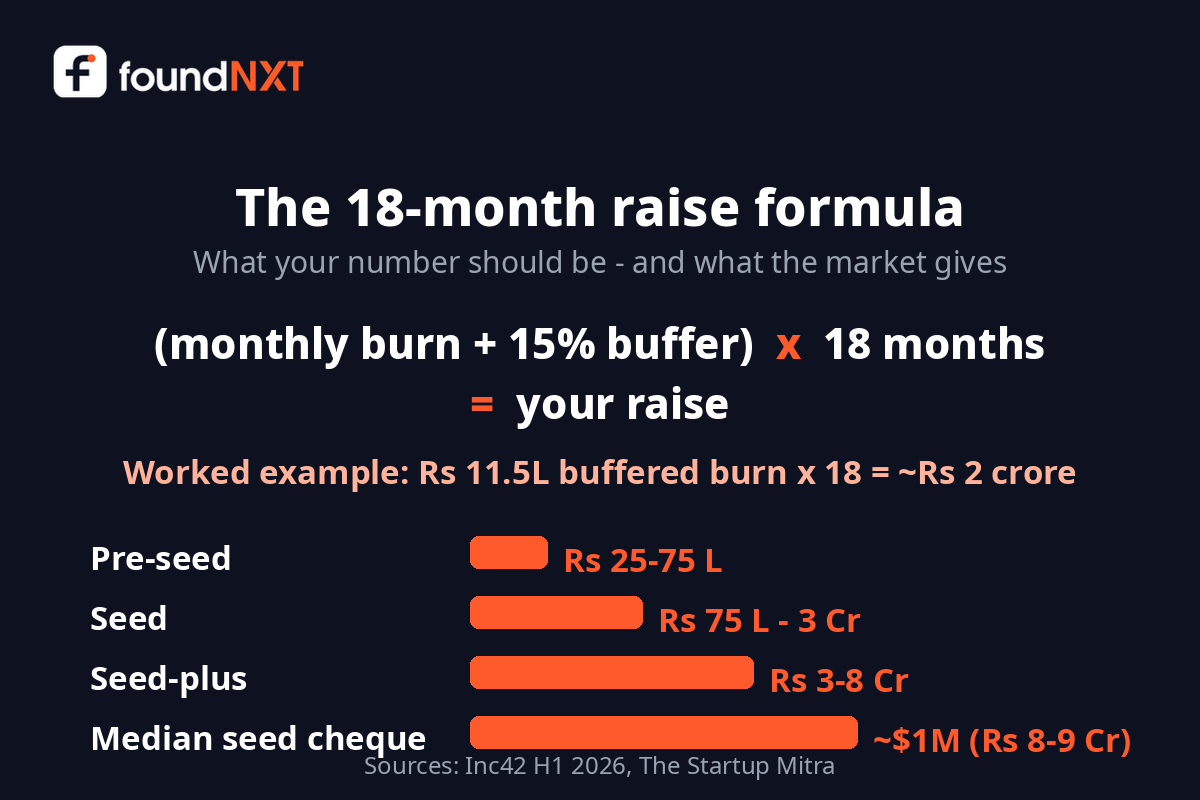
Burn of Rs 10 lakh a month, buffered to Rs 11.5 lakh, times 18 months is roughly Rs 2 crore. That is your number. Now the important half: write down what those 18 months buy. Not “growth”, but specific, dated milestones: “launch by month 4, 100 paying customers by month 10, Rs 15 lakh MRR by month 15, start the Series A process at month 14.” This milestone list is what turns a number into a pitch, because it tells the investor exactly what their money becomes and why the company will be worth more at the end of it.
Worked example: Rs 11.5 lakh buffered burn x 18 months = ~Rs 2 crore to raise. The pitch: this takes us from prototype to Rs 15 lakh monthly revenue, at which point we raise the next round at a valuation these metrics justify. That is a plan an investor can say yes to.
Step 3: Check it against what the market actually gives
Now reality-check your number against Indian norms. Pre-seed rounds typically run Rs 25-75 lakh, seed rounds Rs 75 lakh to Rs 3 crore, and seed-plus Rs 3-8 crore, with the median seed cheque around $1 million (roughly Rs 8-9 crore) at funded companies in H1 2026. If your math says Rs 2 crore, you are squarely in seed territory, and the plan needs to look like a seed plan. If it says Rs 12 crore at pre-revenue, the market will make you earn that story with exceptional traction or a repeat-founder pedigree. Better to raise Rs 3 crore for a tight, achievable 18 months than Rs 10 crore for a fantasy.
Step 4: The dilution check
Every round has a second price: ownership. The unwritten rule is to give up 10-20% per round, because three or four rounds of 25% leave founders with crumbs by Series B. So check your number backwards: if you need Rs 2 crore and want to keep dilution near 15%, you are implicitly pricing the company at roughly Rs 13 crore pre-money. Is that defensible with your evidence? If yes, proceed. If your evidence supports half that, either trim the plan to need less money or accept the heavier dilution with open eyes.

The mistakes that break the math
- Raising for 24-plus months “to be safe”. Extra months at seed prices cost founders more ownership than they save in stress.
- Planning to the month the money runs out. Your runway must reach the close of the next round, not the start of the raise.
- Assuming revenue will cut burn on schedule. Model the version where revenue is six months late, because it usually is.
- Forgetting that the next raise takes 4-6 months of founder time, during which the business still has to perform.
The fix: If the honest math says 18 months costs more than the market will give you, do not inflate the story. Cut the plan: fewer hires, one city instead of three, one product instead of two. A smaller true plan raises; a bigger invented one does not.
Runway math is not pessimism. It is how you make sure the company is still alive, and still yours, when the plan starts working.
A word on raising less than the math says
Sometimes the right answer is a smaller round. If you can reach default alive, the point where monthly revenue covers monthly costs, on Rs 60 lakh instead of raising Rs 2 crore for a bigger plan, you keep more of the company and remove fundraising risk entirely. Zoho and Zerodha built enormous businesses this way. The 18-month math is the ceiling of what you need, not a target to inflate toward. Raise the smallest amount that buys the milestones that unlock the next decision, whether that decision is a Series A or simply never raising again.
Your turn: how many months of runway is your startup running on right now, and is it enough for the plan you actually have? Tell us in the comments. And if you want more plain-English guides like this in your inbox every week, join the Weekly Founder Brief, foundNXT’s free newsletter. Sign up below.
Sources
- The Startup Mitra: how much to raise in your first seed round, a practical guide for founders (Feb 2026)
- Inc42: Indian startup funding slips 9% to $5.2 billion in H1 2026 (median seed ticket $1M) (Jun 2026)
- Pathshala, The Founder Library: bridge rounds, the runway arithmetic that reaches the close (Oct 2026)
FoundNXT publishes independent business intelligence, valuation frameworks, and startup teardowns. Nothing in this article constitutes financial, investment, legal, or tax advice. Company figures, market projections, and valuation metrics represent editorial estimates and regulatory filings. Always consult qualified legal counsel and certified financial advisors before executing investment rounds or financial agreements.