

📑 Table of Contents
- Loading headings…

In the first nine months of 2026, Indian tech companies raised $10.3 billion, 7% more than the same period last year. Sounds healthy. But that money came through just 1,134 funding rounds, down 38% from 1,838 a year earlier. And at the youngest end of the market, seed funding fell 37% to $698 million. More money, far fewer cheques. If you are raising your first round, you are playing in the hardest part of that market.

This is the concentration story of 2026, and it changes how you should raise. We covered the full picture of where the money went in our 2026 funding explainer. This piece is about what to actually do when the number of open wallets shrinks.
What “concentrated market” means
A concentrated market is one where investors put more money into fewer companies. This year, 18 mega rounds of $100 million or more soaked up a huge share of all funding, in areas like AI infrastructure, digital lending and payments. Nxtra alone raised a $1 billion private equity round, Neysa raised $600 million, and CRED raised $540 million.
At the same time, the pipeline of new companies getting funded narrowed sharply. The number of startups raising money for the first time fell 30% to 338, and new “soonicorns”, startups seen as future unicorn candidates, fell 53%. Money did not leave India. It bunched up at the top, with investors doubling down on companies they already know and sectors they already believe in.
Important note: Money did not leave India. It bunched up at the top. If your raise is slow, that is the market’s shape, not necessarily a verdict on your startup.
The headline numbers: $10.3 billion raised in 9M 2026, up 7% year on year, but deal count fell 38%. Seed funding fell 37% to $698 million. First-time funded startups fell 30% to just 338.
Why investors are behaving this way
Three reasons, and understanding them tells you how to pitch. First, the funding winter taught funds that spraying small cheques across hundreds of startups produced too many write-offs. Second, many funds are sitting on unused capital (“dry powder”) raised in 2021 and 2022, and their own investors want to see it deployed into companies with real traction, not experiments. Third, AI has made a small set of sectors look far more promising than everything else, so attention has narrowed further.
None of this means investors stopped taking risks. It means the risk they will take has moved: they want the safety of evidence, and they will pay a premium for it. A startup with real revenue growth is getting funded faster and richer in 2026 than it would have in 2021. A startup with only a story is not getting funded at all.
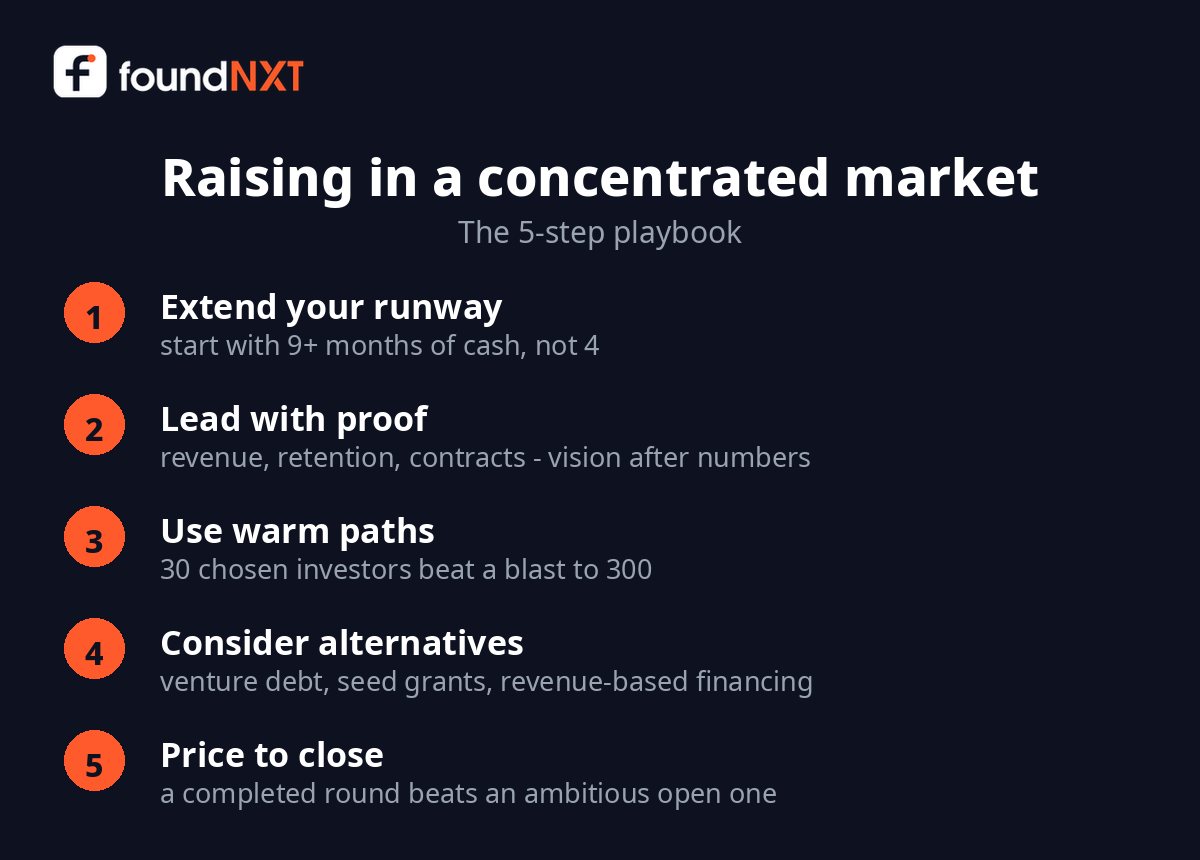
The playbook for raising in this market
1. Extend your runway before you start
Fundraises take longer when investors are picky, often six to nine months from first meeting to money in the bank. If you start raising with four months of cash, you will negotiate from panic, and investors can smell that. Before you open a single conversation, cut costs so you have at least nine months of runway. The founders getting decent terms this year are the ones who can afford to say no.
2. Lead with your strongest proof, not your vision
When investors see fewer deals, each deal gets more scrutiny, so your first impression has to survive it. Open every pitch with your hardest evidence: revenue and its growth rate, retention, a signed contract, a waitlist. Vision matters, but in 2026 vision is what you say after the numbers land, not before.
“In 2026, vision is what you say after the numbers land, not before.”
3. Raise from people who already know you or your space
In a concentrated market, warm paths matter more because cold decks get filtered out faster. Your best odds are with investors who backed similar companies, angels from your industry, and funds that publicly said they invest at your stage. A list of 30 carefully chosen investors will beat a blast to 300. And if an existing investor or advisor can introduce you, the same fund reads your deck very differently.
4. Consider the alternatives to a classic round
If the market will not give you a clean seed round today, you have options that did not exist a few years ago. Venture debt can extend runway if you already have revenue (India’s venture debt market hit about $1.3 billion in 2025). Government schemes like the Startup India Seed Fund offer grants and early capital through incubators. Revenue-based financing lets you borrow against monthly sales. None of these are free, but all of them buy time to reach the traction that unlocks equity investors.
5. Price the round to close
In 2021, founders could anchor high and still get funded. In 2026, an overpriced round sits open for months, and an open round that does not close is a bad signal in itself. Look at what comparable companies at your stage actually raised recently, set a number you can defend with your metrics, and close it. A slightly lower valuation that completes beats an ambitious one that drags.
The fix: If your raise has been open for more than three months with no term sheet, one of three things is wrong: the ask is too big, the price is too high, or the evidence is too thin. Pick the honest one and change it, because the market will not.
The upside nobody mentions
Here is the counter-intuitive part. Companies that do get funded in a concentrated market come out stronger: less competition for follow-on capital in their space, saner valuations, and teams built on discipline instead of hype. Several of India’s most durable companies, Zerodha, Zoho, and more recently the bootstrapped-then-scaled wave of SaaS firms, were forged in years when capital was scarce. Scarcity forces the habits that keep companies alive.
The market has not closed. It has raised its standards. Meet them, and there is $10 billion a year looking for a home.
Your turn: are you raising right now, and is it slower than you expected? What has worked for you? Tell us in the comments. And if you want more plain-English guides like this in your inbox every week, join the Weekly Founder Brief, foundNXT’s free newsletter. Sign up below.
Sources
- CNBC-TV18: Indian tech funding rises 7% as investors back fewer, bigger deals (Tracxn 9M 2026) (Sep 2026)
- StartupFeed: India seed funding falls 37% to $698 million in 9M 2026 (Tracxn)
- ETEntrepreneur: Inside India’s startup funding recovery (Tracxn data) (Oct 2026)
- Inc42: Startup funding crawls up 5% YoY to $2.2 billion in Q3 2026 (Oct 2026)
- Kae Capital: India VC 2025 review and 2026 outlook (Jan 2026)
FoundNXT publishes independent business intelligence, valuation frameworks, and startup teardowns. Nothing in this article constitutes financial, investment, legal, or tax advice. Company figures, market projections, and valuation metrics represent editorial estimates and regulatory filings. Always consult qualified legal counsel and certified financial advisors before executing investment rounds or financial agreements.