

📑 Table of Contents
- Loading headings…

Somewhere between your last round and your next one, there is often a gap. The plan said you would raise a Series A by now, but the market turned, or your metrics are not quite there, and the bank balance says eight months. What happens in that gap decides whether the company survives. The two tools for it are the bridge round and, when things are worse, the down round. Founders treat both as shameful secrets. They are neither. Done right, they are how good companies live to raise again.
What a bridge round actually is
A bridge round is a small top-up of cash from your existing investors, designed to carry the company to a specific milestone that unlocks the next proper round. It is usually structured as an instrument that converts into shares at the next round’s price, with a discount or a valuation cap as the reward for coming in early: in India, typically an iSAFE, compulsorily convertible debentures, or an extension of the previous round’s CCPS at the same price.
Think of it as a loan of time from the investors who know the company best. And that is exactly who should lead it. When insiders refuse to bridge their own company, outside investors read it as a verdict: the people with the most information have chosen not to add money. An insider-led bridge, by contrast, is a quiet vote of confidence.
Important note: When insiders refuse to bridge their own company, outside investors read it as a verdict. If you want a bridge, the conversation starts with your existing investors, not new ones.
The milestone test
A bridge only works if it ends somewhere. Before raising one, write the destination as one sentence with a date and a number: “Rs 1 crore of monthly revenue by March, growing 8% a month”, or “a signed contract with a second enterprise customer and a live pilot with a third by June”. If you cannot name the milestone, you are not raising a bridge, you are postponing a shutdown.
Then do the arithmetic. Count the months to the milestone, add the months the next round will take to close (four to six is realistic now), then add six months of slack for things going slowly. That total is the distance the bridge must cover. If the money plus a burn cut cannot cover it, the honest options are a smaller milestone, cutting costs until the company survives on its own revenue, or selling while you still have time to run a process.
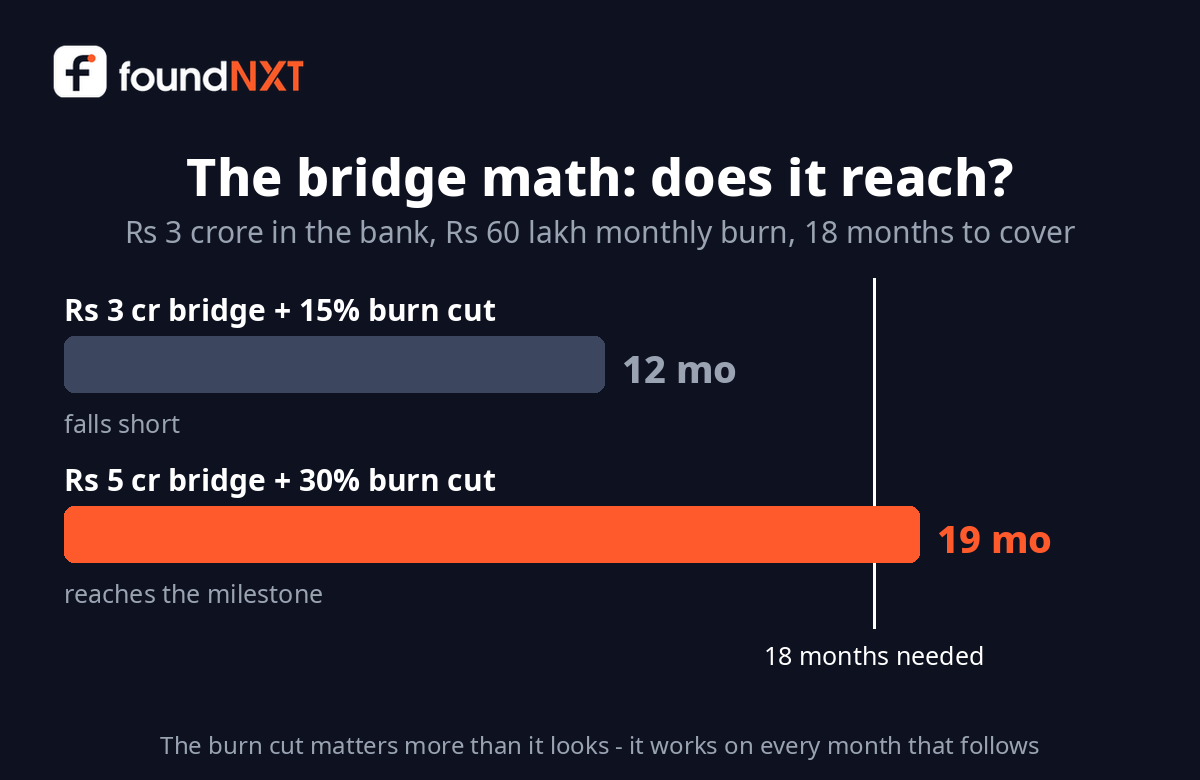
Worked example: A company with Rs 3 crore in the bank burning Rs 60 lakh a month has five months of runway. Its milestone is 14 months away and the next round takes four to close: 18 months to cover. A Rs 3 crore bridge plus a 15% burn cut buys about 12 months. A bridge to nowhere. A Rs 5 crore bridge plus a 30% cut buys 19, which just barely reaches. The cut matters more than it looks, because it works on every month that follows.
What a down round is, and why it is not the end
A down round is a funding round priced lower than the previous one. If you raised your seed at a Rs 40 crore valuation and your Series A happens at Rs 30 crore, that is a down round. It stings because everyone’s paper wealth drops, and it triggers the anti-dilution clauses in earlier term sheets, which hand extra shares to earlier investors and dilute founders further.
But here is what experienced founders know: a down round that funds the company is vastly better than no round. The 2021 boom pushed valuations far ahead of reality, and a large share of the companies that raised then had to choose between a down round and death when they returned to market. Kae Capital’s review of 2025 splits them cleanly into two groups: one took their medicine, raised flat or down, and moved on; the other refused, burned through short extensions, and either shut down or was still stuck raising on worse and worse terms into 2026.
Global examples say the same. Airbnb raised a down round in 2020 at an $18 billion valuation, well below its earlier peak, and went public months later at more than double that. The down round is a price, not a verdict.
“The down round is a price, not a verdict.”
Terms that save you, and terms that sink you
In a bridge or a down round, investors have leverage, and some will use it. The terms to defend:
- Keep the instrument simple: iSAFE, CCD, or same-price CCPS. Complexity now becomes renegotiation later.
- A moderate discount (15-25%) or a cap near the last round’s price rewards the risk fairly. A cap far below the last price is a hidden down round.
- Refuse full ratchet anti-dilution. Accept broad-based weighted average at most.
- Refuse liquidation preferences above 1x, participating preferences, and any new preference that ranks ahead of all earlier money.
- Refuse board changes that arrive with small money. Every one of these is something your next lead investor will demand be undone, and undoing terms costs time you do not have.
Note the pattern: every poison term makes the next round harder. A bridge that saves the company but destroys its fundability has not saved anything.

The fix: Start the bridge conversation when you have nine months of cash, not three. The same investors will offer you completely different terms when you have time to walk away.
The part nobody tells you
Tell your next investors the truth about the bridge and the down round. They will find out in due diligence anyway, and a founder who explains “we bridged to hit Rs 1 crore MRR, and here it is” reads as disciplined. A founder who hides it reads as a risk. Everyone in the Indian ecosystem has watched this cycle play out since 2022. Survival with honest math earns respect, not judgment.
Your turn: have you been through a bridge or a down round? What did it teach you? Share it in the comments, anonymously if you like. And if you want more plain-English guides like this in your inbox every week, join the Weekly Founder Brief, foundNXT’s free newsletter. Sign up below.
Sources
FoundNXT publishes independent business intelligence, valuation frameworks, and startup teardowns. Nothing in this article constitutes financial, investment, legal, or tax advice. Company figures, market projections, and valuation metrics represent editorial estimates and regulatory filings. Always consult qualified legal counsel and certified financial advisors before executing investment rounds or financial agreements.