

📑 Table of Contents
- Loading headings…
A cold storage owner in Uttar Pradesh keeps track of hundreds of farmers’ potato lots in a paper register. Rent is calculated on a calculator, lot by lot, at the end of the season. His phone runs WhatsApp all day. His entire business runs on paper. Now multiply him by every cold storage, transport yard, driving school, and wedding planner in the country.
That gap between the smartphone in the pocket and the paper register on the desk is where niche SaaS lives.
Quick honesty before the list. SaaS simply means software you rent monthly instead of buying, like a Netflix subscription for a business task. And “nobody has built this yet” is almost never literally true. Search any niche below and you will find a few small, young tools. What is true is this: these markets are still young. The tools you will find are small, recent, and mostly unknown to the businesses that need them. That is good news for you, because those tools prove someone already wants this, and most customers are still running on paper, Excel, or WhatsApp.
The openness test. A niche is still winnable when three things are true: the customer still runs on paper, Excel, or WhatsApp; the pain shows up daily or weekly, not once a year; and the buyer can pay ₹500 to ₹2,000 a month without asking anyone’s permission.
1. Licence renewal tracking for small factories
A small manufacturing unit juggles a factory licence, fire NOC, pollution board consent, boiler certificates, and more, each with a different expiry date and a different portal. Miss one renewal and production can stop, or a fine lands.
The product is almost boring: one calendar that stores every licence document and nags the owner before anything expires. A few early trackers exist, but most small factories still rely on their CA’s diary. That diary is your opening.
2. Trip profit and driver khata for small truck owners
An owner with five to twenty trucks deals in diesel, tolls, driver bhatta (daily allowance), tyres, and repairs, trip after trip. Today this lives in a notebook the driver fills in, badly. Ask the owner which of his routes loses money and most cannot tell you.
An app that turns each trip into a simple profit-or-loss line, and keeps the driver’s advance ledger honest, sells itself to the owner who has ever suspected he is working hard to stand still. Small fleet apps have started appearing, but talk to ten truck owners at a transport nagar and count how many use one.
3. RA billing for civil subcontractors
Small subcontractors on construction sites bill the main contractor through “running account” bills: measurement sheets, rate calculations, deductions, approvals. A delayed or disputed bill means the subcontractor’s cash is stuck for months while his labour wants weekly wages.
A tool that lets a subcontractor enter measurements on his phone and produce a clean, trackable bill attacks a pain that is measured in lakhs of stuck rupees. Construction ERPs exist for big builders. The two-crore-turnover subcontractor is still waiting for someone to build for him.
4. Export paperwork for first-time exporters
A Tiruppur T-shirt maker lands her first order from the United States, celebrates for one evening, and then discovers proforma invoices, packing lists, shipping bills, eBRC payment tracking, and RoDTEP refund claims. Thousands of small manufacturers hit this wall every year, right when they should be happiest.
A product that turns one order’s details into every document, with a checklist per shipment, sells relief at the exact moment of panic. Freight software exists for large exporters. The first-time SME exporter is largely served by clearing agents and prayer.
5. Member and procurement management for FPOs
India has promoted thousands of Farmer Producer Organisations, companies owned by farmers themselves, under a central scheme announced in 2020 that targeted 10,000 of them. Each FPO must track member shares, record produce bought from each farmer, and calculate payouts honestly.
Today, most of this runs in ledgers a single overworked manager maintains. Software for FPOs exists in pockets, often grant-funded and clunky. A simple, cheap tool that an FPO manager actually enjoys using would spread by word of mouth between neighbouring FPOs faster than any sales team.
6. Sauda and lot accounting for mandi commission agents
In every grain mandi, commission agents (arhtiyas) receive lots from hundreds of farmers, record weighbridge slips, run same-day auctions, and owe farmers their money minus commission. The volumes are huge and the trust is personal, which makes honest records everything.
A few mandi-specific accounting tools have launched recently, which tells you the pain is real. But walk through a big anaj mandi and the bahi-khata still rules. The winning product here will look and feel like the register it replaces, only searchable and impossible to lose.
7. Cold storage lot management
Back to our friend in UP. Farmers store produce in winter, withdraw it in parts over months, and pay rent per bag. Disputes about which lot belongs to whom, and how much rent is due, eat the owner’s season.
The product maps chambers and lots, tracks every in-and-out, and calculates rent automatically. Small tools exist; adoption is tiny. The market is thousands of cold storages in the potato belts of UP and West Bengal alone, each doing the same maths on the same calculators.

8. An operations workspace for wedding planners
India’s wedding industry is often estimated at around $50 billion a year, and much of it runs through planners coordinating fifteen to thirty vendors: decorators, caterers, photographers, bands, venues. The coordination tool of choice is a WhatsApp group with 200 unread messages.
Planners need one place for vendor lists, advance payments, client approvals, and the day-of run sheet. Wedding CRMs have started appearing, mostly for leads. The operations side, the actual running of the wedding, is still held together by memory and forwarded messages.
9. Driving school management
Every town has driving schools, and every one of them juggles admissions, learner’s licence paperwork, RTO test slots, instructor schedules, and fee installments. The current system is a register, a wall calendar, and hope.
A tool that tracks each student from admission to licence, schedules instructors and cars, and reminds everyone about RTO dates would be an easy monthly subscription for thousands of schools. A handful of early apps exist. The register is still winning, which is exactly the point.
10. Pet boarding and daycare booking
Urban India’s pet population has boomed since 2020, and with it, boarding kennels and daycares. Bookings arrive by phone and WhatsApp, vaccination records live in a file, and a double-booked weekend means angry pet parents at the gate.
A booking calendar with pet profiles, vaccine records, and pickup reminders is simple software for a fast-growing, emotional, high-trust business. Global pet software exists but is priced and built for America. India’s pet boarding boom is waiting for a local tool.
Why these are winnable, and how to check yours
Notice what these ten have in common: small ticket size, customers you can reach directly by visiting them, and no need for venture capital maths. Zoho grew from Tamil Nadu serving boring business needs for decades (we wrote about the Zoho playbook), and Freshworks went from Chennai to a NASDAQ listing by serving support desks nobody found glamorous (that story is here). Boring niches with paper registers are where patient software companies come from.
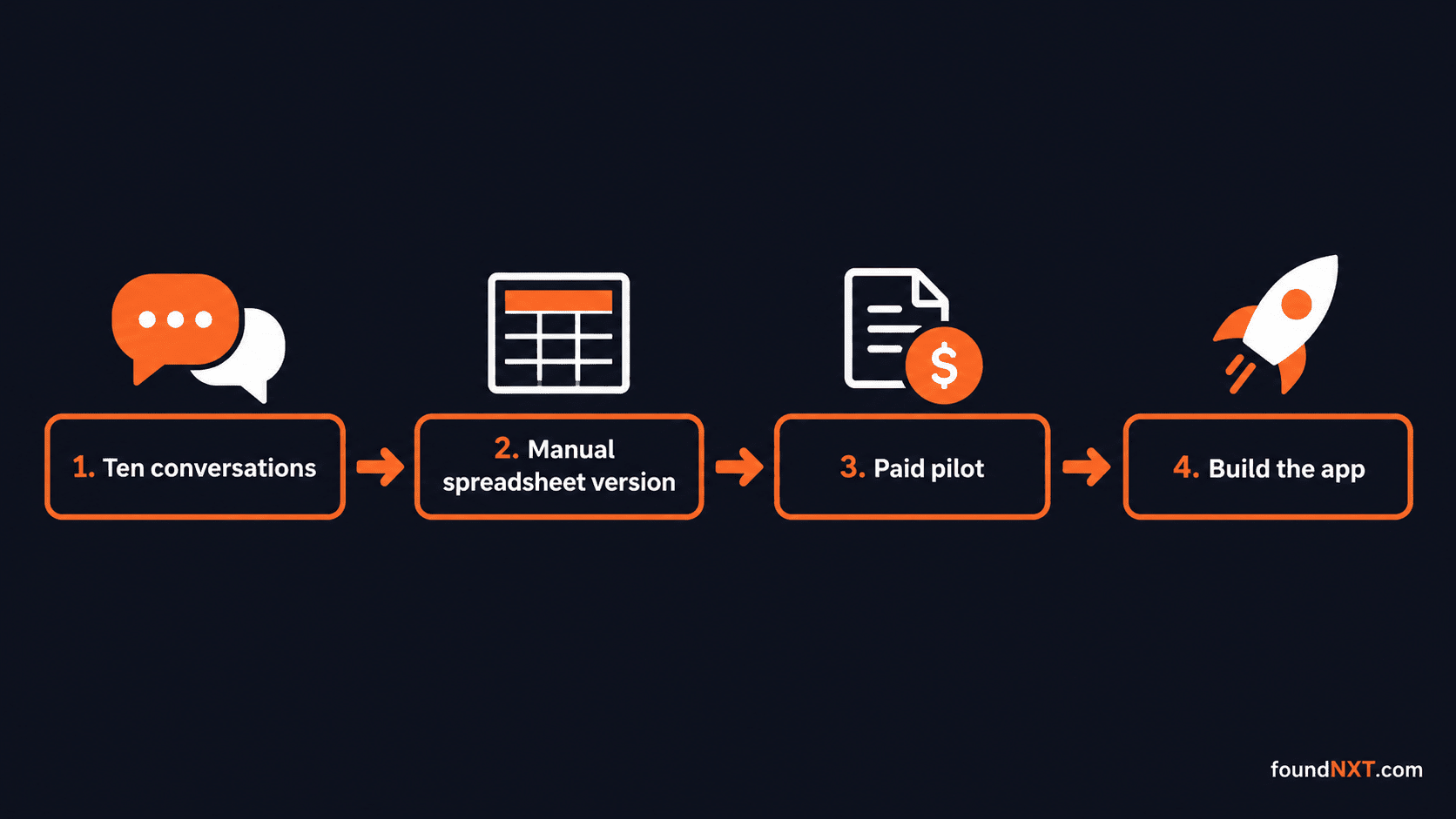
Before writing any code, do three things. First, have ten real conversations with owners in the niche; you are listening for the words they use for the pain, because those words become your sales pitch. Second, solve the problem manually for one or two of them, even in a spreadsheet, and watch what actually gets used. Third, charge from week one, even a token amount, because free users lie to you with kindness. Our guide to validating an idea for ₹0 walks through this, and our AI-era solo business ideas show how small a team can now build the first version.
Charge from week one. At ₹500 to ₹2,000 a month per customer, you need roughly 100 paying customers before this replaces a salary. That is achievable in a big niche, but only if you learn to sell early. A paying customer’s complaints are worth more than a free user’s compliments.
Key takeaways
- “Nobody has built it” usually means “only a few small, young tools exist.” Those tools are proof of demand, not a closed door.
- A niche is open when customers still run on paper, Excel, or WhatsApp and the pain is frequent.
- India’s unglamorous businesses, transporters, mandis, cold storages, driving schools, are full of ₹500 to ₹2,000-a-month software opportunities.
- Validate before building: ten conversations, one manual version, charge from week one.
- Small-ticket SaaS is a volume game; plan for 100 customers, not five.
The thought to leave with
Somewhere near you this week, a business owner will lose a register, miscount a lot, or miss a renewal date, and mutter that there should be an app for this. There mostly is not, not one that won. That muttering you hear is the sound of a market still open.
Which paper register have you seen lately? Tell us, and if you want more ideas like this in your inbox, the Weekly Founder Brief is where they land first.