
📑 Table of Contents
- Loading headings…
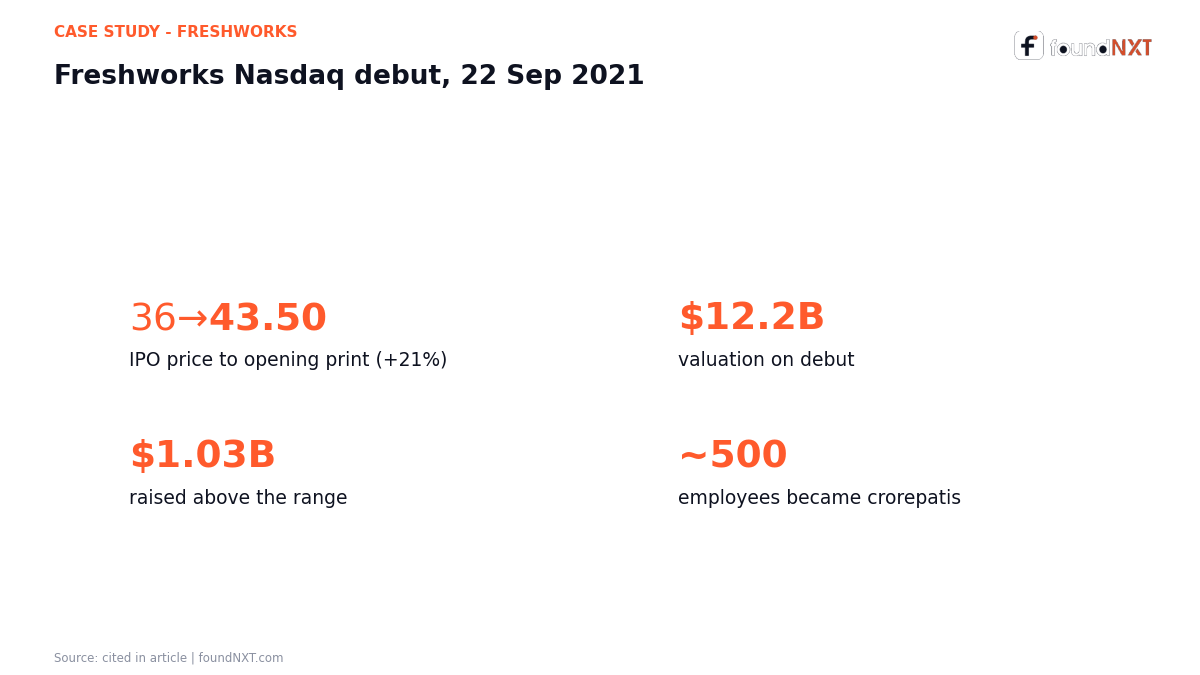
On 22 September 2021, Girish Mathrubootham stood in New York and rang the Nasdaq bell. Freshworks – started eleven years earlier in Chennai – opened trading at $43.50, 21% above its IPO price, and was valued at $12.2 billion on debut. It was the first India-born SaaS company to list in the United States, and the day roughly 500 employees became crorepatis. This is the route India-built software takes to a global listing – and what it demands of you.
From a customer-support ticket to a company
The origin story is SaaS folklore. In 2010, Mathrubootham – then a senior executive at Zoho – read a Hacker News thread about Zendesk raising prices, and saw the gap: small and mid-sized businesses needed modern, affordable customer support software. He and Shan Krishnasamy started Freshdesk in Chennai. The first cheque came from Accel in 2011, the same year the product won its first customer – Atwell College in Australia, found not through a sales army but through inbound interest.
The playbook from there was deliberate: build world-class product from India at Indian cost, sell globally at global prices, and keep the software so easy that it sells itself. Sequoia and Tiger Global joined the cap table. The company rebranded from Freshdesk to Freshworks as it expanded from support into a full suite – CRM, IT service management, marketing automation. By the IPO it served more than 50,000 companies, including Klarna, Cisco and Delivery Hero.
Why Nasdaq and not Dalal Street
This is the question every Chennai founder asks first, and the answer is mostly about rules and buyers. When Freshworks listed, Indian mainboard rules favoured companies with a track record of operating profit: broadly, profits in at least three of the previous five years. A SaaS company that is investing heavily in sales and engineering to win global customers rarely looks like that on paper. There was a second route for loss-making companies, but it required that most of the issue be sold to large institutional buyers, and it was still new in 2021. Zomato had only just used it that July.
The US market, by contrast, had a deep pool of investors who had been valuing software companies for twenty years. They already understood the SaaS scorecard: annual recurring revenue, net revenue retention, gross margin, and how fast a company is growing relative to what it spends to grow. A company burning cash in exchange for 30-40% annual growth was not a red flag there. It was the standard template.
The picture has shifted since. Indian rules have become friendlier to loss-making technology companies, the Indian market has proved it can value them (see our post on [the 2026 IPO wave](https://foundnxt.com/the-2026-ipo-wave-boat-acko-amagi-more/)), and several Indian-founded companies, including Groww, have moved their parent entities back to India before listing. The Freshworks route is still real, but it is no longer the only one.
What the SaaS scorecard actually measures
Public SaaS investors look at a handful of numbers, and a founder who wants to follow Freshworks should know all of them cold:
- Annual recurring revenue (ARR): the yearly value of subscriptions you have signed. A company with 10,000 customers paying Rs 50,000 a year has Rs 50 crore of ARR.
- Net revenue retention (NRR): how much revenue today’s customers pay compared with a year ago, including upgrades and cancellations. An NRR of 110% means that even with zero new customers, revenue grows 10%, because existing customers spend more.
- Gross margin: what is left after hosting, support and payment costs. Good software businesses run at 70-80% or higher.
- The Rule of 40: revenue growth rate plus profit margin should add up to 40 or more. A company growing 35% with a 5% margin scores 40. A company growing 60% while losing 25% also scores 35, and investors judge both on the same line.
A worked example: why the cost arbitrage matters
Take an illustrative example, not Freshworks’ actual accounts. Suppose a US support-software company and a Chennai company both have 100 engineers and sell a near-identical product at the same price. If a fully loaded US engineer costs roughly $200,000 a year and a comparable Chennai engineer costs roughly $50,000, the US company spends $20 million on engineering and the Chennai company spends $5 million. That is $15 million a year of difference, every year, before anyone has sold anything.
Spend that $15 million on sales and marketing instead and the Indian company can acquire thousands more customers than its rival on the same total budget. Over five years, the compounding is the real advantage: more customers, more data, more product investment, and a gross margin picture public investors like. This is the quiet logic behind the Chennai SaaS corridor. It is not that Indian engineers are cheaper and therefore worse. It is that the same quality of work frees up cash for the part of the business that is expensive everywhere: winning customers.
The honest caveat is that the gap narrows. Salaries for good engineers in Bengaluru, Chennai and Pune have risen faster than in the US over the last decade, and global customers now expect support in their time zone. The arbitrage is still there but smaller, which is one reason the best Indian SaaS companies now compete on product depth and speed rather than price.
Zoho, the other Chennai story
It is impossible to tell this story without Zoho. Mathrubootham’s former employer took the opposite road: never raise outside venture capital, never list, and build a product suite from Tenkasi and Chennai that competes with Microsoft and Salesforce. Zoho shows that the Freshworks path is a choice, not a law. If you want control and slow, steady compounding, bootstrapping to a very large business is possible. If you want to move fast against well-funded rivals, venture capital and an IPO are the tools that fit. Neither is the “right” answer; they are different trades of control for speed.
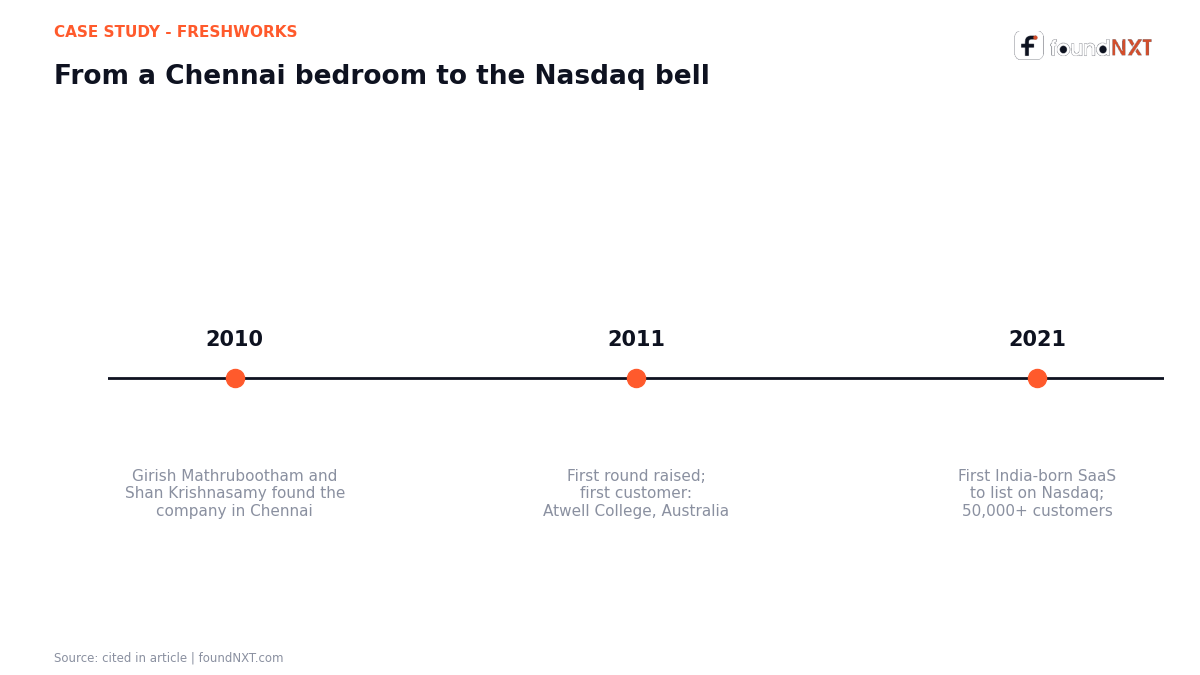
The listing, by the numbers
- IPO priced at $36 per share, above the marketed range
- Opened at $43.50 (+21%), valuing the company at $12.2 billion
- Raised $1.03 billion in the offering
- Underwriters: Morgan Stanley, J.P. Morgan, BofA Securities
- Around 500 employees in India turned crorepatis on their ESOPs
I feel like an Indian athlete who has won a gold medal.
Girish Mathrubootham, on the Nasdaq listing (Moneycontrol)
That quote mattered more than the valuation. Freshworks proved to a generation of Indian founders that you could build a global software company from Chennai – not just a services firm or a back office – and take it public on the world’s biggest tech exchange. Accel’s Sameer Gandhi called it a torchbearer for Indian entrepreneurs. He was right: a wave of SaaS companies, from Chargebee to Zoho-wannabes across Chennai’s OMR corridor, now treat the Freshworks route as the default ambition.
The route, step by step
For founders who want to follow it, the Freshworks route has five non-negotiables:
- Product-led, global from day one. Freshworks’ first customer was Australian, its market was always the world. Selling to the US from India is not a later expansion – it is the founding design.
- Arbitrage on cost, not quality. Chennai engineering salaries funded a product that competed with Salesforce and Zendesk. The margin difference financed years of growth – a capital-efficiency discipline echoed in the runway math.
- Institutional-grade investors early. Accel’s first cheque in 2011 brought more than money: SaaS pattern-matching, US go-to-market playbooks and the credibility that later attracted Sequoia and Tiger. Choosing early backers well is a theme in raising your first cheque.
- Relocate the corporate spine, not the soul. Freshworks headquartered in San Mateo, California, for proximity to customers and public markets, while keeping its engineering heart in Chennai.
- Share the outcome. Five hundred employee crorepatis did not happen by accident – generous ESOPs turned the IPO into a wealth event for the team, and into the best recruiting ad Chennai SaaS ever got.
After the bell: what happened next
Listing day is the start of a harder job. Freshworks opened at $43.50, but software stocks fell sharply in 2022 as interest rates rose, and the share price slid well below the $36 IPO price. In late 2022 the company cut roughly one in eight roles, a reminder that public investors, once they own a piece, expect cost discipline as quickly as they once expected growth. The Indian employees who sold early or held through the volatility ended up with very different outcomes from the same grant, depending on the day they chose to sell.
That is the lesson most IPO stories skip. A listing converts paper wealth into tradeable wealth, and tradeable wealth is subject to a daily vote. We explain what that means for employees in [ESOPs after listing](https://foundnxt.com/esops-after-listing-what-employees-actually-make/), and for the company in [profit before IPO](https://foundnxt.com/profit-before-ipo-public-markets-startup-math/).
Playbook: what to do if you are three years out
If a US or global listing is your long-term plan, the work for the next three years looks roughly like this:
- Year one: get the revenue quality right. Move customers from monthly to annual contracts where you can, track ARR and retention every month, and make sure at least 60-70% of your customers are outside India if the plan is a global listing.
- Year two: build the reporting muscle. Audited financials that follow international standards, a finance lead who has worked with public-company auditors, and a board that includes at least one person who has been through an IPO. Clean books are cheaper to build in year two than to fix in year four.
- Year three: choose your domicile and your bankers. Decide where the parent company sits, understand the tax and regulatory trade-offs, and begin conversations with underwriters well before you need them.
Along the way, keep an eye on dilution. The earlier you take capital, the more of the company you give up, and a long path to listing usually means several rounds. Our [runway math](https://foundnxt.com/how-much-should-you-raise-the-18-month-runway-math/) post shows how to size each raise.
Three myths about the Freshworks route
- Myth: you need to be in Silicon Valley. Freshworks kept engineering in Chennai and moved only the corporate headquarters. The product was built where the talent and cost structure were, and the customers were global from day one.
- Myth: only huge companies list abroad. Freshworks was valued at $12.2 billion on debut, but the underlying discipline (annual contracts, retention metrics, clear unit economics) matters at any size, because it is exactly what a Series B investor will ask for too.
- Myth: the IPO is the reward. For the employees who held shares, it was a payday. For the company, it was a new set of obligations. The reward is the business you built; the IPO is just how the market values it.
Important: The route has a cost. A US listing means quarterly earnings pressure, US disclosure rules and a shareholder base far from home. Mathrubootham himself stepped down as CEO in 2024. Going public is a financing event, not a finish line.
Freshworks’ debut closed one chapter – proving Indian SaaS belongs on Nasdaq – and opened another. The next Freshworks is being built right now, probably in Chennai, probably by someone who watched that bell ring. If that is you, the route is documented, the investors know the way, and the patient capital exists in India to get you started.
Enjoyed this case study? We break down one Indian startup story like this every week – the numbers, the strategy, the lessons. Join the Weekly Founder Brief and get the next one in your inbox.
Sources
FoundNXT publishes independent business intelligence, valuation frameworks, and startup teardowns. Nothing in this article constitutes financial, investment, legal, or tax advice. Company figures, market projections, and valuation metrics represent editorial estimates and regulatory filings. Always consult qualified legal counsel and certified financial advisors before executing investment rounds or financial agreements.