

📑 Table of Contents
- Loading headings…
While Silicon Valley taught the world that software companies are built on venture money, one man in a village in Tamil Nadu quietly proved the opposite. In FY25, Zoho Corporation crossed Rs 12,313 crore in revenue – the first bootstrapped software company in India to cross the Rs 12,000 crore mark – with Rs 3,191 crore in profit. No IPO. No external investors. No headquarters glass tower. This is the Zoho playbook.
A 55-product company most consumers have never heard of
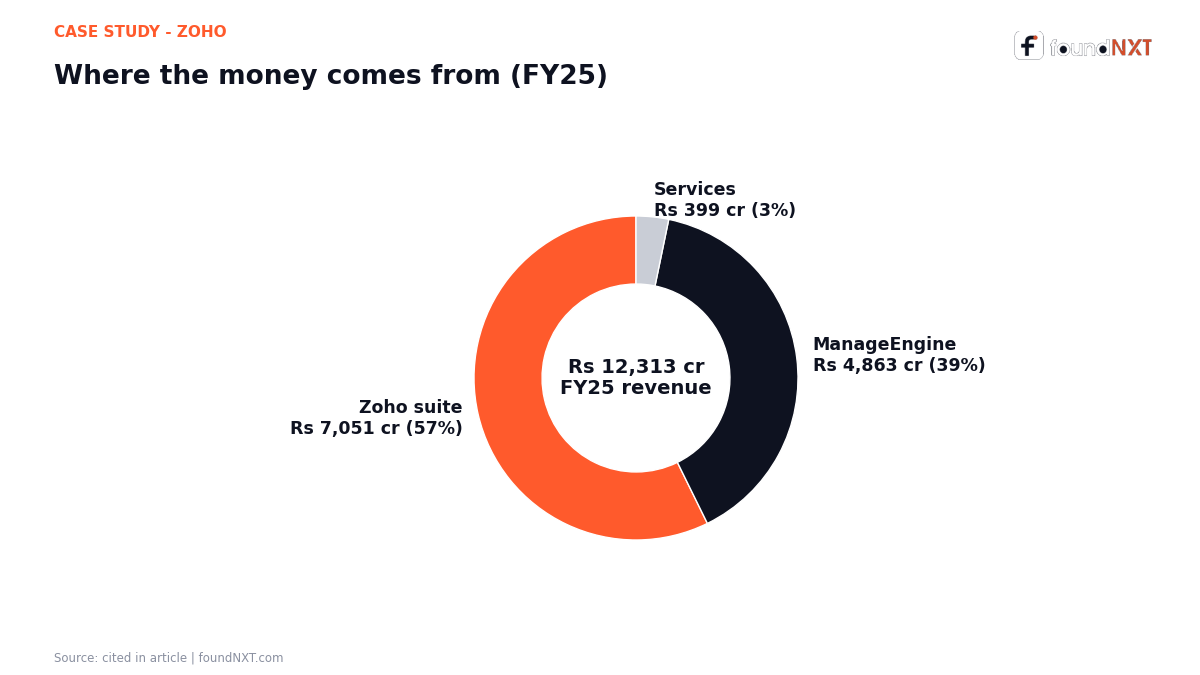
Zoho makes business software: CRM, email, accounting, HR, helpdesk, analytics – more than 55 products that together compete with Microsoft, Google and Salesforce for the budgets of small and mid-sized businesses. Its two engines in FY25 were the Zoho suite (Rs 7,051 crore, 57% of revenue) and ManageEngine, its enterprise IT management arm (Rs 4,863 crore, 39%). North America is its biggest market at 41% of revenue, followed by Asia at 30% and Europe at 23%.
Put that in plain terms: a small business can run its entire operation on Zoho – email instead of Gmail, Zoho CRM instead of Salesforce, Zoho Books instead of QuickBooks, Zoho People instead of BambooHR. Zoho One, the all-in-one bundle, covers 45-plus apps at a per-employee price closer to a streaming subscription than an enterprise software contract. For a 50-person company, the savings over stitching together the equivalent American stack run into lakhs of rupees a year.
The founding story is now legend. Sridhar Vembu and Tony Thomas started AdventNet in 1996 in Pleasanton, California, making network management software. When the dot-com bust crushed that market, Vembu did not shut down or sell. He rebuilt the company around business software, renamed it Zoho in 2009, and made a decision that would define everything after: no outside capital, ever.
That decision was forged in a near-death experience. When the dot-com bubble burst in 2001, AdventNet’s customer base of network equipment makers collapsed with it. Vembu faced the choice every founder of that era faced: raise emergency money on terrible terms, sell cheap, or rebuild on revenue. He rebuilt. ManageEngine – still about 39% of the business today – came out of that pivot. Founders who live through one crash tend to write “never again” into the company’s DNA.
The Tenkasi bet: talent is everywhere, opportunity is not
In 2019, Vembu moved from California to Tenkasi, a small town in rural Tamil Nadu, and started building what he calls “rural revival”. Zoho set up spoke offices in villages, hired local youth – many without engineering degrees – and trained them through its own Zoho Schools of Learning, which pays students a stipend instead of charging fees. Today, a meaningful share of Zoho’s global product is written from places most tech companies cannot find on a map.
The economics are elegant. Rural offices slash the two costs that kill software margins: real estate and attrition. An engineer in Tenkasi stays for a decade; the same engineer in Bengaluru gets poached in eighteen months – something we tracked in India’s AI talent war. Lower churn means product knowledge compounds inside the company instead of walking out the door.
Run the cost math. A software engineer in Chennai or Bengaluru costs a company Rs 15-25 lakh a year all-in, and big-tech bidding wars push that higher. Metro office rent adds another fat line per seat. In Tenkasi, salaries track local living costs instead of metro bidding wars, the office costs a fraction of a metro tech park, and – this is the part spreadsheets miss – the engineer is still there in year five. Replacing a trained engineer costs six to nine months of salary in recruiting, onboarding and lost context. Zoho’s model quietly deletes that line item.
Talent is universal. Opportunity is not. If you take the work to where the talent is, you do not have to fight for talent in overcrowded cities.
Sridhar Vembu, founder and Chief Scientist, Zoho
Zoho Schools deserves a closer look, because it inverts the usual hiring pipeline. Instead of filtering for IIT and NIT degrees, Zoho takes motivated 18-year-olds – many from families that could never afford an engineering college – teaches them programming and English over roughly a year, pays them a stipend throughout, and hires the graduates. College, in Vembu’s framing, is a credentialing machine that filters for privilege; skill is what actually matters. Graduates of the program now make up a visible slice of Zoho’s engineering teams, and the model does double duty: it supplies loyal engineers and anchors the company’s rural identity.
What the FY25 numbers say
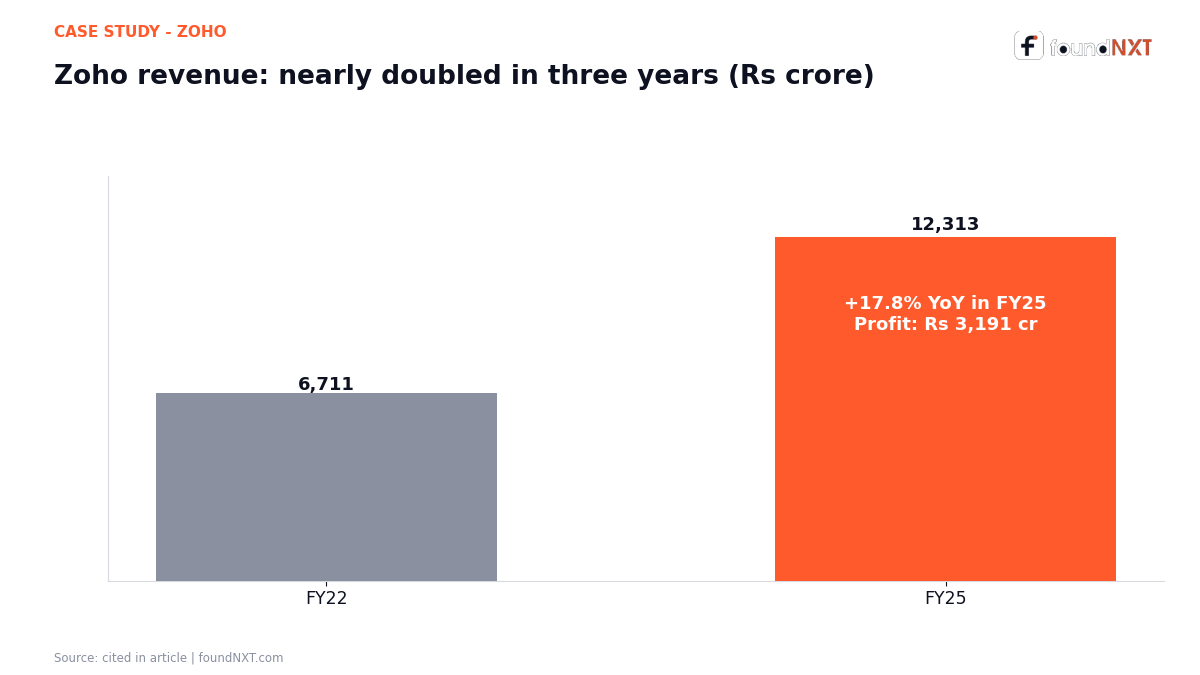
Zoho’s revenue grew 17.8% in FY25 to Rs 12,313 crore, nearly doubling from Rs 6,711 crore in FY22. Profit was roughly flat at Rs 3,191 crore (Rs 3,299 crore in FY24) as costs rose 30% – employee benefits alone hit Rs 4,347 crore as the company hired and raised pay, and advertising spend jumped 31% to Rs 2,230 crore. EBITDA margin stood at a healthy 31.3%.
For context, a 31% EBITDA margin on Rs 12,313 crore means Zoho throws off roughly Rs 3,800 crore of operating cash a year – money it can pour into R&D, new products like Arattai, or village offices without asking anyone’s permission. That single number explains the whole philosophy: profitability is not the goal, it is the fuel.
There was also a leadership transition: Vembu moved from CEO to Chief Scientist to focus on deep-tech R&D, while long-time executive Shailesh Kumar Davey became Group CEO. And the company keeps launching swadeshi-flavoured bets – the Arattai chat app and Zoho Pay – while winning prestige contracts like powering email for several Indian government ministries.
Those consumer bets look odd for a B2B company until you see the strategy: Zoho is assembling an entire swadeshi software stack – messaging, payments, email, office tools – running on its own data centres, answerable to no foreign platform. It is the same independence instinct, applied to a national market that worries about depending on American tech giants.
Important: Zoho’s model is hard to copy late. It works because frugality and patience were baked in from year one. A funded startup burning cash cannot “switch” to the Zoho playbook mid-flight – the cap table will not allow it.
The global mirror: Mailchimp’s 12-billion-dollar proof
Zoho’s path has a famous American parallel. Mailchimp, the email marketing company from Atlanta, also took zero venture capital for twenty years. Its founders ignored Silicon Valley’s advice, stayed profitable, priced for small businesses – and in 2021 sold to Intuit for about 12 billion dollars, one of the largest bootstrap exits in history. Basecamp, another profitable and proudly investor-free software company, has made the same argument for two decades: a business that answers only to customers can afford to be weird, patient and durable.
The pattern is not anti-capital. It is pro-optionality. Because Zoho never sold equity, every major decision – rural offices, owning data centres, a decade-long R&D push into AI and even semiconductor design – needed no one’s permission. Vembu’s new full-time role as Chief Scientist, focused on deep-tech research, is a luxury a quarterly-earnings CEO simply does not have.
The bootstrap playbook, distilled
- Own 100% of your time horizon. With no investors, Zoho thinks in decades. It can invest in R&D for years before payoff – including building its own data centres instead of renting cloud.
- Price for the underserved. Zoho undercuts Salesforce and Microsoft on price, which wins small businesses that big competitors ignore. Volume plus low churn beats a few whale contracts.
- Grow talent, don’t buy it. Zoho Schools converts raw, loyal local talent into engineers at a fraction of market cost – and builds rural economies in the process.
- Let profit fund ambition. Like patient capital – except the patient capitalist is your own P&L. The same discipline shows up in the 18-month runway math.
- Build what you sell, own what you run. From data centres to internal tools, Zoho prefers owning the stack. It costs more upfront and pays back forever: no cloud bill that scales with success, no vendor that can raise prices on you later.
Zoho is what happens when a founder treats revenue as the only funding round that matters. In a year when India’s startup funding stayed selective, a Rs 12,313 crore bootstrapped company is not the exception to the rule. It is the argument for a different rulebook.
If you are building a SaaS product from India, the Zoho question is uncomfortable but useful: are you pricing for the customers the giants ignore, and are your costs low enough to serve them profitably? Zoho’s 55 products all answer yes. Most funded SaaS answers one, sometimes neither.
Enjoyed this case study? We break down one Indian startup story like this every week – the numbers, the strategy, the lessons. Join the Weekly Founder Brief and get the next one in your inbox.
Sources
- Entrackr – Zoho reports Rs 12,313 Cr revenue and Rs 3,191 Cr profit in FY25
- Moneycontrol – Zoho revenue crosses Rs 12,000 crore in FY25
- The Week – How Zoho transformed Tenkasi into a rural tech hub
- Wikipedia – Zoho Corporation history
- Intuit – Mailchimp acquisition announcement (about $12 billion, 2021)
FoundNXT publishes independent business intelligence, valuation frameworks, and startup teardowns. Nothing in this article constitutes financial, investment, legal, or tax advice. Company figures, market projections, and valuation metrics represent editorial estimates and regulatory filings. Always consult qualified legal counsel and certified financial advisors before executing investment rounds or financial agreements.