

📑 Table of Contents
- Loading headings…
There is a kirana store near every Indian home that runs like clockwork. The owner goes to his native place for two weeks, and somehow the shop still opens at seven, the delivery boy still knows your order, and the accounts still add up at night. Then there is the other kind of business, the one where the owner cannot take a single Sunday off, because every price, every password, and every decision lives inside his head.
The difference between those two businesses is not talent or hard work. It is something much less glamorous: the first one wrote things down. This guide is about that boring-sounding superpower, SOPs and systems, and how to build them before your startup’s growth turns into chaos.
What is an SOP, in plain words?
SOP stands for standard operating procedure. Forget the corporate jargon. An SOP is simply a written recipe for a task your business does again and again. How to onboard a new customer. How to pack an order. How to reply to an angry email. If your mother has a handwritten recipe book where the same sambar comes out perfect every time, she understands SOPs better than most managers.
A system is the bigger idea: a set of SOPs plus the habits and tools around them, so that the business produces the same good result no matter who is doing the work that day.
Why systems beat heroes
Young startups run on heroes: the founder who fixes everything, the one engineer who knows the whole codebase, the sales star who keeps his pipeline in his head. Heroes feel wonderful right up until the hero gets sick, quits, or simply cannot be in five places at once. Then the company discovers it never had a business; it had a person.
The most famous proof that systems beat heroes is McDonald’s. In 1948, the McDonald brothers redesigned their restaurant kitchen like an assembly line, where every step, from grilling to wrapping, was written down and timed. When Ray Kroc later franchised the concept, he did not sell burgers; he sold the manual. That is why a burger tastes the same in Mumbai and Madrid. The genius was never the recipe. It was the fact that the recipe was written down so precisely that almost anyone could follow it.
If you think checklists are beneath skilled professionals, consider surgery. In 2008, hospitals in eight cities around the world, including New Delhi, started using a simple one-page surgical checklist from the World Health Organization: confirm the patient, confirm the site, antibiotics given, and so on. The result, reported by the WHO, was that deaths and major complications fell by more than a third. A piece of paper did that. Not a new machine, not a new drug. A list.
India has its own systems hero in Zoho, the software company from Tamil Nadu that we profiled in the Zoho bootstrap playbook. Zoho grew to serve millions of customers without venture money, partly by documenting everything, from how code gets reviewed to how support replies get written, so that new employees in small towns could do world-class work without a guru looking over their shoulder.
When should you start writing things down?
Earlier than feels natural. Three moments are the right trigger:
- The second time you do a task. The first time, you are figuring it out. The second time, write the steps while you still remember what confused you the first time.
- Before your first hire. You cannot hand over work that exists only in your head. Every SOP you write before hiring is a week of training you will not have to repeat.
- Before anything goes wrong twice. A mistake that happens twice is not bad luck; it is a missing system.
A warning in the other direction too: do not document a process that is still changing every week. A process should be stable, meaning it works, before you freeze it onto paper. Documenting chaos gives you laminated chaos.
What a good SOP actually looks like
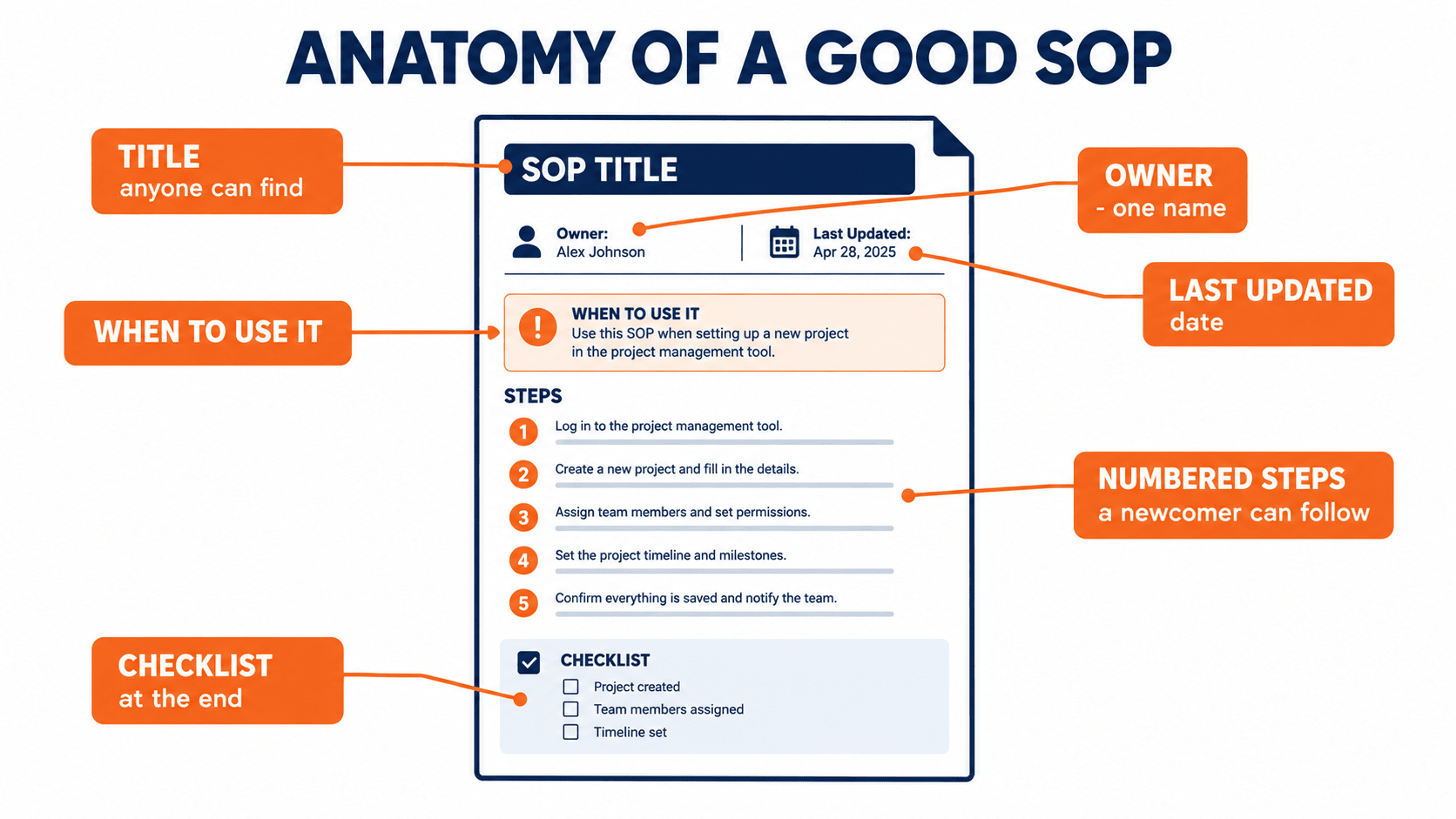
A good SOP fits on one page and has six parts. A title anyone can find by searching, like “How to refund a customer” instead of “Refund process v7 final FINAL”. One owner, a name, not a team, responsible for keeping it true. A line saying when to use it. The steps, numbered, written for a smart stranger on their first day. A short checklist at the end for the “did I miss anything” moment. And a last updated date, because an SOP nobody maintains becomes a trap: it tells people to do things the old way with confidence.
The quality test is simple. Hand the SOP to someone new and watch them follow it without help. Every question they ask is a sentence your SOP is missing.
The flywheel: do, document, delegate, improve
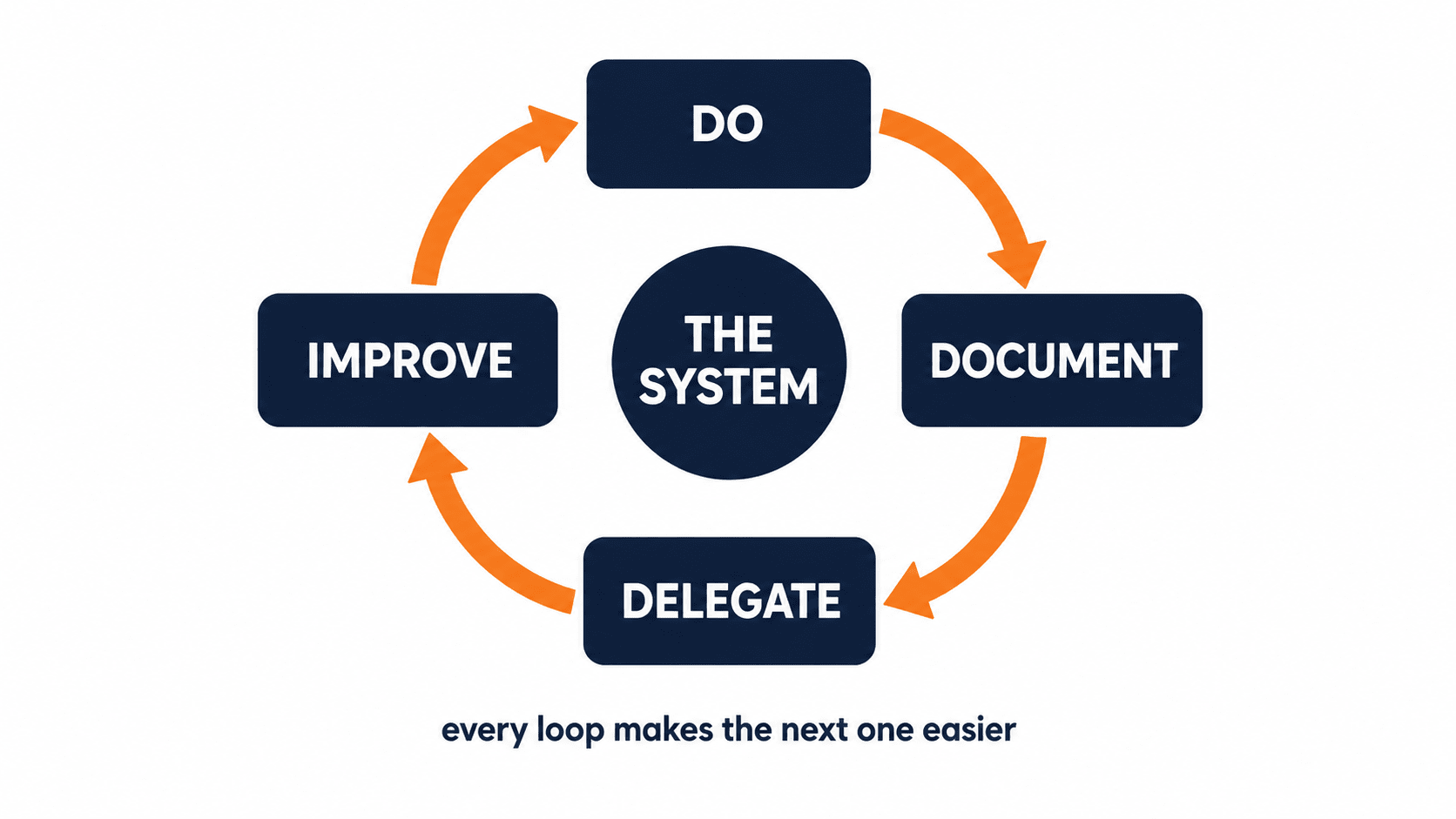
Here is how the system builds itself. First, do the task yourself until it works. Second, document it the next time you do it, which costs maybe twenty extra minutes. Third, delegate it: hand the document to someone and let them run it while you only check the result. Fourth, improve it: the person doing the task daily will find better ways; their job includes updating the page. Then the wheel turns again.
Each loop moves one more task out of your head and into the company. Do this for a year and something remarkable happens: the founder’s calendar empties of routine work, and the business finally has something venture capitalists pay a premium for, a machine that does not depend on any one person.
Which SOPs to write first
Start with the “hit by a bus” test: if you disappeared for a month, which three tasks would break the business fastest? Those are your first SOPs. For most young companies the list looks like this: how a sales lead is handled from first call to close, how a new customer is onboarded, how support questions get answered, how invoices and follow-ups for payment work, and how a new hire’s first week goes. Five documents. None longer than a page. That is the entire starting kit.
Where should SOPs live?
Anywhere your team already looks. A shared Google Drive folder works. A simple Notion page works. A printed folder at the billing counter works. The only rules are that everyone can find it in under thirty seconds, everyone can read it without asking for permission, and one named person can edit it. The best format for most steps is bullets, not paragraphs, and photos beat sentences for anything physical, like how a parcel should be packed or how a store shelf should look at opening time.
Mistakes that kill SOPs
The biggest one is writing novels. An SOP that takes forty minutes to read will never be read; keep it to one page and link out for detail. The second is no owner: a document everyone owns is a document nobody updates. The third is building a graveyard, a shared drive full of outdated files that people stop trusting. It is better to have five SOPs that are current than fifty that are stale. And finally, do not mistake the tool for the work: a fancy Notion setup or expensive software is not a system. A Google Doc that people actually open is.
Key takeaways
- An SOP is just a written recipe for a repeated task; a system is the set of recipes plus the habit of using them.
- Startups run on heroes until a hero leaves. Systems are what survive.
- Write things down the second time you do them, before your first hire, and after any mistake that happens twice.
- A good SOP is one page: findable title, one owner, numbered steps, end checklist, last-updated date.
- Run the flywheel: do, document, delegate, improve. A year of loops buys the founder their time back.
Systems also protect the person building them. Half of what founders call burnout is just undocumented work rattling around in one head. If that sounds familiar, our guide on why burnout is a business risk pairs well with this one.
What is the one task in your business that only you can do right now? That is your first SOP, write it this week and tell us how it went. And for one practical founder lesson in your inbox each week, subscribe to the Weekly Founder Brief from FoundNXT.