
📑 Table of Contents
- Loading headings…
In January 2026, Deepinder Goyal did something most founders never do voluntarily. He announced he was stepping down as CEO of Eternal, the company that owns Zomato, the business he had built from a menu-scanning side project into one of India’s biggest consumer tech companies. Reuters reported that Albinder Dhindsa, the man running Blinkit, would take over, while Goyal moved on to explore new, riskier ideas.
Love the decision or hate it, it forces a question most founders avoid until it is forced on them: the person who starts a company and the person who should run it at scale are doing two different jobs. Sometimes the same human can grow from one into the other. Sometimes not. This guide is about that transition, why it is so hard, and how to make it on purpose instead of by accident.
Wait, isn’t the founder already the CEO?
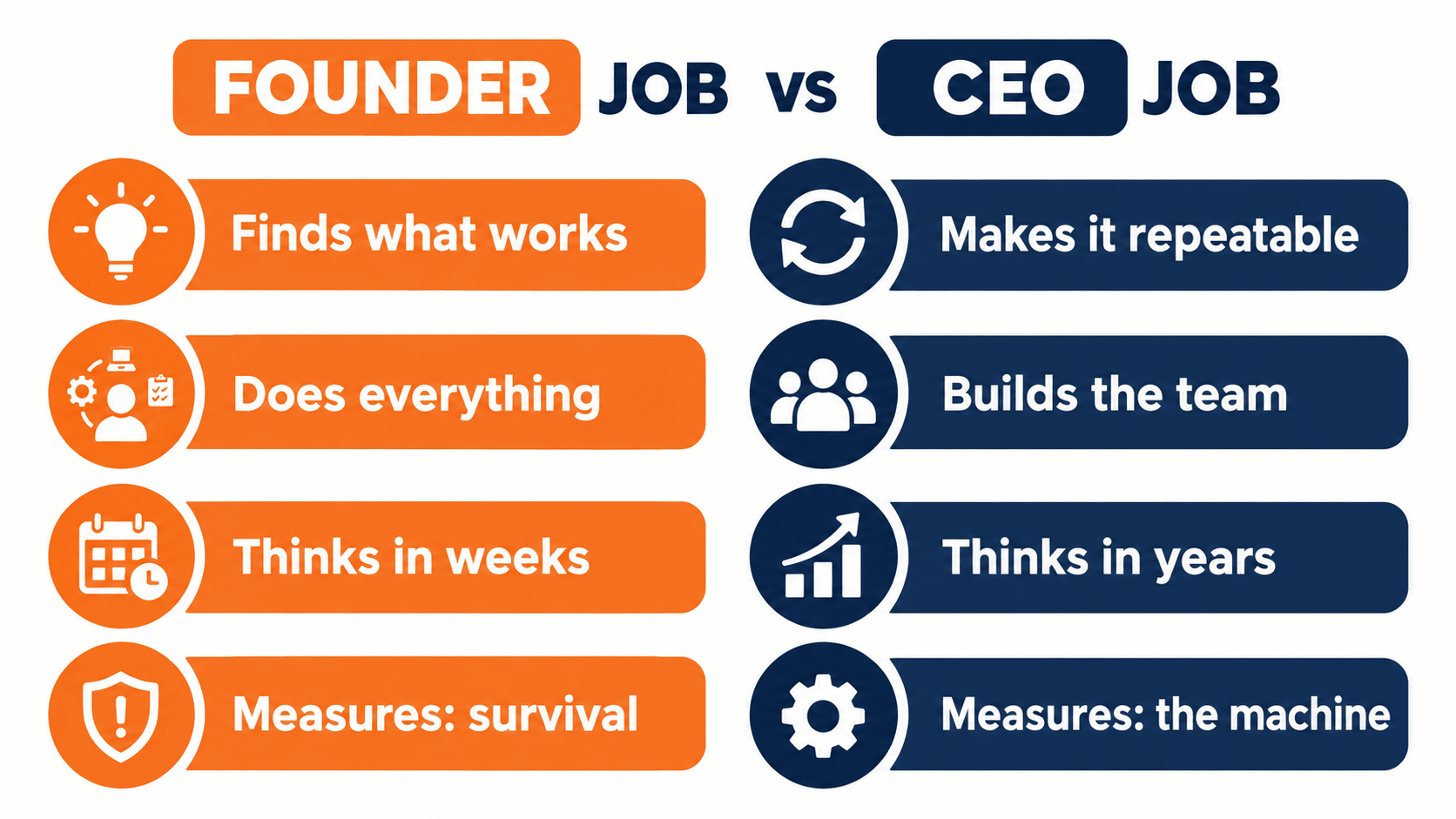
On paper, usually yes. In practice, not really. In the early days, “CEO” is a title on a visiting card while the actual job is founder: find customers, build the thing, beg for money, fix the printer, repeat. The skills that win here are speed, stubbornness, and the willingness to do fifty jobs badly rather than one job well.
A CEO of a scaling company does something else entirely. The job becomes building the machine that builds the product: hiring leaders, setting culture, deciding where money goes, and communicating the same story a hundred times until everyone from the newest intern to the board of investors can repeat it. The skills that win here are patience, delegation, and boring consistency. Notice that the two lists barely overlap.
The signs that the job has changed under you
The transition rarely announces itself. It shows up as small frictions. Your calendar fills with approval meetings, because thirty people cannot all grab you in the corridor. Decisions queue up waiting for you, and the queue is now the company’s speed limit. Managers come to you with questions they should be answering themselves, because you accidentally trained them that you always will. And the work you loved, the product, the customers, keeps getting pushed to “when things calm down,” which is never.
If three or four of those feel familiar, congratulations and condolences: your startup worked, and your old job is gone.
Climbing the delegation ladder
The way up is not a leap; it is a staircase, and founders fall when they skip steps.
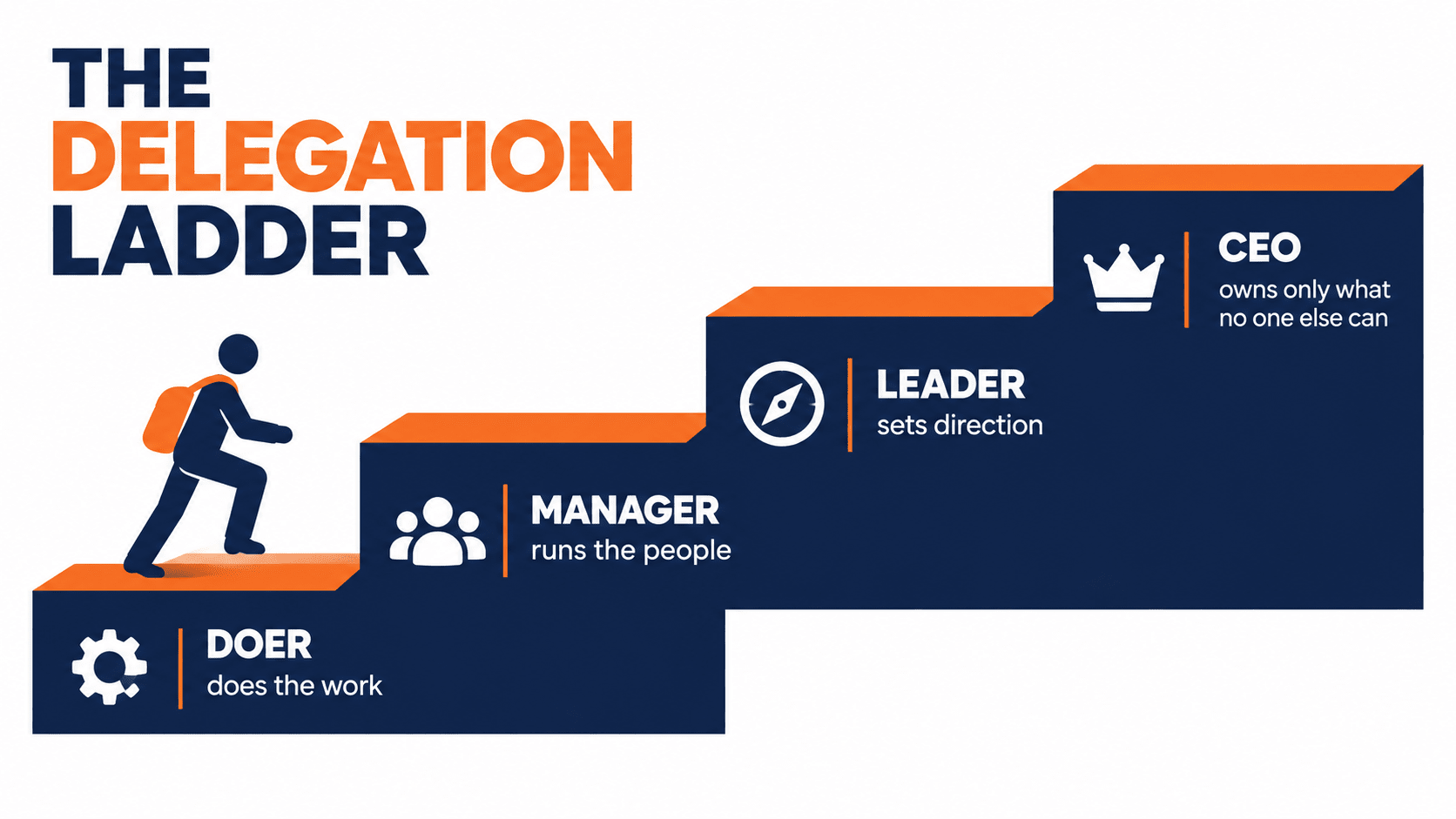
Step one, doer: you do the work. Step two, manager: you stop doing the work and start running the people who do it, which means weekly check-ins, clear targets, and feedback instead of midnight fixes. Step three, leader: you manage managers, and your output becomes decisions and direction rather than tasks. Step four, CEO: you keep only the jobs nobody else can do, typically final hiring calls on leaders, money decisions, culture, and the story of where the company is going.
The trick at every step is the same: hand over the task and the authority, then judge the result instead of the method. Founders who delegate the task but keep every decision have not climbed anything; they have just renamed their bottleneck.
Founder mode, manager mode, and the honest middle
In September 2024 this debate exploded in the startup world. Brian Chesky of Airbnb gave a talk arguing that the classic advice, “hire good people and get out of their way,” had nearly wrecked his company, and that founders should stay deeply involved in the details. Paul Graham turned the talk into a famous essay, Founder Mode, and founders have been arguing about it since.
The honest answer sits between the two extremes, and it is worth saying plainly because both caricatures kill companies. “Manager mode” done badly means the founder disappears into meetings and the company’s soul leaks out. “Founder mode” done badly means a hundred-person company still waits for one person’s WhatsApp reply. The working version is this: stay close to the few details that define the company, for Airbnb that was the product experience, and run everything else through people you trust. Chesky did not stop delegating; he stopped delegating blindly.
The parts nobody warns you about
Three hard moments come with this transition, and knowing their names helps. The first is letting go of the product. The product was your baby, and now someone else’s taste will shape it. It will be built differently from how you would have built it, and sometimes worse, and you must let that happen or the new leaders will never own anything.
The second is outgrowing people. Some early teammates will thrive as the company professionalizes; some will not, and no amount of loyalty changes that. Handling this with honesty and generosity, real conversations, fair exits, credit where due, is one of the true tests of a CEO.
The third is your calendar becoming the job. Paul Graham’s classic essay on the maker’s schedule versus the manager’s schedule explains why: makers need long empty blocks to build, while managers live in hour-long meetings. A CEO’s week is a manager’s week. Founders who do not accept this end up doing both jobs and sleeping through neither. If that tension is already wearing you down, read our guide on burnout as a business risk.
What the first ninety days actually look like
If you decide to grow into the CEO seat yourself, treat the next ninety days like a deliberate project, not a mood. In the first month, map where your time goes: track your calendar for two weeks and label every hour as doing, managing, or leading. Most founders are shocked by how little leading they do. In the second month, pick your three direct reports who can own whole areas, give each of them one clear number to own, and move your involvement from daily questions to a weekly review. In the third month, write down the decisions you will still make yourself, everything else belongs to the team by default.
Expect it to feel wrong. Watching someone do your old job at eighty percent of your speed, while you sit in a planning meeting, feels like failure. It is not. That gap between your speed and theirs is the tuition the company pays for a leader who will later run at a hundred and twenty percent without you.
Sometimes the answer is someone else
And sometimes the bravest CEO move is deciding you should not be the CEO. Google did it in 2001, when the young founders brought in Eric Schmidt to run the company while they grew into their roles, a move that helped Google become Google. India watched two versions of this recently. At Freshworks, founder Girish Mathrubootham moved to executive chairman in 2024 and handed the CEO seat to Dennis Woodside, a professional operator, which we touched on in our Freshworks story. And at Eternal, Goyal stepped aside in 2026 to chase new ideas while a proven operator scaled the company.
The opposite choice can work too: Nithin Kamath still runs Zerodha as a founder-CEO, and Brian Chesky stayed and reinvented how he led. There is no single right answer. There is only a wrong one: drifting, neither leading the company nor letting anyone else.
Key takeaways
- Founder and CEO are two different jobs: one finds what works, the other makes it repeatable. Growing from one into the other is a skill change, not a promotion.
- The warning signs are a calendar full of approvals, decisions queuing at your desk, and the real work pushed to “later.”
- Climb the ladder in order: doer, manager, leader, CEO. Delegate the task and the authority together.
- Founder mode versus manager mode is a false war: stay close to the few decisions that define the company, run the rest through trusted people.
- Handing the CEO seat to someone else, as Google, Freshworks and Eternal each did in their own way, is a valid and sometimes excellent move.
The founders who survive this transition share one habit: they review their own job description every six months as honestly as they review their employees’. The company you started deserves the leader it needs next, and becoming that person, or choosing them, is the real work.
Which job are you actually doing right now, founder or CEO? Tell us, we read every reply. And for one practical founder lesson in your inbox each week, subscribe to the Weekly Founder Brief from FoundNXT.