

📑 Table of Contents
- Loading headings…
It is 11:40 on a Tuesday night. You just finished answering customer emails, and now you are designing tomorrow’s social media post. Tomorrow morning you will fix a bug, pitch an investor at noon, and interview a delivery partner at four. Somewhere between those meetings you are supposed to do the actual job: building the company.
Every founder hits this wall, and everyone gives the same advice: hire people. But hiring too early burns money you do not have, and hiring too late burns you. This guide is about timing: how to know when the moment has come, who those first ten people should be, and how to choose them without regrets.
Why the first ten matter more than the next hundred
Here is something most founders learn too late: your first ten employees do not just do work. They decide what your company is. Employee number eleven will not learn the culture from you; they will learn it from the ten people already sitting there. If those ten gossip, the company gossips. If those ten call customers back within the hour, the company does that for years.
Brian Chesky, the co-founder of Airbnb, has said the team looked for their first engineer for four or five months and interviewed hundreds of people before hiring one. Why so picky? His answer, roughly: these first people are like DNA. Get the DNA wrong and every cell that follows is wrong. Zappos, the American shoe company famous for its service culture, goes even further: after training, it offers brand-new hires a cash bonus to quit. The idea is that anyone staying only for the salary should leave now, cheaply, instead of poisoning the culture later. Harvard Business Review wrote about the practice back in 2008, and companies still copy it.
Three signals that say it is time
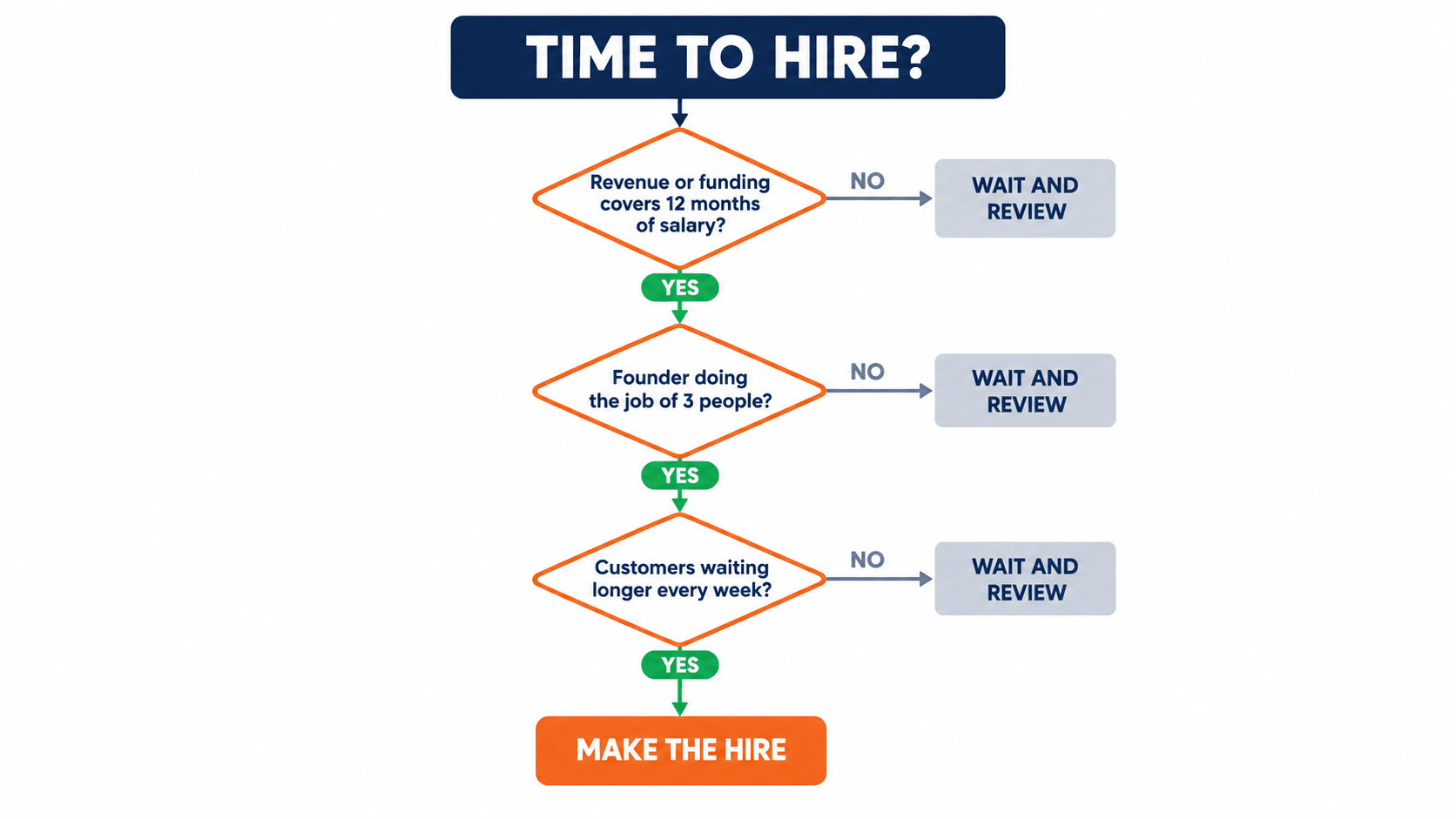
Signal one: you can pay for at least a year. A salary is a promise that repeats every month, in good months and bad. Before hiring, count your money honestly. Either revenue already covers the new salary, or you have enough funding to pay it for twelve months while the person ramps up. Hiring someone you will have to fire in four months is not just expensive; it is unfair to them.
Signal two: the founder is doing the job of three people, and one of those jobs is suffering. Notice the second half of that sentence. Being busy is normal for a founder and is not, by itself, a reason to hire. The signal is when something that directly makes money or keeps customers, like shipping the product or closing sales, is being delayed because nobody owns it.
Signal three: customers are starting to feel it. Replies take two days instead of two hours. Bugs stay open for weeks. Orders slip. When the queue of unhappy customers grows every week, you are not saving money by staying small; you are spending reputation, which is the one currency startups cannot raise more of.
And three reasons that are traps
Just as important: when not to hire. Do not hire to look like a “real company” for investors or relatives; headcount is a cost, not a trophy. Do not hire a person to fix a broken process, because a new person inside a broken process just becomes another confused person; write the process down first, then hand it over. And do not hire before you have evidence that strangers want what you are building. If you are still at that stage, our guide to validating an idea for Rs 0 comes first.
So who are these first ten people?
Every business is different, but a pattern shows up again and again in the first ten hires of companies that made it:
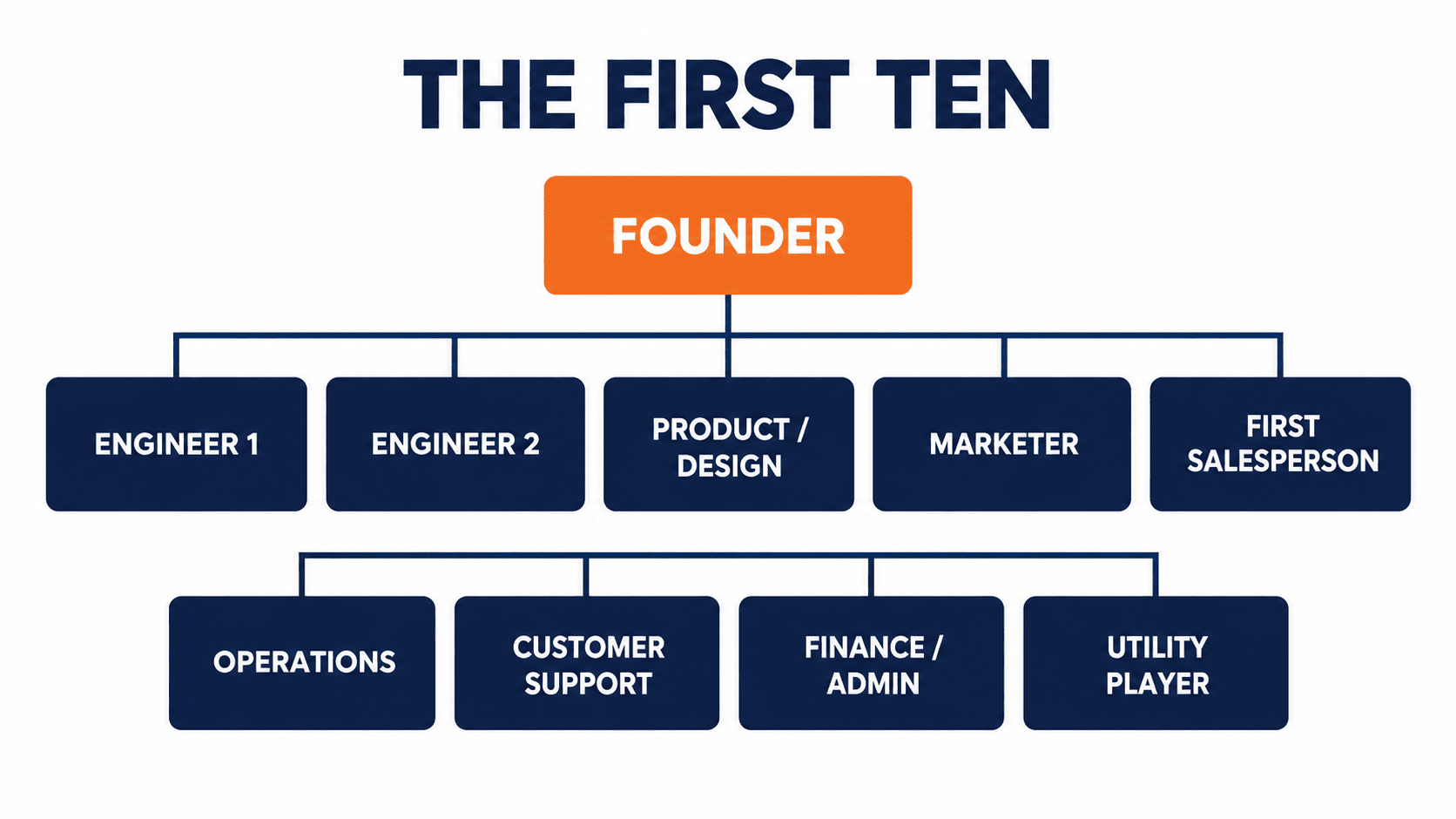
The builders come first. Hires one and two are usually engineers or product people, because in a young startup the product is the company. Then the seller. Somewhere around hire three to five, someone must own revenue full-time, because a founder selling between meetings leaves money on the table. Then the glue. Operations, customer support, and a finance or admin person, the unglamorous roles that stop small problems from becoming 2 a.m. emergencies. And keep one slot for a utility player: a smart generalist who does whatever this week needs. Early startups run on such people.
One important note: if you do not yet have a co-founder, that decision comes before all of these. A co-founder is not employee number one; it is a different relationship entirely, with equity and shared risk. We wrote a separate guide on how to find a co-founder.
How to actually choose them
Start with people who already know you: ex-colleagues, college friends, contributors from communities you are part of. Early startups cannot outbid big companies on salary, so they win on trust and mission. When you interview, pay for a small real work trial, a week-long project or a few paid days, before offering the job. Resumes tell you what people have done; trials tell you how they will work with you.
On money: be honest about what you can pay, and make up the gap with ownership. An ESOP, an employee stock ownership plan, gives employees a small piece of the company that becomes valuable if the company succeeds. It aligns everyone: when the company wins, they win. We explained what ESOPs actually pay out in real life in our guide to what employees actually make from ESOPs. And yes, your own salary is part of this conversation; if you have not thought it through, read our take on how much a founder should pay themselves.
Interview questions that actually work
Forget “where do you see yourself in five years.” For an early hire, ask things that reveal how they behave when nobody is watching: “Tell me about a project you finished that nobody asked you to do.” “What did you do the last time you were completely stuck?” “What would your last manager say you are bad at?” You are listening for ownership, honesty, and whether they light up when describing hard, messy work, because that is what a young startup is made of.
One red flag deserves its own sentence: a candidate who spends the interview asking about job titles, cabins, and growth paths. There is nothing wrong with ambition, but in a ten-person company the job is the work, not the ladder. The people you want ask about the customers and the product instead.
Mistakes that haunt founders for years
The most common one is hiring a friend who cannot tell you no. Early companies need people who argue respectfully, not cheerleaders. The second is hiring a big-company executive too early: someone brilliant at running a 200-person machine may be lost when the machine is twelve people and a spreadsheet. The third is skipping reference checks because the candidate “feels right.” A thirty-minute call with two past managers has saved more startups than any interview trick ever invented.
And when a hire goes wrong, act fast. Keeping a wrong hire for a year out of guilt costs the salary, the team’s morale, and the work that did not get done. Kind but slow is actually cruel, to them and to the rest of the team.
Key takeaways
- Your first ten employees become the company’s DNA; every later hire copies them.
- Hire when three signals align: twelve months of salary is covered, real work is suffering, and customers are starting to feel the delay.
- Never hire to look big, to patch a broken process, or before the idea is validated.
- Builders first, then a seller, then the glue roles, plus one utility player.
- Pay with honesty and ownership, test with a work trial, check references, and fix bad hires quickly.
Bad early hiring is quietly one of the biggest reasons young companies fail, right alongside the ones we listed in why startups fail. The good news: it is one of the few risks you fully control.
Who was your first hire, and would you make the same call again? Tell us, we read every reply. And for one practical founder lesson in your inbox each week, subscribe to the Weekly Founder Brief from FoundNXT.