

📑 Table of Contents
- Loading headings…
In 2019, one of India’s most loved startups was growing faster than almost any company in the country’s history. Money was pouring in, new offices were opening every month, and the founder was on magazine covers. Three years later, that same company, Byju’s, was fighting for its life. We wrote the full story in our Byju’s post-mortem, and the short version is painful: the company did not fail because it grew too slowly. It failed because it grew too fast, before the machine underneath was ready.
That is the strange thing about scaling. Every founder dreams of it, and it kills more startups than almost anything else. This guide explains what scaling really means, how to know when you are ready, and how to grow fast without snapping the business in half.
What does “scaling” actually mean?
People use the word scaling to mean “growing,” but they are not the same thing. Growing means adding more: more salespeople, more offices, more spending, and getting more revenue in return. A shop that opens a second branch with a second full team is growing. Scaling means revenue rises much faster than costs. A food delivery app that adds 10,000 new customers without hiring 10,000 new employees is scaling.
Think of a chai stall. If the owner opens a second stall, hires a second team, and earns double, that is growth. If the owner figures out a way to supply pre-mixed chai to fifty offices from one kitchen, and revenue jumps twenty times while the team only doubles, that is scaling. Scaling is a multiplier, not an addition.
The mistake that kills: scaling too early
A large research project called Startup Genome studied data from more than 3,200 startups and found that one reason for failure showed up again and again: premature scaling, meaning the company started spending like a big company before it had earned the right to. They hired fast, raised big rounds, launched in new cities, and then discovered the core business did not work yet. You can read their work at startupgenome.com.
Why does this happen so often? Because slow progress feels like failure, and investors and social media celebrate headcount and funding announcements, not quiet profitable months. So founders hit the accelerator before the engine is built. The car goes very fast for a short while, right into a wall.
The three dials that tell you if you are ready
Before you scale, check three dials. If any one of them is in the red, scaling will make things worse, faster.
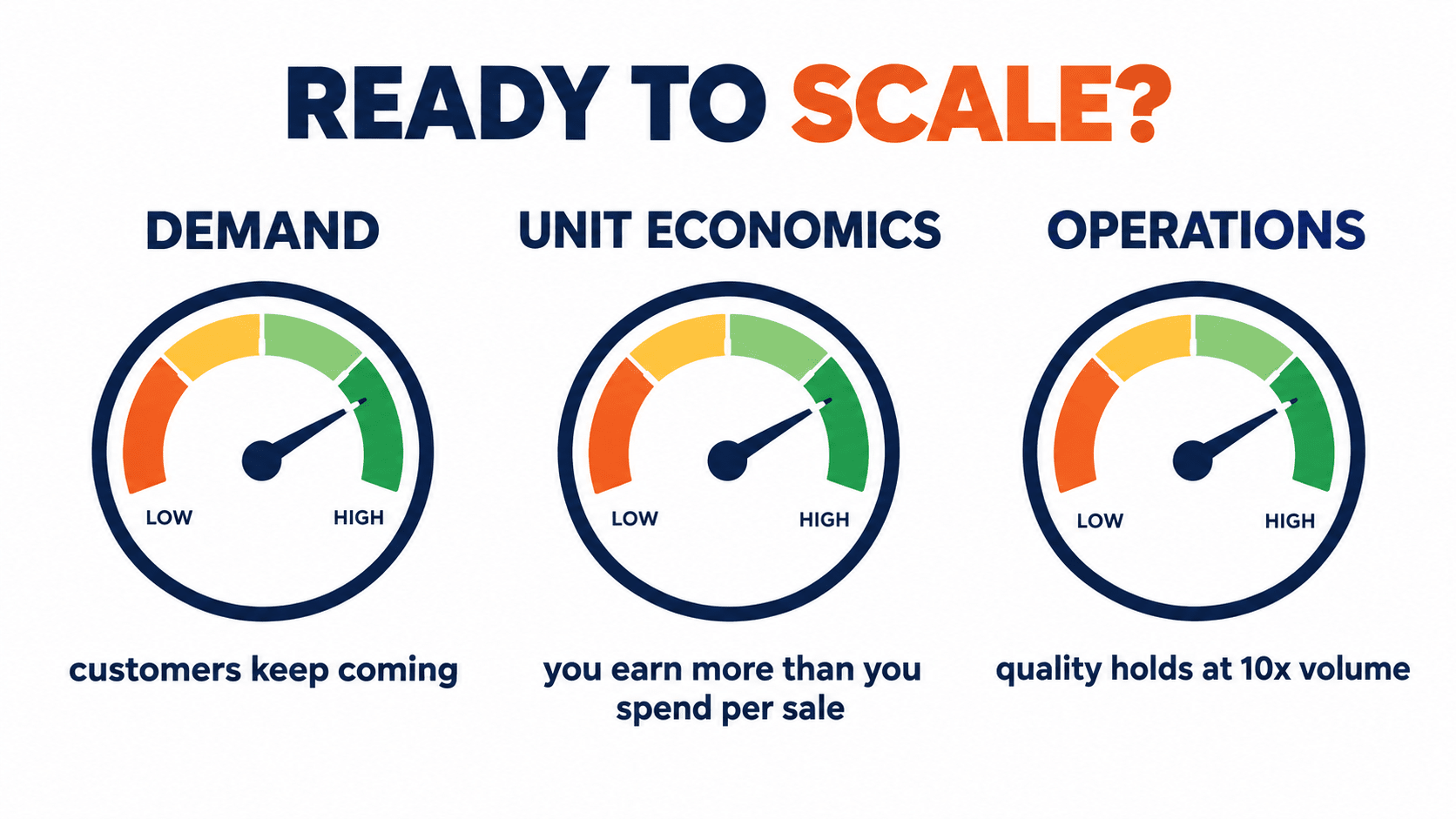
Dial one: demand. Do customers keep coming back without being pushed? The honest test is retention: how many people who bought last month are still with you this month? A business that has to re-win every customer from scratch is a leaking bucket. Pouring more water in, which is what marketing spend does, does not fix the hole. Zerodha is the classic Indian example of strong demand: for years it grew mostly through word of mouth, because the product was genuinely cheaper and better, so customers pulled their friends in for free.
Dial two: unit economics. This term simply means the profit or loss on one single sale. Take the price a customer pays, subtract everything it costs to serve that one customer (the product, delivery, support, payment fees), and see what is left. If one order loses Rs 80, then a million orders lose Rs 8 crore. Scaling a business with broken unit economics is like franchising a dosa stall that loses money on every dosa. More stalls, more losses.
Dial three: operations. Can you deliver the same quality at ten times the volume? This is where good companies quietly break. Support tickets go unanswered, deliveries arrive late, and the culture that made early employees care gets diluted by fast hiring. Dunzo, which we covered in our Dunzo teardown, kept expanding into new cities and new categories while the core service struggled, and the cracks eventually swallowed the company.
Nail it first, then scale it
Paul Graham, co-founder of Y Combinator, the startup school behind Airbnb and Stripe, gave founders famous advice: do things that don’t scale. In the early days, recruit users by hand, answer every support message yourself, and deliver orders personally if you have to. This is not wasted effort. It is how you learn exactly what customers want, so that when you do scale, you multiply something that works.
The order matters. First make one small group of customers love you. Then build systems so that serving them does not depend on your personal heroics. Only then pour fuel on the fire. Companies that reverse this order, fuel first and product later, become cautionary tales on websites like this one.
What steady scaling looks like in real life
Steady scaling is not slow scaling. It means each stage pays for the next. A practical sequence looks like this:
- Stage 1: ten customers who would be genuinely upset if you shut down. You serve them by hand.
- Stage 2: one repeatable way to find more of those customers, tested with small amounts of money.
- Stage 3: one city or one segment where the unit economics work, proven for at least a few months.
- Stage 4: systems and a small team that deliver without the founder touching every order.
- Stage 5: only now, expansion: new cities, new products, bigger rounds.

Notice how unglamorous this is. There is no viral moment, no fifty-person hiring spree. But this is roughly how the durable companies got built. Physics Wallah, which we profiled in our edtech case study, spent years making the core teaching business profitable before expanding, while better-funded competitors burned through billions chasing speed.
The traps that look like progress
Three traps deserve special warning because they feel like winning. The first is discount-led growth. If customers only come because you are the cheapest, they are not your customers; they are the discount’s customers. The day you raise prices to survive, they leave, and you have scaled a customer base that never belonged to you.
The second is hiring ahead of revenue. Every hire is a fixed monthly cost, but the revenue they are supposed to create is a hope. A good rule many founders use: hire when the pain of not hiring is clearly costing you money, not before.
The third is new-city fever. Opening in ten cities while your first city loses money does not spread the problem thin; it spreads it wide. Win one market so completely that competitors cannot enter it, then copy that playbook next door.
And watch the founder’s own fuel tank. Scaling multiplies decisions, and a founder running on empty makes bad ones. We treat this seriously enough to have written a separate guide: burnout is a business risk.
A five-question readiness test
Before your next big growth push, sit down with a notebook and answer these honestly:
- If our top marketing channel disappeared tomorrow, would customers still find us?
- Do we make money on an average order before counting the office rent?
- If order volume doubled this month, what is the first thing that would break?
- Could the business run for two weeks without the founder?
- Do we know our three most important numbers this week, without checking five dashboards?
If any answer made you wince, you have found the work that comes before scaling. That is not a delay. That is the work.
Key takeaways
- Growth adds resources for more revenue; scaling multiplies revenue without multiplying costs. Know which one you are doing.
- Premature scaling, spending big before the core business works, is one of the most common ways startups die.
- Check three dials before accelerating: customers stay, each sale earns money, and quality holds at ten times the volume.
- Fix the weakest dial first. Scaling a broken system gives you a bigger broken system.
- Steady scaling is not slow: each stage pays for the next, which is why companies like Zerodha and Physics Wallah outlasted faster rivals.
If you are standing at the edge of a growth decision right now, ask yourself one question: if I doubled sales next month, what would break first? Whatever your answer is, that is your real to-do list.
What broke first when you tried to grow? Tell us, we read every reply. And for one practical founder lesson in your inbox each week, subscribe to the Weekly Founder Brief from FoundNXT.