

📑 Table of Contents
- Loading headings…
Every company that wants to list in India has to file a DRHP, a Draft Red Herring Prospectus, with SEBI. It is the single most honest document a startup ever produces, because lying in it is a crime. It is also 600 pages of legal and financial dense text, which is why almost nobody reads it. Here is the secret: you only need about 40 of those pages. Whether you are a founder studying how listed rivals disclose their numbers, or an investor deciding whether to apply for an IPO, this is the 20-minute route through the document.
DRHP vs RHP: what is what
The DRHP is the first draft filed with SEBI. It has everything except the final price band and dates. SEBI reviews it, usually issuing observations within about 30 days, and the whole back-and-forth takes 4-6 weeks. Then the company files the RHP (Red Herring Prospectus) with the final price band and issue dates, the anchor book opens a day before the public issue, and listing happens within three working days of the issue closing. From DRHP to listing typically takes 3 to 6 months. Since 2022, companies can also file confidentially (the “pre-filing” route), which is what Acko and Razorpay are reportedly using: they can work with SEBI privately and only go public with the document when they are nearly ready.
Who files, who reads, who decides
Three groups look at a DRHP, and each reads it differently. SEBI checks that the disclosures are complete and fair, not that the business is good. SEBI does not tell you whether to invest. Merchant bankers write the document and are legally responsible for its accuracy, which is why the risk factors are so long. Investors, from large funds to individual applicants, decide whether the price is fair.
This matters because the DRHP is a disclosure document, not an endorsement. A company can be approved by SEBI and still be a poor investment. Approval means the paperwork is in order. Your job is to read the numbers.
The DRHP is also public. It is usually available on SEBI’s website and the stock exchanges’ sites for public comments, so analysts, rivals and journalists read it too. Many of the stories you see on launch day about “what the DRHP reveals” come from people doing exactly the 20-minute route below, only faster.
The 20-minute route: 7 sections in order
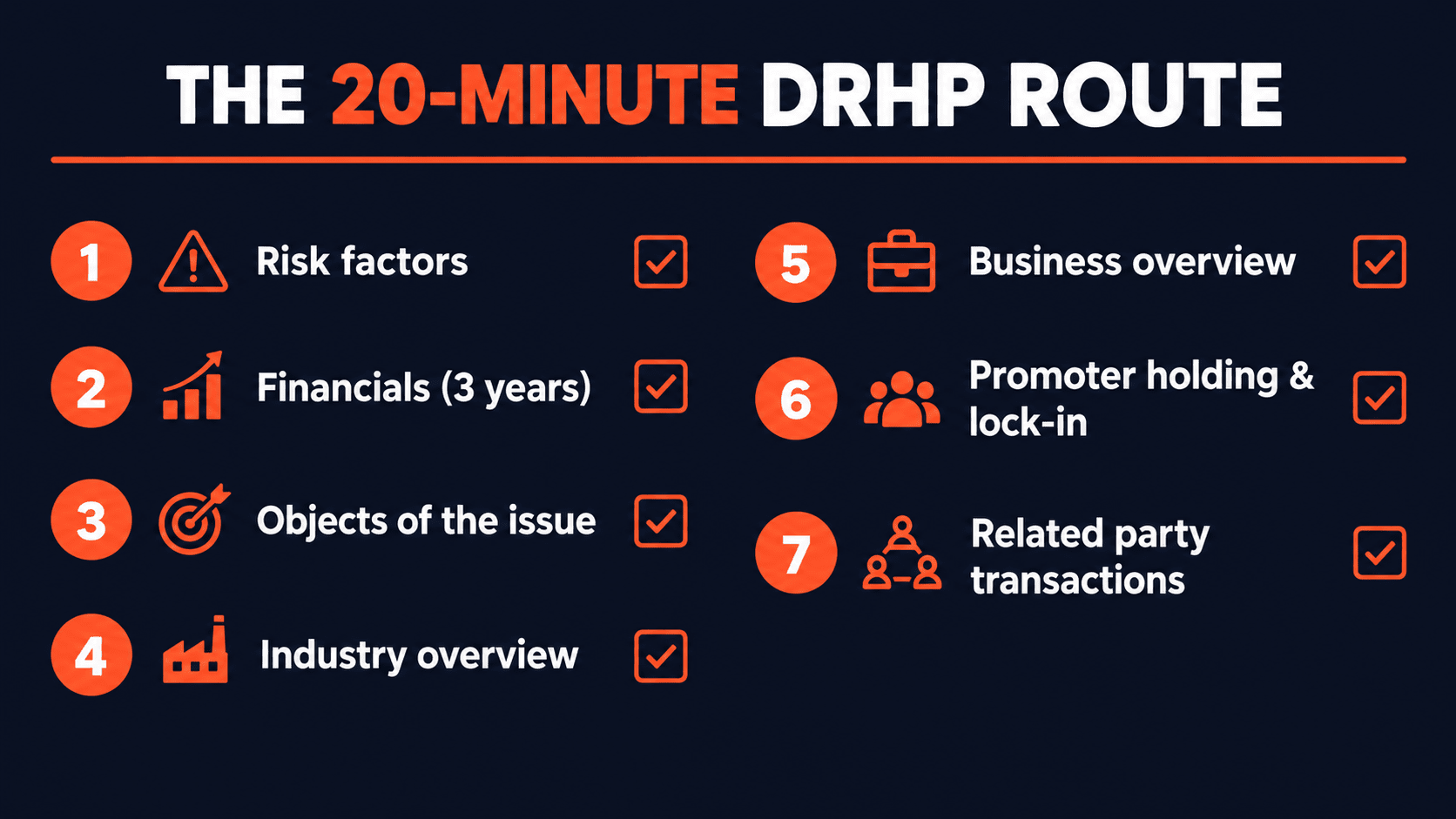
- Risk factors (5 minutes). Usually 50-150 pages near the front. Skip the boilerplate (“our industry is competitive”) and hunt for risks with specific rupee amounts and named entities: a tax dispute, a licence the business depends on, one customer who is 40% of revenue. Those are the real ones.
- Financial statements (5 minutes). Three years of restated accounts. Check four things: is revenue growing, are margins improving, is operating cash flow positive, and are receivable days stable. Profit without cash flow is the oldest trick in the book.
- Objects of the issue (3 minutes). Where does the money go? Fresh capital for expansion and debt repayment is good. A large OFS (offer for sale) means the money goes to selling shareholders, not the company. “General corporate purposes” is capped at 25% for mainboard issues; a maxed-out bucket means vague plans.
- Industry overview (2 minutes). A commissioned report from CRISIL or Frost & Sullivan. Useful for market size and growth claims, but remember the company paid for it.
- Business overview (2 minutes). The company’s own story. Look for customer concentration (top 5 customers’ share of revenue), supplier dependence, and capacity utilisation.
- Promoter holding and lock-in (2 minutes). Who actually owns the company before and after the issue, and how much is pledged. Promoter lock-in is a minimum 20% of post-issue capital for 18 months under SEBI rules. Pledged shares above 30% of the promoter holding are a warning.
- Related party transactions (1 minute). Near the financials. Big loans, purchases or rentals with promoter-owned entities at unclear prices are how value quietly leaks out of companies.
“You only need to read around 30-40 specific pages to make an informed decision.”
IPO Cracker, How to Read a DRHP
A worked example: reading the financials
Let us practise on a made-up company, “Acme Foods”, so we are not judging a real one. The DRHP shows three years of restated numbers:
- Year 1: Revenue Rs 400 crore, net profit Rs 20 crore, operating cash flow Rs 10 crore.
- Year 2: Revenue Rs 520 crore, net profit Rs 36 crore, operating cash flow Rs 5 crore.
- Year 3: Revenue Rs 700 crore, net profit Rs 63 crore, operating cash flow minus Rs 15 crore.
At first glance this is a great story: revenue is up 75% in two years and profit has tripled. Now apply the four checks. Revenue is growing (yes). Margins: net margin went from 5% to 6.9% to 9% (improving). Operating cash flow: Rs 10 crore, then Rs 5 crore, then a negative Rs 15 crore (getting worse, and negative in year 3). That means profits are rising on paper while the business is spending more cash than it brings in. The most common cause is customers paying slowly.
So the fourth check, receivable days, is what you look at next. If the DRHP shows receivables (money owed by customers) rising from 40 days of sales to 90, then Acme is booking sales it has not collected. That could be a growth strategy (extending credit to win customers), or it could be a sign that some of those sales will never be collected. Either way, you have found the question to ask. That is what the DRHP is for.
A second example: objects of the issue
Suppose Acme plans to raise Rs 800 crore. The DRHP’s “Objects of the Issue” says: Rs 300 crore to repay borrowings, Rs 250 crore for a new plant, Rs 100 crore for brand marketing, and the balance of Rs 150 crore for general corporate purposes. Do the maths: general corporate purposes is 150 out of 800, or 18.75%, below the 25% cap, so no flag there. Debt repayment is 37.5%, which is not unusual, but ask: what was that debt used for? If it was borrowed to fund losses, then the IPO is partly a rescue. If it was borrowed to build capacity that now earns money, the story is healthier.
Now imagine the same company, but with Rs 700 crore of the issue as OFS and only Rs 100 crore fresh. Same company, same financials, completely different message: the main use of the IPO is exit. Both can be reasonable. But you should know which one you are reading.
What the notes to the accounts hide in plain sight
Experienced readers spend their time in the small print, because that is where the facts live. Four places to look:
- Contingent liabilities. Disputes with tax authorities, customers or regulators that could cost money if lost. Compare the total with the company’s net worth. If it is a large fraction, the headline profit may be fragile.
- Auditor qualifications. Phrases like “emphasis of matter” or “qualified opinion” are rare and important. An auditor flagging something is telling you where to dig.
- Change in accounting policy. If revenue recognition or depreciation methods changed just before the IPO, find out why. Sometimes it is a good reason; sometimes it flatters the numbers.
- Litigation tables. Pending cases against the company, its promoters and directors are listed by category and amount. A long list of cases against promoters is worth a second look.
The red flags that should make you pause
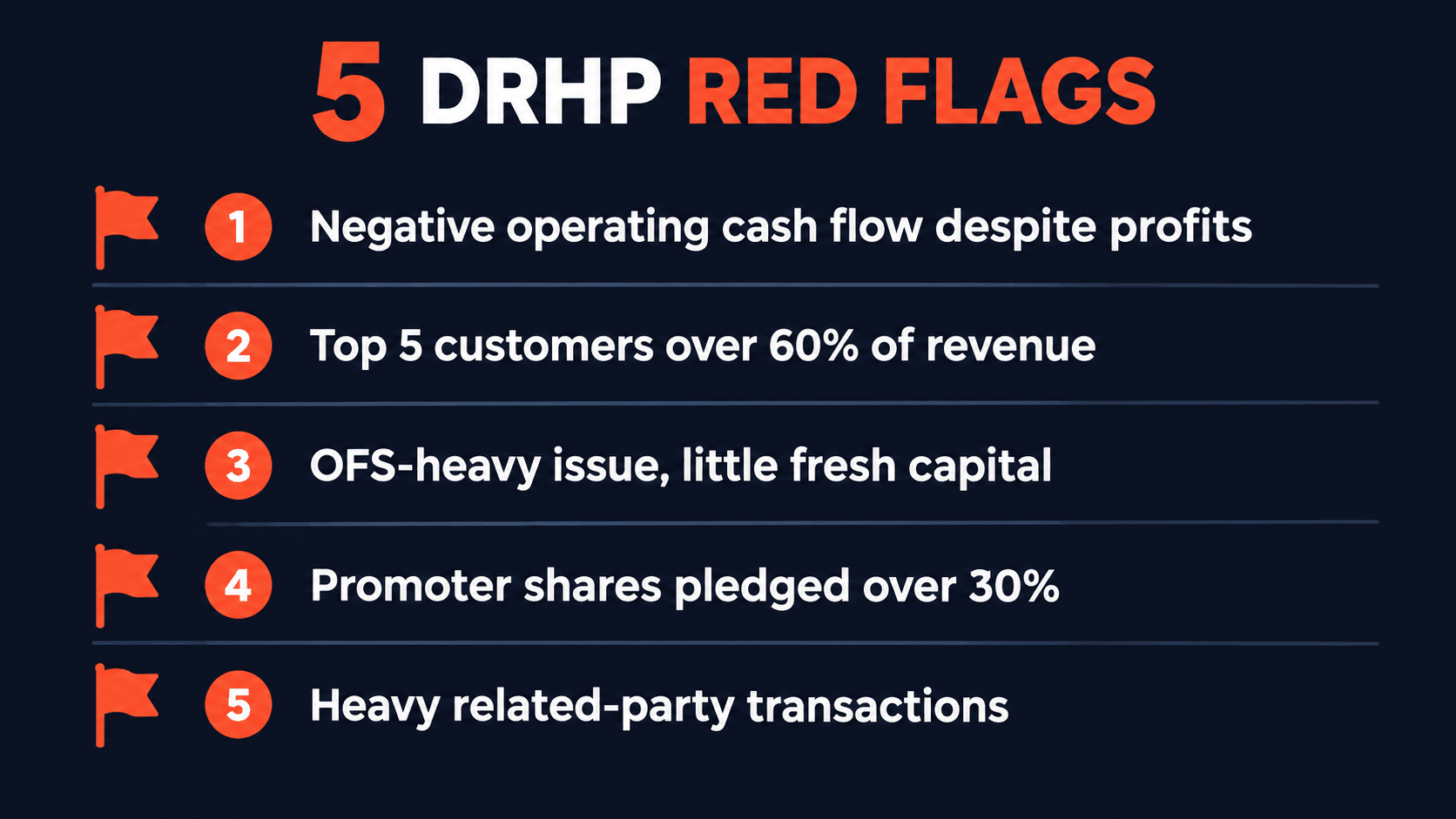
One red flag has a story; three together are a pattern. The ones that matter most:
- Negative operating cash flow for 2+ years despite reported profits
- Top 5 customers above 60% of revenue
- OFS-heavy issue with little fresh capital, the classic exit vehicle
- Promoter shares pledged above 30%
- Heavy related-party transactions at non-arm’s-length pricing
- Pre-IPO placements at prices well below the issue band (someone smart already passed at a lower price)
Valuation: the one number everyone argues about
A DRHP does not give you a valuation. It gives you the ingredients, and the price band later arrives in the RHP. The simplest check is the price-to-earnings (P/E) ratio: the price band divided by earnings per share. If a profitable company’s shares are priced at Rs 300 and it earns Rs 10 per share, the P/E is 30. Compare that with listed rivals. If the rivals trade at 20 and the IPO is priced at 30, you are being asked to pay a premium. Is the growth rate high enough to justify it?
For loss-making companies, P/E does not work, so investors use price-to-sales instead. A company with Rs 1,000 crore of annual revenue valued at Rs 8,000 crore trades at 8 times sales. Again, the question is relative: what are comparable listed businesses valued at, and is this one growing faster or slower?
Some caution. These ratios are rough tools, not answers. A lower ratio is not always better, and a higher one is not always a warning. The point is to anchor the price in something, rather than in how exciting the story feels.
The anchor book and what it tells you
A day before the public issue opens, large institutions are allotted a portion of the shares at the final price. This is the anchor book. It is a useful signal because these investors have read the DRHP carefully and put real money behind their view. If well-known long-term funds are in the book, it suggests the issue passed a serious check. If the book is thin, or the names are unfamiliar, that is information too. Anchor investors also have a lock-in of 30 days on half their shares and 90 days on the rest, which prevents an immediate dump.
Global comparisons: how other markets handle this
India’s DRHP is similar in spirit to the S-1 in the United States, the document Freshworks filed before its Nasdaq listing (see our post on [Freshworks](https://foundnxt.com/freshworks-nasdaq-indias-saas-route-going-public/)). Both are public, both go through regulator review, and both include risk factors, financials and use of proceeds. A difference worth noting: US filings often include a detailed management discussion in plain language, while Indian ones lean toward legal structure and tables. If you read an Indian DRHP and want a faster summary of the narrative, the S-1 style “Management’s Discussion” section, which Indian documents also contain under a similar heading, is the place to look.
A 20-minute checklist you can print
- Risk factors: find three with a rupee amount or a named party.
- Financials: revenue growth, margin trend, operating cash flow, receivable days.
- Objects of the issue: fresh versus OFS, and how large is general corporate purposes.
- Business: top customers, top suppliers, capacity use.
- Promoters: holding before and after, pledges, lock-in.
- Related parties: who, how much, at what price.
- Valuation: P/E or price-to-sales against listed rivals.
If three or more of these raise concerns, step back. If none do, you have still only done a first pass, but it is a better first pass than most applicants ever make.
Important: founders, read your rivals’ DRHPs
Every DRHP is free on sebi.gov.in, bseindia.com and nseindia.com. If a competitor is listing, their DRHP hands you their real margins, customer concentration, growth rates and unit economics, disclosed under oath. It is the best competitive intelligence in Indian tech, and almost nobody in your industry will bother to read it. Pair this with our guides on term sheets explained like you’re five and the 2026 IPO wave.
Enjoying this? The Weekly Founder Brief sends one practical playbook like this to your inbox every week. Subscribe free at foundNXT.com.
Sources
FoundNXT publishes independent business intelligence, valuation frameworks, and startup teardowns. Nothing in this article constitutes financial, investment, legal, or tax advice. Company figures, market projections, and valuation metrics represent editorial estimates and regulatory filings. Always consult qualified legal counsel and certified financial advisors before executing investment rounds or financial agreements.