

📑 Table of Contents
- Loading headings…
Indian startups raised $10.9 billion between January and mid-October this year. On paper, that is a healthy market. So why do so many founders say raising money has never felt harder?
Because both things are true at once. The Tracxn data for January 1 to October 15 shows $10.94 billion raised, about 7% more than the same period last year. Here is the catch: investors wrote 37% fewer cheques to do it. Only 1,253 funding rounds happened in that period, down from 1,982 a year earlier.
Same money. Fewer hands. In this post, we break down where the money actually went in 2026, which sectors investors are betting on, why new founders are feeling locked out, and what you can do about it if you are building right now.
The headline numbers: $10.94B raised across 1,253 rounds (Jan 1 – Oct 15, 2026). Rounds down 36.8% year on year. The average cheque nearly doubled, from $5.15M to $8.73M.
Fewer cheques, bigger amounts
Think of it like the same amount of rain falling on fewer fields. Each lucky field gets more water. Many get nothing at all. That is the simplest way to understand startup funding in 2026.
The total pool of money did not shrink. It barely moved, actually. What changed is how it was divided. The average funding round grew from $5.15 million last year to $8.73 million this year. That means when an investor does decide to back a company, they are going in bigger than before. They are just making that decision far less often.
The concentration at the top is striking. The 10 most-funded startups alone raised $3.92 billion, which is 36 paise of every rupee of venture funding in India this year. Companies like Sarvam AI and Inox Clean Energy were so favoured that they raised money not once but twice within ten months. Meanwhile, hundreds of good companies outside that small circle heard “no” or, worse, heard nothing.
Why are investors behaving this way? After the funding winters of recent years, venture capital firms have become careful about where they park money. Instead of placing many small bets and hoping a few win, they are picking companies they already believe in and doubling down. It is safer for them. For founders, it means the bar to get noticed at all is much higher.
AI took the crown
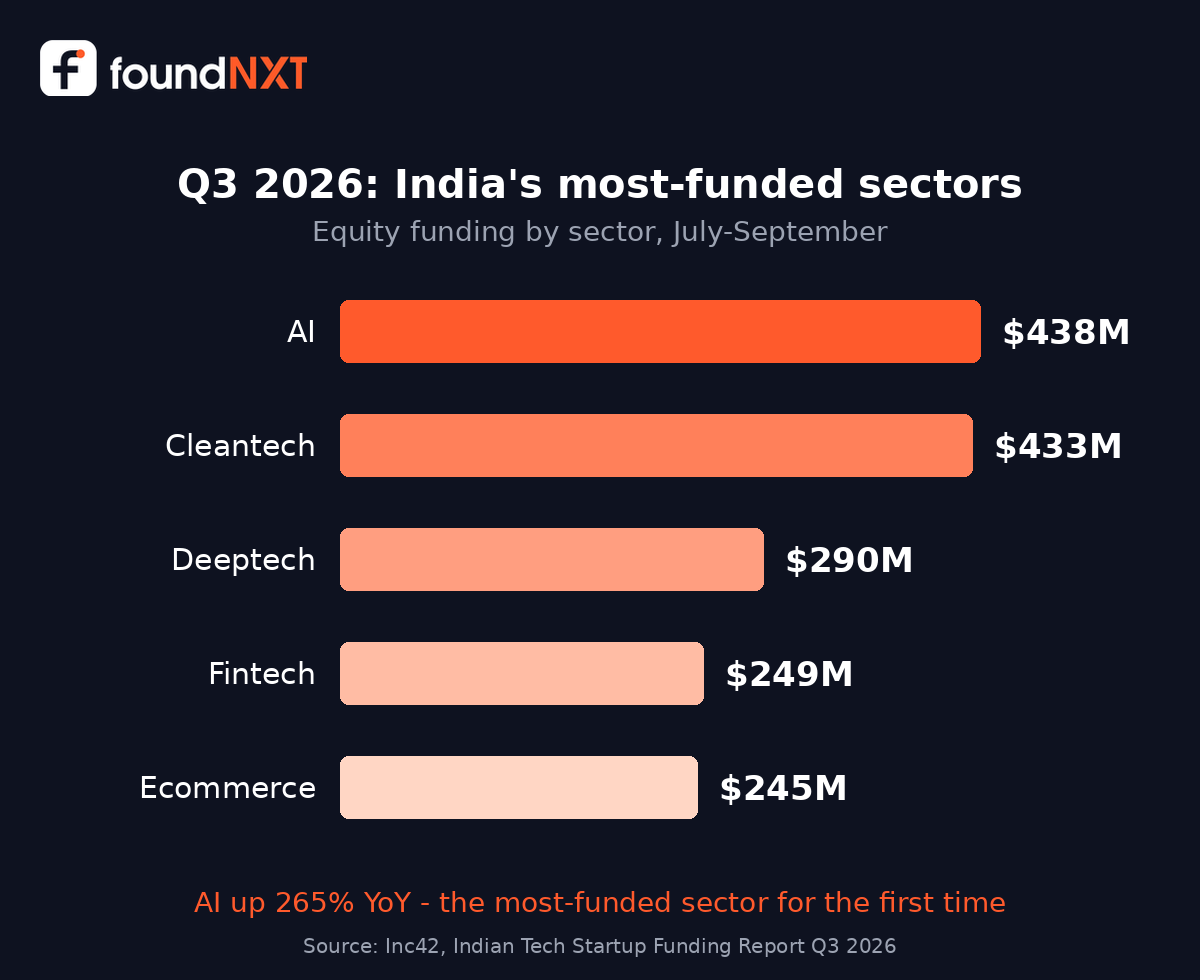
Now for the biggest story of the year. In Q3, the July to September quarter, AI became India’s most-funded startup sector for the first time ever. AI startups raised $438 million across 35 deals, up 265% compared to the same quarter last year, according to Inc42’s funding report. No sector has ever jumped to the top that fast.
To understand how concentrated even AI funding is, look at one deal: a company called Emergent raised $130 million in the quarter. That single round was the largest of the quarter and made up nearly a third of all AI money. So even inside the hottest sector, a handful of companies are taking most of the cash.
AI was not the only winner. Cleantech finished just $5 million behind, raising $433 million, driven by India’s push into clean energy and electric mobility. Deeptech funding climbed 176% to $290 million. Deeptech means startups built on hard science and engineering: spacetech, semiconductors, defence technology. These are businesses that take years to show results, so the money flowing into them is patient capital from investors willing to wait a long time for a payoff. That is a big shift in a market that used to chase quick consumer apps.
One honest note before you rewrite your pitch deck to include AI: in Inc42’s investor survey, 63% said AI valuations already look frothy. Frothy means prices are running ahead of what the businesses may actually be worth. Investors are still writing AI cheques, but many privately admit they might be overpaying. Money chasing a hot sector does not mean every startup in it deserves the price it is asking, and a correction later can hurt the honest companies too.
The first cheque is now the hardest
If there is one group this market is toughest on, it is brand-new founders. Seed funding, the very first institutional money a startup raises, fell 37% to $698 million in the first nine months of 2026, down from $1.1 billion a year earlier.
Here is the number that should worry every first-time founder: only 338 companies got funded for the first time this year, down 30% from last year. Out of thousands of startups being built across India, a few hundred managed to convince an investor to take a first chance on them.
Why? When money gets selective, investors fall back on pattern matching. A founder who has built and sold a company before feels safer than an unknown name, even if the unknown name has the better idea. Funds would rather back a repeat founder’s average idea than a newcomer’s brilliant one. It is not fair, but it is how risk works when capital is cautious.
The fix: show traction, not decks. Pre-orders, pilots, a paying waitlist, real revenue. Anything that proves a stranger will give you money. A repeat founder can raise on reputation. A first-time founder in 2026 raises on proof. In this market, proof raises rounds. Stories alone do not.
2026 is not a bad year to build. It is a selective year to fund. The money is there; what has changed is what it takes to unlock it.
So what should a founder do with this?
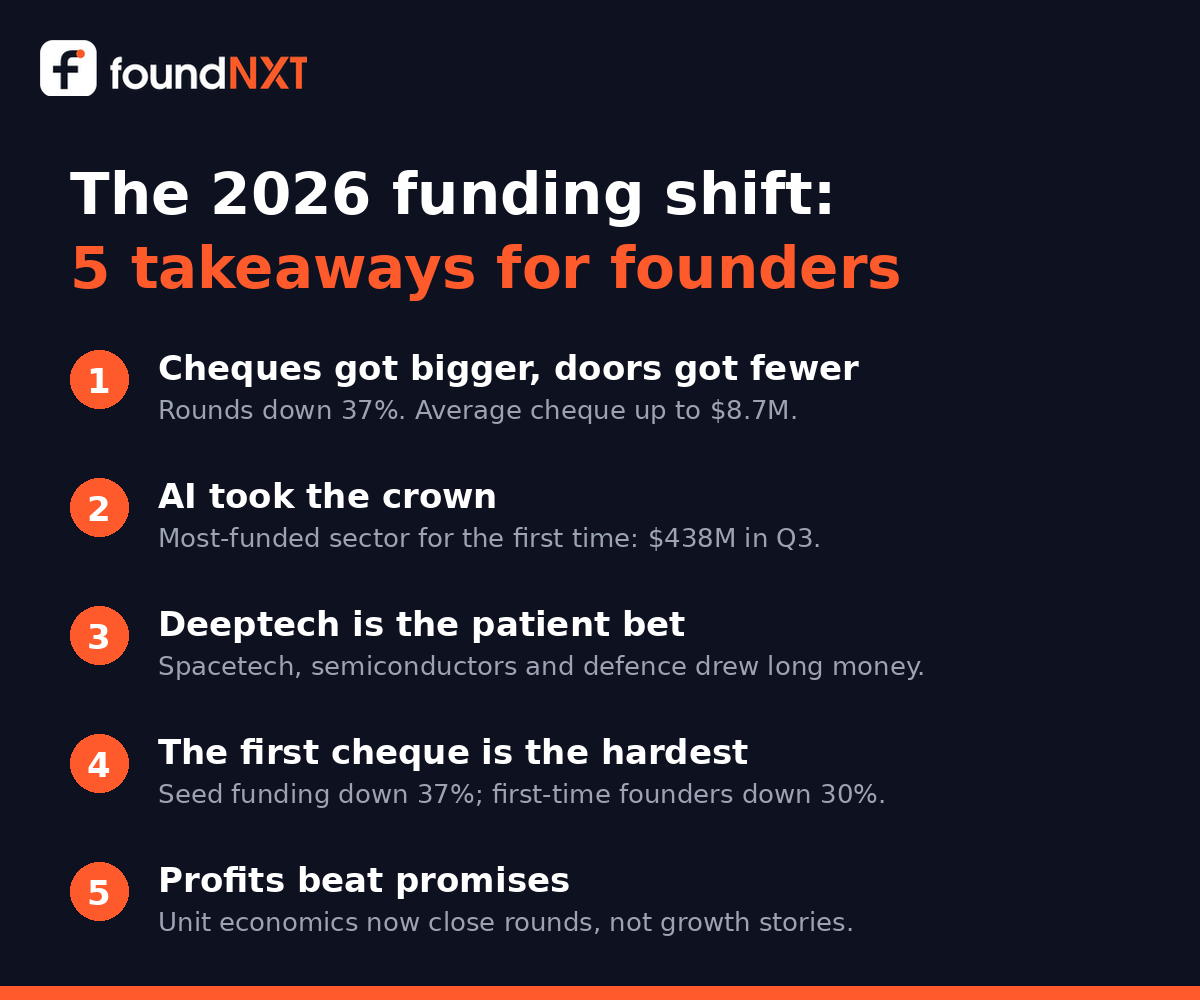
Five takeaways from the 2026 numbers, explained:
- Cheques got bigger, doors got fewer. Rounds are down 37%, but the average round nearly doubled to $8.73M. If an investor decides to back you, they will likely back you properly. The real challenge is getting through the door at all, so treat every warm introduction and every pitch like it is your only shot.
- AI took the crown. It is the most-funded sector for the first time, with $438M in Q3. But investors can now spot an “AI-washed” deck in minutes. If AI is genuinely core to your product, say exactly how. If it is a feature you bolted on for the pitch, leave it out. Authenticity is filtering faster than hype.
- Deeptech is the patient bet. Spacetech, semiconductors and defence are attracting long-term money. If you are building something hard that takes years, 2026 is actually your moment. The investors entering these sectors know they will wait, and they have priced that patience in.
- The first cheque is the hardest. Seed is down 37% and first-time founders are down 30%. Plan to bootstrap longer than you hoped. Build something small that earns before you raise, because revenue is the one argument no investor can talk you out of.
- Profits beat promises. The question investors ask first has changed. It used to be “how big can this get?” Now it is “how does this make money?” Know your unit economics: what you earn per customer minus what it costs to serve them. If that number is positive and improving, you are already ahead of most pitches they heard this week.
The bottom line
2026 is not a bad year to build. It is a selective year to fund. The money is there, all $10.9 billion of it, sitting with investors who want to deploy it. What has changed is what it takes to unlock it. A good story and a big market used to be enough. Today you need evidence: customers who pay, costs that make sense, and a clear reason your company is one of the few worth a bigger cheque.
Fewer doors are open, so make your one knock count. Founders who understand this shift early will waste less time pitching the wrong way and more time building the proof that actually raises money.
Your turn: is funding genuinely harder this year, or just different? Tell us in the comments. And if you want numbers like these in your inbox every week, join the Weekly Founder Brief, foundNXT’s free newsletter. Sign up below.
Sources
- ETEntrepreneur: Inside India’s startup funding recovery (Tracxn data, Oct 2026)
- Business Standard: India’s VC funding stays flat at $10.9 billion in 2026 (Oct 2026)
- Inc42: Indian AI startup funding surges 265% YoY in Q3 2026
- Inc42: Startup funding crawls up 5% YoY to $2.2B in Q3 2026
- StartupFeed: India seed funding falls 37% to $698M in 9M 2026 (Tracxn)
FoundNXT publishes independent business intelligence, valuation frameworks, and startup teardowns. Nothing in this article constitutes financial, investment, legal, or tax advice. Company figures, market projections, and valuation metrics represent editorial estimates and regulatory filings. Always consult qualified legal counsel and certified financial advisors before executing investment rounds or financial agreements.