

📑 Table of Contents
- Loading headings…
A founder we know signed his first term sheet in 40 minutes. It looked standard, his investors were friendly, and the valuation was higher than he expected. Three years later the company was acquired, and he discovered that one word in that document, “participating”, moved Rs 16 crore out of his pocket in a Rs 100 crore exit. The valuation was never the real number. The clauses were.
“The valuation was never the real number. The clauses were.”
A term sheet is the document you get before the money. It is not the final legal agreement; it is the summary of the deal, usually two to five pages, that says how much an investor will put in, at what valuation, and on what conditions. Most of it is not legally binding, but once you sign it, renegotiating later is almost impossible. So this is the document to understand. Here it is in plain language.
Important note: Most of a term sheet is not legally binding, but once you sign it, renegotiating later is almost impossible. Treat every clause as final before the signature, not after.
The two numbers everyone sees, and the clauses that matter more
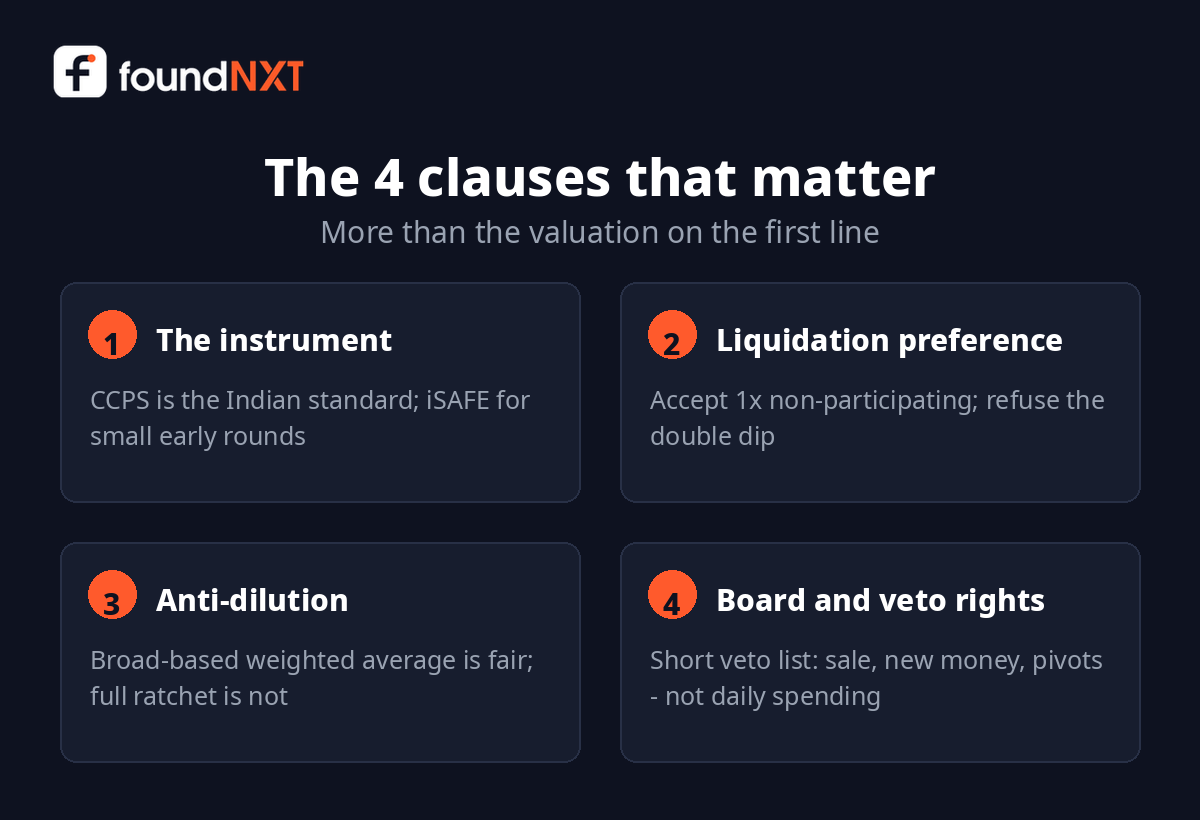
Every term sheet has two headline numbers: how much money comes in, and at what valuation. Founders obsess over these because they are simple and they feel like a score. Investors know the real deal lives in the clauses below. Four of them decide who actually makes money when things go well, and who gets hurt when they go badly.
Clause 1: the instrument
In the US, early rounds often use a SAFE, a one-page agreement that converts into shares later. In India, a US-style SAFE does not fit the law cleanly, because foreign exchange rules (FEMA) require shares to be priced properly when money comes in. So Indian institutional rounds mostly use CCPS: compulsorily convertible preference shares. These are special shares that must eventually convert into ordinary shares, and they carry the protective clauses investors want. You may also see CCDs (compulsorily convertible debentures, which start as debt) or an iSAFE, an India-adapted SAFE used mostly in small early rounds and bridge rounds.
You do not need to pick the instrument yourself; your lawyer does. But know this: whatever it is called, the clauses attached to it matter more than its name.
Clause 2: liquidation preference
This clause decides who gets paid first when the company is sold or shut down. “1x non-participating” is the founder-friendly market standard in India: if the company is sold, the investor takes back either their investment amount or their percentage share of the sale price, whichever is higher. Fair enough.
The dangerous version is “participating”, sometimes called the double dip. The investor first takes their money back, and then also takes their percentage of whatever is left. Here is the math on a Rs 100 crore exit where an investor put in Rs 20 crore for 20%. Non-participating: they take the higher of Rs 20 crore or Rs 20 crore (20% of 100), so Rs 20 crore. Participating: they take Rs 20 crore first, then 20% of the remaining Rs 80 crore, so Rs 36 crore. One word cost the founders Rs 16 crore.

The rule of thumb: Accept 1x non-participating as standard. Treat anything above 1x, or any participating preference, as a red flag you push back on hard, no matter how good the valuation looks.
Clause 3: anti-dilution
This protects the investor if your next round is a down round, meaning it prices shares lower than what they paid. Anti-dilution adjusts their conversion price downward, giving them extra shares to compensate. The question is how harsh the adjustment is.
Full ratchet is the brutal version: all their shares get repriced as if they had invested at the new lower price. Broad-based weighted average is the market standard: a formula adjusts the price partially, weighing old and new, so the pain is shared. At Indian seed rounds, broad-based weighted average is the normal ask. Full ratchet is rare and worth refusing, because it can quietly transfer a huge slice of the company away from founders after one bad round.
Clause 4: board and control rights
Term sheets also say who sits on your board and which decisions need investor consent. A board seat for the lead investor is normal at Series A and later. At seed, a board observer or no seat at all is common. What to watch is the veto list, often called reserved matters: decisions the company cannot take without investor approval. A short, sensible list (selling the company, raising new money, changing the business entirely) is fine. A long list covering hiring, budgets and daily spending hands control of your company to someone else while you still own most of it.
The clauses that cost founders crores
Three patterns show up again and again in deals that went wrong:
- A high valuation paired with a 2x participating preference. The headline number is bait; the clause claws it back at exit.
- Full ratchet anti-dilution accepted “because we will never do a down round”. Then the market turns, and one down round wipes out years of founder equity.
- A veto list so wide that the founder needs permission to hire a senior executive or sign a large lease.
The counter-intuitive lesson: a slightly lower valuation on clean terms is usually worth more than a higher valuation loaded with these clauses. Clean terms keep your future rounds simple, and every later investor reads the old term sheets before writing a new one. Poison clauses compound.
What to actually do when one lands
First, slow down. A term sheet is not a prize with an expiry timer, and any investor who says “sign by Friday” is using pressure as a tactic. Second, hire a startup lawyer who does venture deals regularly, not a general family lawyer. This costs Rs 50,000 to Rs 2 lakh for a seed round and is the best money you will spend in the entire raise. Third, negotiate the clauses, not just the valuation. Investors expect it, and how you negotiate tells them how you will run the company.
And remember what a term sheet is not: it is not money in the bank. Between signing and the cash arriving sit due diligence and the final legal documents, which usually follow the term sheet’s clauses exactly. Every clause you accept now, you will live with for years.
Your turn: have you ever found a nasty surprise in a term sheet, or pushed back on a clause and won? Share your story in the comments. And if you want more plain-English guides like this in your inbox every week, join the Weekly Founder Brief, foundNXT’s free newsletter. Sign up below.
Sources
FoundNXT publishes independent business intelligence, valuation frameworks, and startup teardowns. Nothing in this article constitutes financial, investment, legal, or tax advice. Company figures, market projections, and valuation metrics represent editorial estimates and regulatory filings. Always consult qualified legal counsel and certified financial advisors before executing investment rounds or financial agreements.