
📑 Table of Contents
- Loading headings…
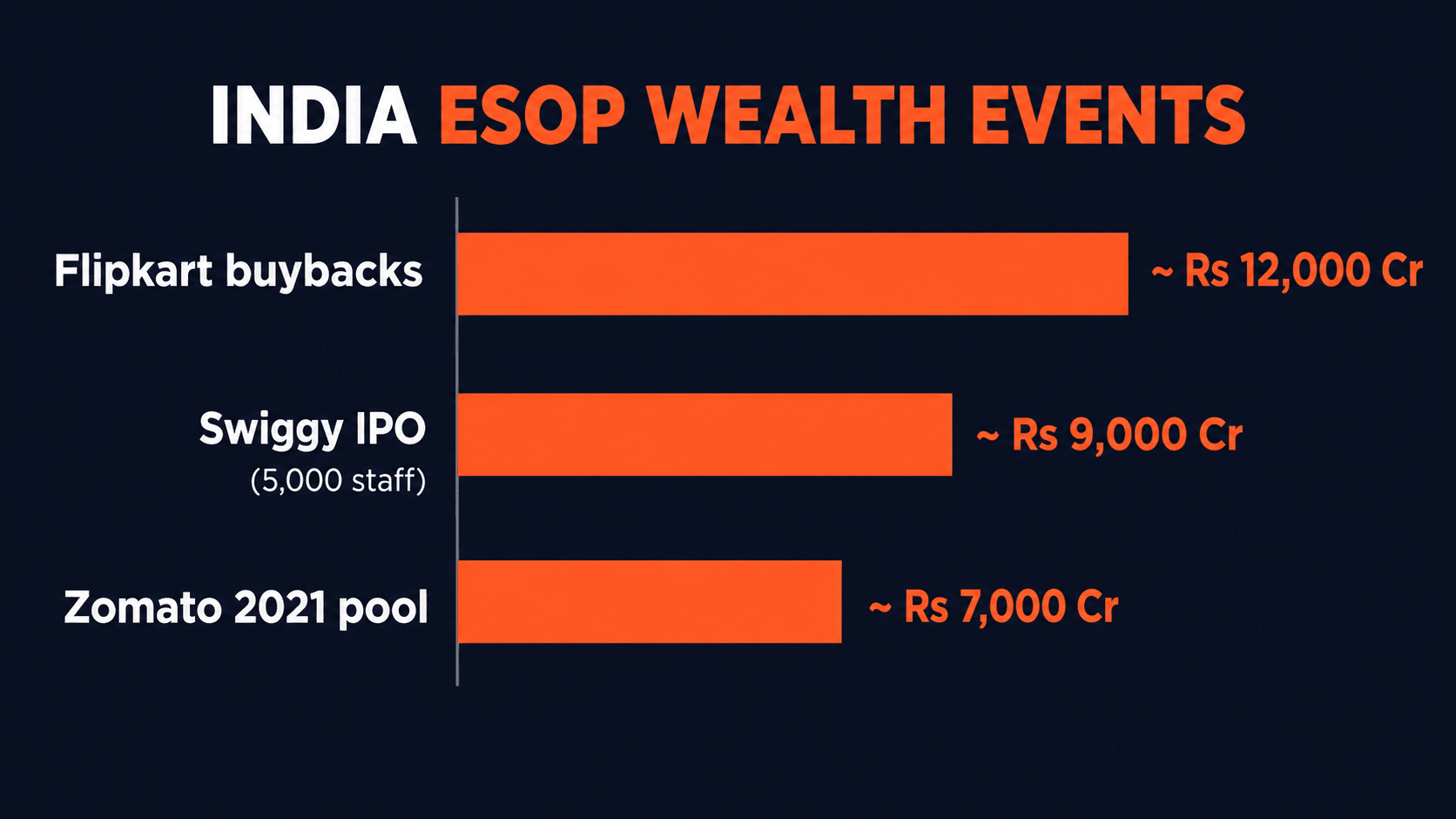
When Swiggy listed in November 2024, around 500 of its employees became crorepatis, and about 5,000 current and former staff shared roughly Rs 9,000 crore of ESOP wealth. It was one of the largest employee wealth events in Indian startup history, and it was not a one-off: Flipkart had already returned $1.4-1.5 billion to employees through buybacks, and Zomato’s 2021 listing came with an ESOP pool worth about Rs 7,000 crore. If you hold ESOPs in a startup that might list, this post explains how paper options turn into real money at an IPO, what the tax department takes, and the four things to check in your grant letter today.
What an IPO actually does to your options
An ESOP is a right to buy shares at a fixed exercise price, usually set low when you join. Before listing, that right is mostly theoretical: you can own the shares, but there is nobody to sell them to. An IPO changes three things at once:
- Liquidity. Your shares can now be sold on the exchange, often after a lock-in. This is the whole game. Wealth you can sell is wealth; wealth you cannot is wallpaper.
- A public price. The market now prices your shares every second, replacing the last funding round’s negotiated number. Sometimes that is a pleasant surprise; sometimes, as employees of companies that listed below their last private valuation learned, it is not.
- Vesting accelerations and exercises. Many companies run special exercise or buyback windows around the IPO so employees can convert options to shares in time to sell them.
A worked example: from grant to bank account
The numbers below are illustrative, not from any real company, but they follow the structure of real ESOP grants. Say you join a startup and are granted 10,000 options with an exercise price of Rs 100 each, vesting over four years. After four years, all 10,000 have vested. The company lists, and the stock trades at Rs 600.
Step one: you exercise. Your cost to buy the shares is 10,000 x Rs 100 = Rs 10 lakh. That is cash you have to find. If the company’s fair market value (FMV) on the exercise date is Rs 500, say, the perquisite is (Rs 500 – Rs 100) x 10,000 = Rs 40 lakh. That Rs 40 lakh is taxed as salary income, and at a 30% rate (plus surcharge and cess, so let us say about 35% for simplicity) the tax is about Rs 14 lakh. So the cash you need on exercise day is about Rs 24 lakh (Rs 10 lakh to buy, Rs 14 lakh for tax), and you are holding shares you have not yet sold.
Step two: you sell. If you sell at Rs 600 after more than 12 months of holding the listed shares, your gain over FMV is (Rs 600 – Rs 500) x 10,000 = Rs 10 lakh. Long-term capital gains at 12.5% on the amount above the annual exemption is roughly Rs 1.1 lakh of tax. Your total sale proceeds are Rs 60 lakh.
Step three: add it up. Rs 60 lakh in, minus Rs 10 lakh exercise cost, minus about Rs 14 lakh perquisite tax, minus about Rs 1.1 lakh capital gains tax, leaves roughly Rs 35 lakh. So a “Rs 50 lakh gain on paper” (Rs 600 minus Rs 100, times 10,000) turns into about Rs 35 lakh in your pocket. Taxes and the cost of exercise took about 30%.
The point of the example is not the exact figure. It is the shape: tax arrives first, on a price you have not yet received, and the cash outlay on exercise day can be larger than most employees expect.
What if the price falls?
Now suppose that instead of Rs 600, the stock drops to Rs 350 by the time your lock-in ends. You still paid the perquisite tax on the Rs 500 FMV, so your tax bill is unchanged at about Rs 14 lakh. But your sale proceeds are only Rs 35 lakh. After the Rs 10 lakh exercise cost and Rs 14 lakh of tax, you are left with about Rs 11 lakh, and you have a capital loss of Rs 15 lakh (Rs 350 minus Rs 500, times 10,000) that you can only set against other capital gains.
This is the real risk of exercising early and holding. Tax is calculated on the value at exercise, not the value at sale. Employees who exercise in a rising market and then see a fall can pay tax on gains they never keep. That is why many advisers suggest timing your exercise and sale together where the rules allow, rather than exercising and hoping.
Lock-ins: when can you actually sell?
After an IPO, not everyone can sell on day one. The rules in broad terms: shares held by promoters have a lock-in of 18 months on the minimum contribution, while employees holding shares under an ESOP plan are generally treated more favourably, and employee shares are often exempt from the longer pre-IPO lock-ins, provided the ESOP was set up under SEBI’s rules. Some companies still impose their own shorter lock-in, say six months, to avoid a flood of selling. Your plan document and the offer document (the RHP) will say exactly which applies to you.
This matters for planning. If you have a large tax bill at exercise and cannot sell for six months, you may need to borrow or sell other assets to pay it. Some companies help with this through cashless exercise or sale-to-cover arrangements, where a portion of your shares is sold to pay the tax. Ask HR which options exist well before the IPO, not after.
The math employees forget: tax
In India, ESOPs are taxed twice, and the first bite is the painful one:
- At exercise: the difference between the fair market value (FMV) and your exercise price is taxed as a salary perquisite, at your income tax slab rate, up to 30% plus surcharge and cess. Your employer deducts this as TDS, which means you often owe real cash tax on shares you have not sold yet.
- At sale: any further gain over the FMV is taxed as capital gains. For listed shares, holding for more than 12 months qualifies as long-term, currently taxed at 12.5% above the Rs 1.25 lakh annual exemption; shorter holds are taxed at 20%. Unlisted shares have their own (generally harsher) rules and a 24-month long-term threshold. Rates change in budgets, so verify current numbers before you plan.

“Swiggy’s employee stock option payout exercise will be among the top ones in India’s startup scene, where companies generating wealth at this scale is rare.”
Moneycontrol
Four things to check in your grant today
- Vesting schedule and cliff. Typically 4 years with a 1-year cliff. Know exactly how many options are vested today.
- Exercise window after exit. Many plans give you just 30-90 days to exercise after you leave, forcing a painful decision (and a tax bill) on your way out. The best plans allow years.
- Exercise price vs today’s value. Your upside is the gap between the two, minus tax. An IPO price below the last round’s valuation can shrink that gap fast.
- Dilution. New rounds and pool top-ups shrink your percentage. Track your ownership as a percentage, not just an option count.
Selling smart: a few rules of thumb
Once you can sell, the next decision is how much. There is no formula, but these principles hold up well:
- Do not hold more than you can afford to lose in one stock. If your employer’s shares are already your job, your reputation and your future bonuses, owning a large amount of the same stock concentrates risk. Many advisers suggest selling enough to cover taxes, debt and near-term needs first.
- Sell in tranches. Rather than choosing one day, sell a portion each month or quarter. This reduces the chance of regretting a single poor price.
- Respect the 12-month line. If a sale is close to the long-term threshold, waiting a few weeks can cut the tax rate substantially, provided the risk of a price fall is acceptable to you.
- Know the blackout windows. Insiders usually cannot trade near earnings announcements or while holding unpublished price-sensitive information. Breaking these rules can lead to serious penalties.
- Keep records. Exercise date, FMV, tax deducted and sale price all matter at filing time. Save the payslip and the broker statement.
Comparing the three big wealth events
The post opened with Flipkart, Swiggy and Zomato, and each one shows a different mechanism. Flipkart’s employee wealth came mainly through buybacks, where the company or investors bought back vested shares at an agreed price, without a public listing. Swiggy’s came through the IPO, where employees could sell on the exchange after lock-ins. Zomato’s came through a mix: a large ESOP pool granted over years, with value realised after listing as the share price moved.
The lesson for employees: the route matters. A buyback gives a known price and date but only if the company offers one. An IPO gives liquidity but with market risk. A pool granted early at a low strike price has the most upside but also the most waiting. If you are choosing between offers, ask how past employees actually cashed out, not just how many options they held.
Questions to ask before you join a startup
- What percentage of the company does this grant represent, on a fully diluted basis?
- What is the exercise price, and how does it compare with the last round’s price?
- What happens to my vested options if I leave? How long do I have to exercise, and is financing available?
- Has the company ever run a buyback or liquidity window? How often, and for whom?
- What is the plan if the company is acquired? Do unvested options accelerate?
If the recruiter cannot answer these, ask for the plan document and read it yourself. The answers are in there, and an unclear answer is itself a signal.
A short note on international comparisons
In the United States, employees usually receive either incentive stock options or non-qualified options, with different tax rules, and many companies run regular secondary sales so employees can sell some shares before an IPO. In India, secondary sales exist but are less common, which is why the IPO moment carries so much weight. Longer post-exit exercise windows are one way startups here compete for talent, so check yours.
Disclaimer
Tax rules change in every budget, and the figures in the worked examples are simplified to show the logic, not to calculate your own bill. Before exercising or selling, speak to a chartered accountant who knows ESOP taxation and can run your exact numbers.
Important: the founder side of the table
ESOPs are also a founder’s tool, and the IPO wave has made them a recruiting weapon: candidates now ask about exit windows and exercise terms, not just option counts. A 10-15% pool, a post-departure exercise window measured in years, and honest communication about dilution will beat a bigger salary offer for the hires who matter most. More on this in India’s AI talent war and term sheets explained like you’re five. And if you are the employee: read the plan document, not the offer letter summary. The plan is what pays you.
Enjoying this? The Weekly Founder Brief sends one practical playbook like this to your inbox every week. Subscribe free at foundNXT.com.
Sources
FoundNXT publishes independent business intelligence, valuation frameworks, and startup teardowns. Nothing in this article constitutes financial, investment, legal, or tax advice. Company figures, market projections, and valuation metrics represent editorial estimates and regulatory filings. Always consult qualified legal counsel and certified financial advisors before executing investment rounds or financial agreements.