

📑 Table of Contents
- Loading headings…

On 1 July 2025, the Union Cabinet approved something Indian science had asked for over decades: a Rs 1 lakh crore Research, Development and Innovation (RDI) scheme. By February 2026, its first call was offering companies collateral-free loans at 2-4% interest for up to 15 years, covering half the cost of serious R&D projects. That is a very strange loan. No bank lends like that, and no venture fund waits like that. It has a name: patient capital. This post explains what it is and where an Indian founder actually finds it.
Patient capital, in one minute
Normal venture capital is impatient by design. A VC fund lives for about ten years, so it needs your startup to become worth many times more, and visibly so, within five to seven. That works beautifully for software, where a product can scale in 18 months. It breaks down for deeptech: a rocket, a chip, a new material or a drug can spend five years in a lab before its first rupee of revenue. Patient capital is money structured for that reality: long tenures, low or no expectation of quick exits, and comfort with years of risk before results.
Deeptech does not need smarter money. It needs slower money.
Why India suddenly has some
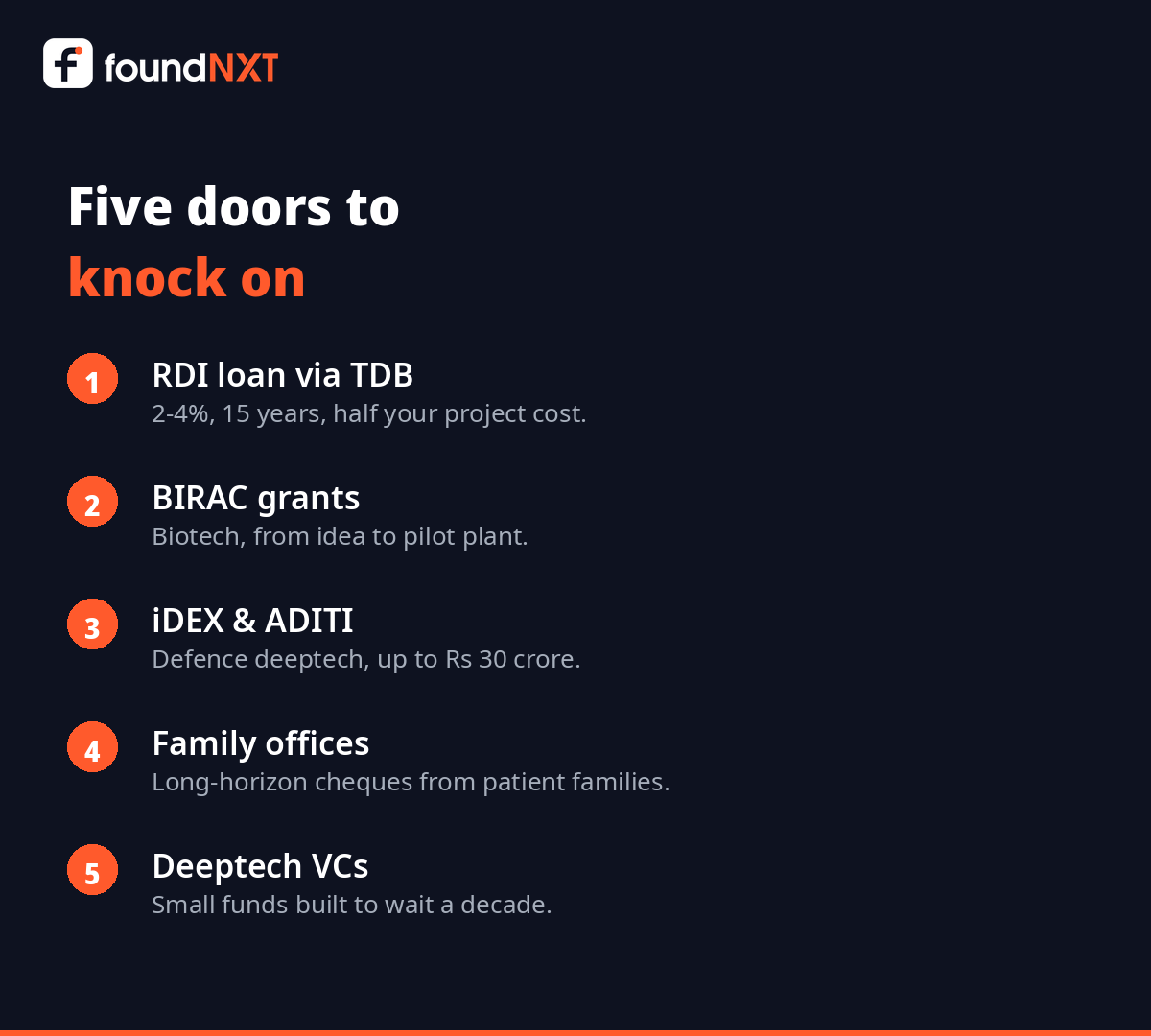
The RDI scheme is the headline. Run under the Anusandhan National Research Foundation (ANRF), it spends its Rs 1 lakh crore over six years on “high-risk, high-impact” innovation, explicitly including deeptech. The first call, opened by the Technology Development Board in February 2026, tells you what patient means in practice: loans at 2-4% (home-loan money is 8-9%), tenures up to 15 years, no collateral, funding up to 50% of project cost, and a promised 8-week approval timeline. The first priority sectors, named in January 2026, read like a deeptech wishlist.

Where to find it in India, beyond the RDI
Grants that never ask for equity. BIRAC funds biotech from idea to pilot. iDEX and its ADITI sub-scheme (Rs 750 crore outlay) fund defence deeptech, with grants up to Rs 30 crore per project. These are the most patient money in the country: they want a working technology, not an exit.
Family offices. India’s rich families, many of whom built businesses over decades, think in longer cycles than funds. When rocket startup Agnikul needed growth money, its co-founder has said it turned to family offices, because the venture ecosystem’s time horizons were too short for rockets.
Dedicated deeptech funds and strategic corporates. A small band of Indian funds, names like Speciale Invest and pi Ventures, writes cheques into deep science and waits. Increasingly, large companies play the role too: HCLTech did not just invest in AI startup Sarvam’s round in June 2026, it put in $150 million as lead, betting on a capability it wants for a decade.
The global template
America solved this problem decades ago by making the government the patient first customer and first funder: DARPA funds wild research, the SBIR programme gives small firms R&D grants, and In-Q-Tel invests for the intelligence community. GPS, the internet and Siri all came out of that pipeline. India’s RDI scheme, iDEX and BIRAC are recognisably the same idea, adapted for a country that wants its own rockets, chips and drugs. We mapped the government end of this in Free Government Money.

The fix: if you are building something deeptech, do not pitch a normal VC first and take the rejection personally. Match the money to the timeline: grants and RDI loans for the lab years, strategic or family money for the scale-up years, VC only when revenue is in sight. The wrong money is more dangerous than no money.
Patient capital is the quiet reason India’s deeptech wave exists at all. The rockets and chips get the photographs. The 15-year loans make them possible.
Five doors to knock on
One warning before you celebrate. Patient capital is not free money. RDI loans come with milestone reviews and audits. Grants come with deliverables. Family offices come with expectations and relationships to manage. What changes is the clock, not the accountability. You are buying time to do hard science properly; you still have to do it.
The founders who will use this best are the ones who treat patience as a design constraint from day one: pick problems where a decade of work compounds, structure the company so no single impatient investor can force a premature sale, and stack the slow money, grant on loan on strategic cheque, the way the best deeptech companies abroad already do.
How big is the gap the RDI is filling? Consider the scale mismatch it fixes. A deeptech startup needing Rs 40 crore over six years of lab work had three bad options before 2025: give away most of the company to VCs who needed it to grow faster than physics allows, beg for small grants that covered months rather than years, or die in what investors call the valley of death, the gap between a proven lab result and a sellable product. A 15-year, low-interest loan for half the project cost is designed to carry a company exactly across that valley. It will not suit everyone; for software, normal VC remains faster and simpler. But for the rocket, chip and drug builders, it is the first financial product in India that matches the shape of the work.
Your turn: if you are building something that needs ten years, where are you finding money that waits? Tell us in the comments. And for one plain-English read like this every week, join the Weekly Founder Brief, foundNXT’s free newsletter. Sign up below.
Sources
- ANRF: the Research, Development and Innovation Fund
- ANRF: RDI funding modalities and amounts
- PIB: Cabinet approves the Rs 1 lakh crore RDI scheme (Jul 2025)
- PIB: TDB launches the first RDI call, loans at 2-4% for 15 years (Feb 2026)
- PIB: sunrise sectors identified under the RDI Fund (Jan 2026)
- Moneycontrol: long-term investment over short-term gain (May 2025)
- Outlook Business: drones and space startups lack growth-stage capital (Jan 2026)