

📑 Table of Contents
- Loading headings…

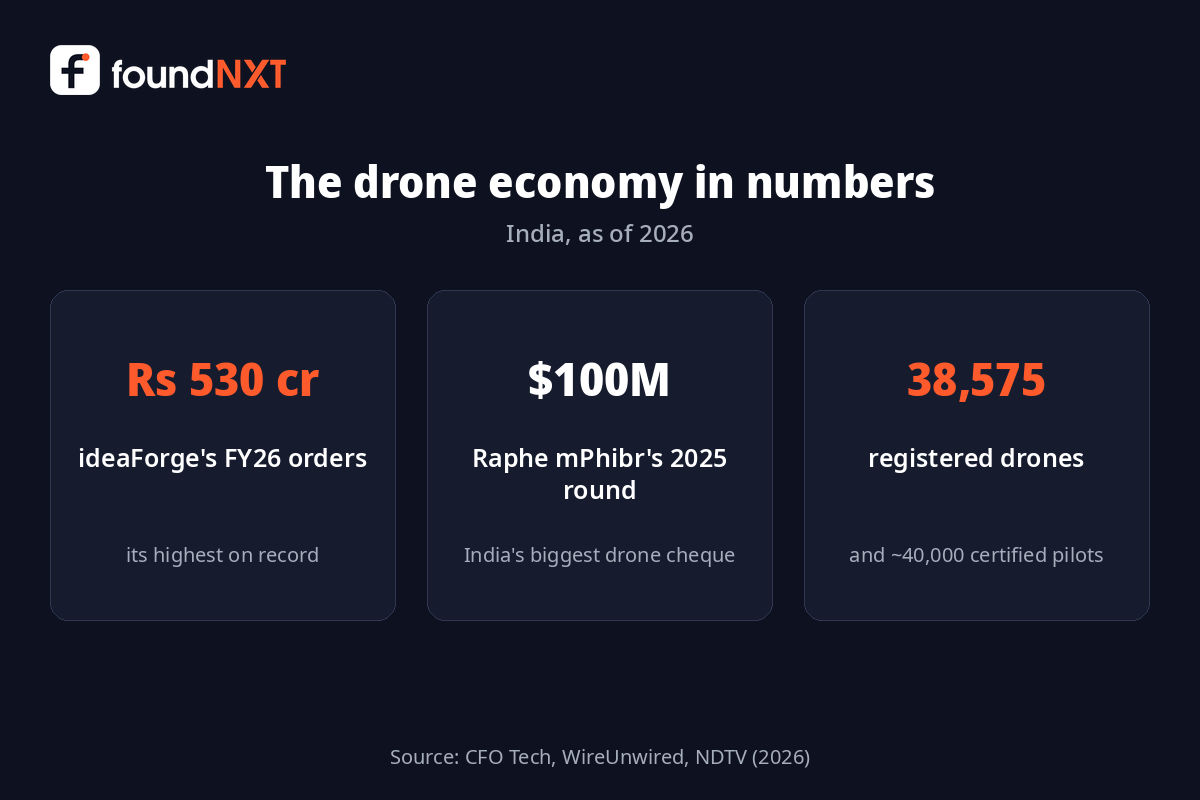
Between January and mid-October 2026, India’s drone industry quietly stacked up a set of numbers that would have sounded imaginary five years ago. ideaForge, the listed drone pioneer, closed its best year ever with about Rs 530 crore in new orders and launched armed and hybrid versions of its ZOLT drone on 6 October. The country had 38,575 registered drones and nearly 40,000 certified remote pilots as of February 2026. The same basic machine now films weddings in Coimbatore, sprays cotton in Vidarbha and watches the border in Kashmir. Here is how that happened, and where the money is.
How India got a drone industry
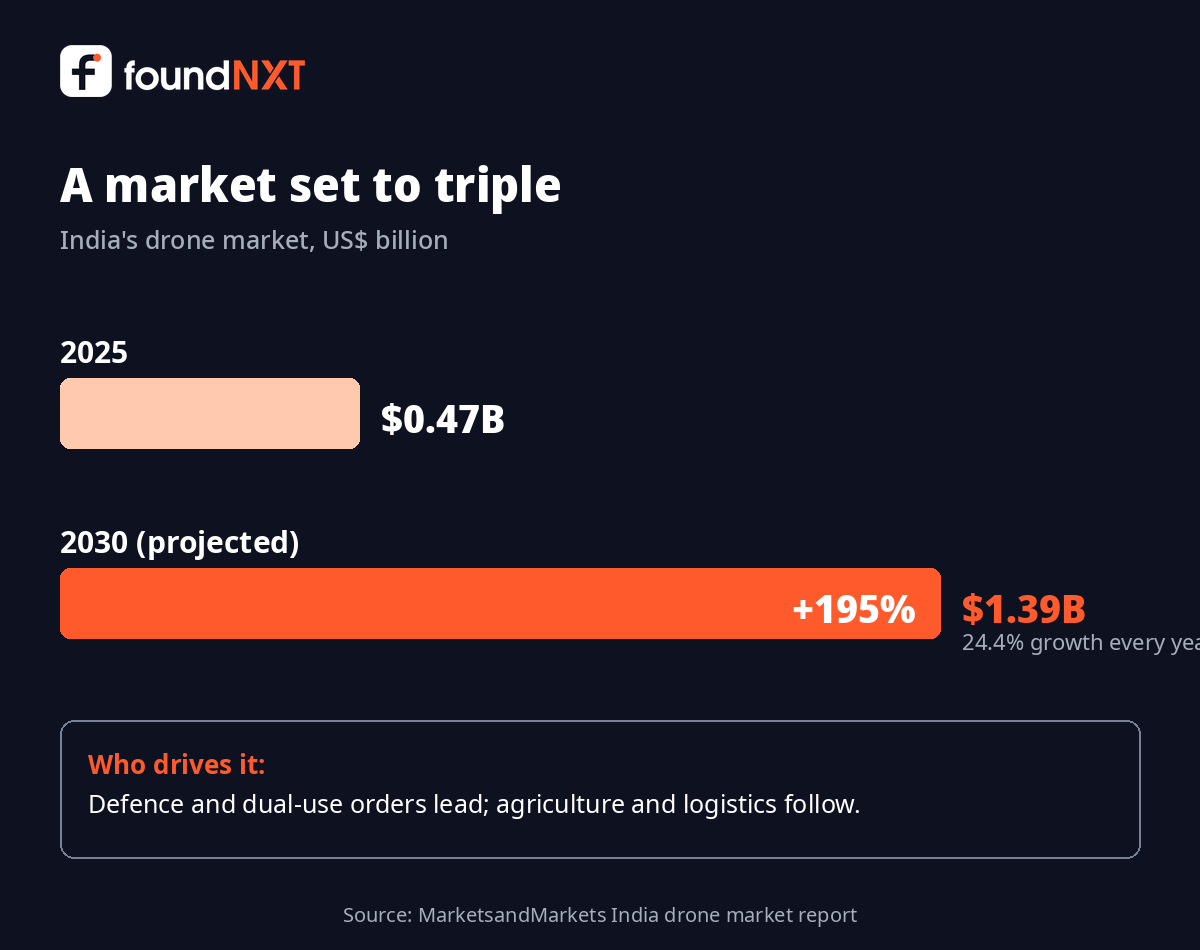
Until 2020, India mostly imported drones, and flying one legally was a maze. Three decisions changed that. The Drone Rules, 2021 slashed the paperwork: the forms you needed fell from 25 to 5, and a digital map of the country marked where you can fly. A ban on importing finished drones forced demand toward Indian makers. And a production-linked incentive scheme paid manufacturers to build here. The result: more than 900 drone startups, and a market that was worth about $470 million in 2025 and is projected to reach $1.39 billion by 2030, growing at about 24% a year, per MarketsandMarkets.
The wedding-and-farm economy
Start at the gentle end. Drone photography is now standard at big Indian weddings and real-estate launches. More consequential is the farm: spraying drones cover an acre in minutes with a fraction of the water and no human breathing pesticide, and government programmes have pushed drones into villages, including training rural women as drone pilots. Companies like Garuda Aerospace, IG Drones, Dhaksha and Zuppa built their businesses here: agriculture, surveying, mapping, inspection. It is honest, growing, thin-margin work.
The warzone economy
The thick margins are at the other end. Indian drone startups raised only about $151 million between 2020 and 2025, and three defence-focused companies took most of it, WireUnwired Research found. The largest cheque was Raphe mPhibr’s $100 million in 2025, the biggest drone round in Indian history. ideaForge sells surveillance UAVs to the forces and, after Operation Sindoor put drones at the centre of war planning, reported its highest-ever order bookings. NewSpace Research works on swarms. Big Bang Boom Solutions builds the anti-drone systems that shoot the others down.
In India, the same drone films the wedding, sprays the farm and guards the border. Only the customer changes.
Reading the market honestly
Two truths sit side by side. The market is genuinely tripling this decade, and defence demand after Sindoor is real and urgent. But funding is brutally concentrated: defence and dual-use companies get the cheques, while consumer and farm-drone founders scrape by. The Financial Express found startups reporting surging revenues in mid-2025; WireUnwired found the capital going to three companies. Both are true. If you are building in this space, the shortest path to revenue in 2026 runs through a uniformed customer, a government spraying contract, or industrial inspection, in that order.
The fix: if your drone startup is starving, stop selling drones. Sell the outcome: acres sprayed per day, kilometres of pipeline inspected, hours of border watched. The Indian buyer, from farmer to army, pays for the result, not the aircraft.
Drones are the most visible piece of India’s deeptech build-out, the one you can literally see overhead. We placed them in the bigger picture in Deeptech Rising.
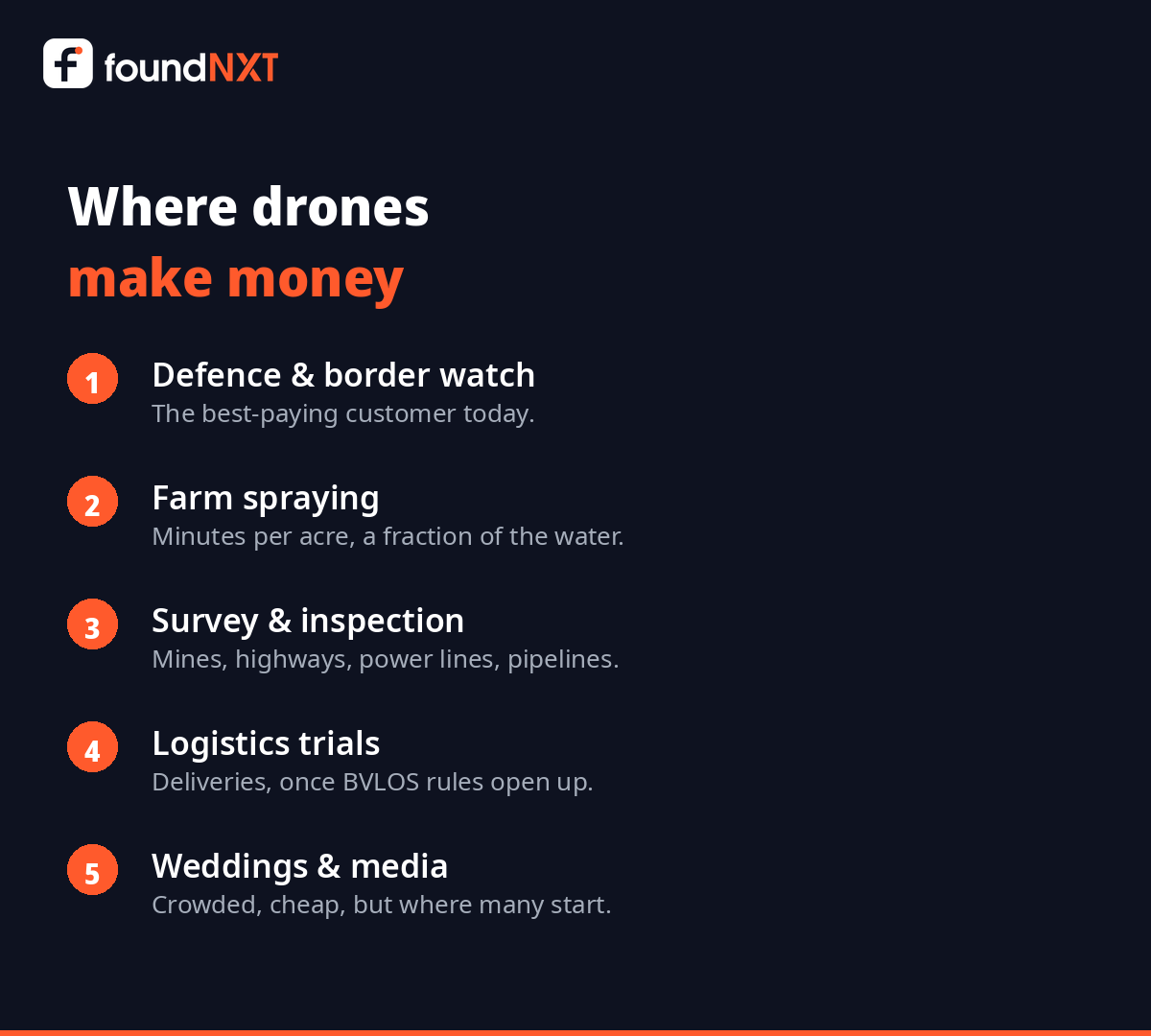
Where drones make money in India
The next regulatory unlocks to watch are BVLOS (beyond visual line of sight) permissions, which delivery and long-range inspection need, and the slow opening of drone corridors for logistics. When those land at scale, the wedding-and-farm end of the market gets its own growth spurt, and the industry’s centre of gravity will finally sit somewhere between the two extremes of this post’s title.
The economics differ sharply by segment, and founders misread this often. Wedding and event photography is crowded and cheap: anyone with a Rs 1 lakh drone is competition. Agricultural spraying runs on government tenders and village-level entrepreneurs who rent rather than buy. Survey and inspection work for mines, highways and power lines pays steadily but demands reliability paperwork. Defence pays best but demands certifications, trials and patience measured in years. The startups that survive pick one segment, win it properly, and only then expand. The graveyard is full of companies that pitched “drones for everything”.
One more tailwind deserves mention: the pilot pipeline. Nearly 40,000 certified remote pilots and 244 training organisations mean the industry no longer has to train every operator itself, the way it did in 2021. That is what an ecosystem maturing looks like: the unglamorous infrastructure of training, insurance, maintenance and spare parts filling in behind the headline companies.
So where does this leave the wedding photographer with a drone? Better than it looks. The defence boom funds the core technology: better batteries, smarter autopilots, tougher airframes. Those improvements flow downhill into the cheap civilian models within a year or two, the same way phone cameras benefited from satellite research. India’s drone story is not really two industries, one festive and one military. It is one industry whose military end currently pays the bills, while the civilian end learns to stand on its own.
Your turn: where have you actually seen a drone at work: a wedding, a farm, a construction site? Tell us in the comments. And for one plain-English read like this every week, join the Weekly Founder Brief, foundNXT’s free newsletter. Sign up below.
Sources
- MarketsandMarkets: India drone market, $0.47 billion in 2025 to $1.39 billion by 2030
- CFO Tech: India’s drone makers race to scale for military orders (Jul 2026)
- Deeptech Navigator: India’s drone field 2026 (Oct 2026)
- WireUnwired Research: Indian drone startups raised $151M in five years (Mar 2026)
- Financial Express: drone startups soar with revenue surge, new use cases (Jun 2025)
- NDTV: the drone ecosystem, a year after Operation Sindoor (May 2026)
- Content Cabinet: drone startups in India, 2026 (Oct 2026)