

📑 Table of Contents
- Loading headings…

Between July and September this year, Indian deeptech startups raised $290 million across 28 deals. In the same three months last year, they raised $105 million across 29 deals. The money going into rockets, satellites, chips and defence technology has nearly tripled in a year. Over the same period, overall startup funding grew just 5%.
This is not a one-quarter blip. Something bigger is going on, and it matters even if you never plan to build a rocket. Let us break down what is happening, why it is happening now, and what it means if you are a founder.
First, what exactly is deeptech?
Deeptech means startups built on real science and hard engineering, not just software. Think satellites, rockets, semiconductors, defence systems, robotics and quantum computing. An app can be built in a weekend. A rocket cannot.
Two things make deeptech different from a normal startup. First, it takes years of research before there is anything to sell. Second, it needs serious money before there is any proof the thing works. For years, that combination scared Indian investors away. “Too risky, too slow” is what deeptech founders kept hearing. That is what has changed.
An app can be built in a weekend. A rocket cannot. Deeptech takes years of research and serious money before there is proof it works, and that is exactly what has changed.
The numbers: deeptech is breaking away
According to Inc42’s Indian Tech Startup Funding Report for Q3 2026, deeptech funding rose 176% year on year in the July-September quarter, even as the number of deals stayed flat. In a market where total startup funding is nearly flat and investors are writing fewer, bigger cheques, deeptech is the clear outlier.

The headline numbers: $290 million raised across 28 deals in Q3 2026 (July to September). That is up 176% year on year. Spacetech alone pulled in $130 million, and Pixxel’s single $100 million round was about a third of all deeptech funding in the quarter.
One company driving a third of a sector is concentration, and we will come back to that. But first, look at where the momentum is coming from. It is three industries: space, chips and defence.
Space: India’s rockets and satellites grew up this year
On July 18, 2026, a rocket called Vikram-1 lifted off from Sriharikota. It was the first privately built orbital rocket ever launched from India. The company behind it, Hyderabad-based Skyroot Aerospace, started by former ISRO scientists, had flown a smaller suborbital rocket in 2022. This was the real thing.
Two months before the launch, Skyroot raised $60 million from investors including Singapore’s sovereign fund GIC, Sherpalo Ventures and BlackRock, at a $1.1 billion valuation. That made it India’s first spacetech unicorn. It is now reportedly raising a larger $200 million round, and it expects 70 to 80% of its future launch demand to come from the US, Europe and Southeast Asia.
Then there is Pixxel, a Bengaluru startup that builds hyperspectral satellites. Normal satellite cameras see the world the way your phone camera does. Pixxel’s satellites see in hundreds of narrow colour bands, which lets them spot things invisible to the eye: crop disease before it spreads, oil leaks, mineral deposits, pollution. In September 2026, Pixxel raised $100 million in a round led by Temasek and Seraphim, taking its total funding to $195 million, the most ever raised by an Indian space startup. Its six-satellite Firefly constellation is already in orbit.
And they are not alone. Digantara, which tracks satellites and debris in orbit (think of it as space traffic control), raised $50 million in a round led by Reliance in January. GalaxEye became the first Indian startup to get a US patent for its OptoSAR satellite imaging technology, and won ₹63.84 crore of government RDI support for its next satellite. Agnikul Cosmos, incubated at IIT Madras, test-fired Agnite, India’s first semi-cryogenic rocket engine and the world’s largest single-piece 3D-printed engine.
Spacetech startups have raised about $253 million in 2026 so far, nearly double what the sector raised in all of 2025. Behind the boom is a deliberate opening: space reforms in 2020 created IN-SPACe, the agency that lets private companies use ISRO’s facilities, and the government has since launched a ₹1,600 crore space venture fund. The Union government pegs India’s space economy at $9 billion today and projects it to reach $45 billion in a decade.
Chips: the hardest industry in the world gets a “Made in India” label
Semiconductors are the tiny chips that run everything: your phone, your car, your fridge, every missile and every satellite. India has world-class chip designers but, until now, made almost none of its own chips. Nearly everything was imported.
2026 is the year that started to change. Three chip plants began commercial production this year: Micron’s assembly and testing plant in Sanand, Gujarat (February), Kaynes’ plant (March), and CG Semi’s facility (July). The big one is still coming: Tata Electronics’ ₹91,000 crore fabrication plant in Dholera, Gujarat, built with Taiwan’s PSMC, is expected to produce its first chip by December 2026. It would be India’s first commercial chip fab.
The government has now approved 12 chip plants under the India Semiconductor Mission, which started with a ₹76,000 crore outlay in 2022. In July 2026, it followed up with ISM 2.0, worth another ₹1.27 lakh crore. For startups, this matters because a domestic chip supply chain, from design to packaging to fabrication, is what chip design and electronics companies need to exist at all. You cannot build a hardware ecosystem on imports forever.
Defence: building for the country, and the world
Operation Sindoor in 2025 changed how India thinks about defence technology. Drones, electronic warfare and home-grown systems decided outcomes, and the cost of depending on imports became impossible to ignore. Procurement that used to take a decade started moving, and startups suddenly had a real buyer.
The results are showing up in the trade data. India’s defence exports hit a record ₹38,400 crore in FY26, a 25-fold jump in nine years. The defence budget has tripled since 2014 to ₹7.85 lakh crore. And startup funding followed: Indian military tech startups raised $3.1 million in all of 2016. In 2025, they raised $192 million, a 61-fold increase in a decade, according to Tracxn.
The names to know: ideaForge, whose drones are used by the armed forces, is a listed company that raised ₹500 crore from institutional investors in July and won ₹151 crore of government funding this month to build YETI, a heavy-lift autonomous drone. Raphe mPhibr raised a $100 million Series B, the round that signalled defence tech had gone mainstream. Sagar Defence builds unmanned boats for the Navy. What these companies have in common is that the government is their first and most important customer.
Why now: the government built a patient-capital stack
Deeptech needs what investors call patient capital: money that can wait ten years and tolerate failure along the way. Ordinary venture funds, which need returns in five to seven years, are structurally bad at this. That is why the government’s role here matters so much.
The centrepiece is the Research, Development and Innovation (RDI) Scheme, a ₹1 lakh crore fund approved in July 2025 and launched by the Prime Minister in November 2025. It is designed for exactly the risk private investors avoid: it offers collateral-free loans at 2 to 4% interest with tenures up to 15 years, covering up to half the project cost, for technologies that are past the basic lab stage. GalaxEye’s ₹63.84 crore and ideaForge’s ₹151 crore both came through this channel. About ₹834 crore from the fund’s first cohort went to spacetech startups.
Around it sits a whole stack: the ₹76,000 crore semiconductor mission plus its ₹1.27 lakh crore sequel, IN-SPACe’s ₹1,600 crore space fund, the ₹6,003 crore National Quantum Mission, and a ₹10,000 crore Fund of Funds for startups. In February 2026, the government also gave deeptech its own legal identity: a “deep tech startup” now gets 20 years of recognition instead of the usual 10, with a higher ₹300 crore turnover limit, because the government finally accepted that these companies simply take longer to grow up.
Private money has started following public money. Asiana Fund and JC Capital launched a ₹1,000 crore deeptech fund this year, and Transition VC and Accel launched vehicles for technology-led businesses. That is how ecosystems form: the government absorbs the scariest risk, and private capital moves in behind it.
The honest catch
Two warnings before the celebration. First, the money is concentrated. One Pixxel round was a third of the quarter’s deeptech funding, and the industry body IVCA points out that India still has very few funds that can write the big Series B and C cheques needed to take a technology from the lab to global scale. Early-stage deeptech founders still face a thin market.
Second, revenue is still small compared to the hype. Valuations are running ahead of proven demand, especially in space, and investors themselves worry about a FOMO zone. The likely outcome, as early Pixxel backer GrowX Ventures puts it, is that not many companies will make the cut, and the stronger ones will end up absorbing the smaller ones. The technology is real. The business models still have to prove themselves.
The pattern to watch: in space, chips and defence, the government acts as the first customer and the risk-absorber, then private capital follows. If you are building in any of these areas, that order of operations is your business plan.
What this means for founders
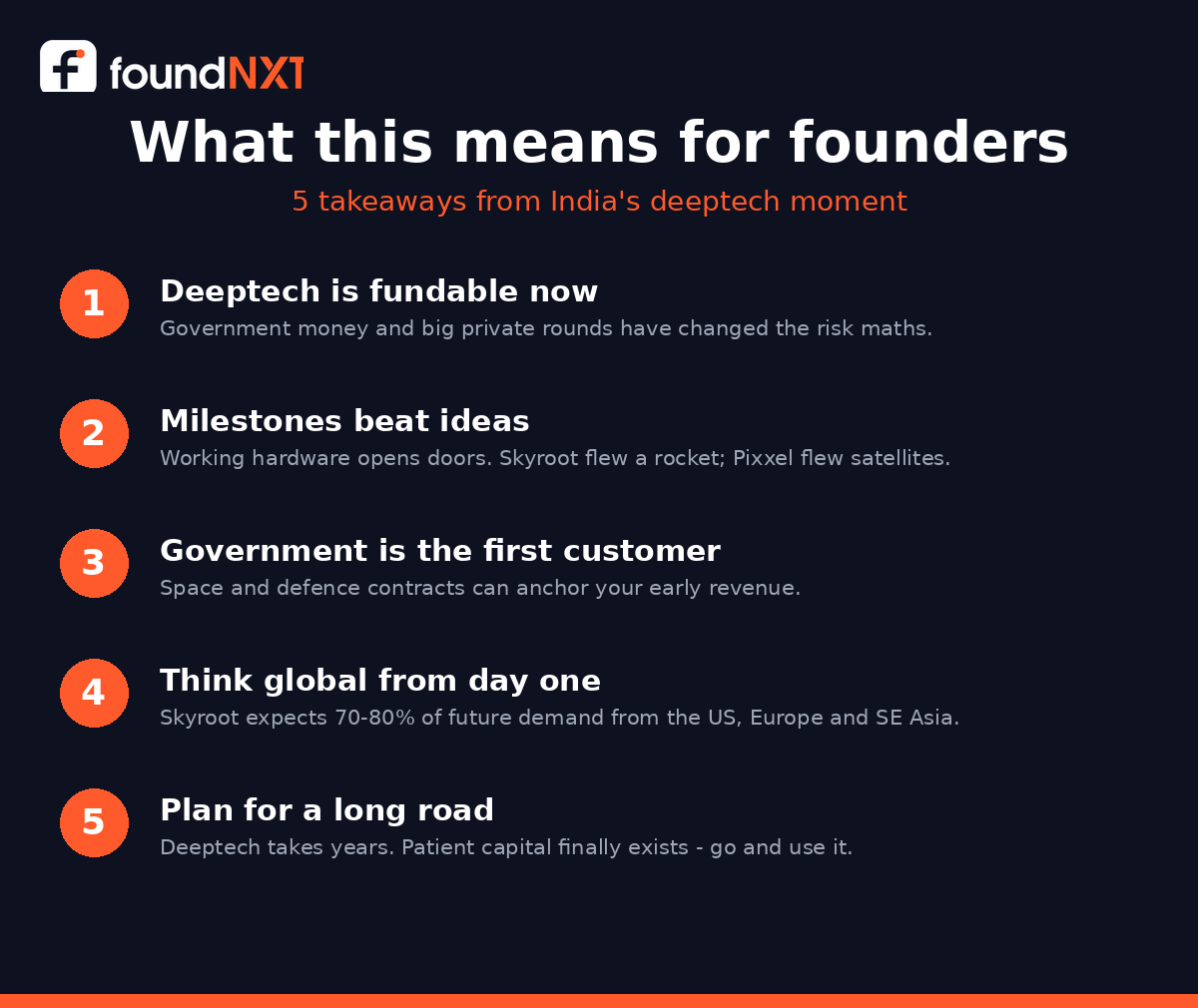
- Deeptech is fundable now. The combination of government money and large private rounds has changed the risk maths. Investors who would not take your meeting two years ago now have deeptech mandates.
- Milestones beat ideas. Skyroot flew a rocket. Pixxel flew satellites. Agnikul fired an engine. In deeptech, working hardware is the pitch. Pick a milestone you can hit in 18 to 24 months and build everything around hitting it.
- The government is the first customer. In space and defence, early revenue comes from government contracts and grants like the RDI fund. Treat those applications as seriously as a pitch deck, because that is what they are.
- Think global from day one. The Indian market alone is too small for most deeptech. Skyroot expects most of its demand from overseas, and Pixxel sells to the world. Design your company for export from the start.
- Plan for a long road. Deeptech companies take a decade to build. The good news is that patient capital, 15-year loans and a 20-year recognition window finally exist. Founders who understand this timeline will outlast those who do not.
India spent twenty years building software companies that serve the world. The next twenty look different: rockets from Sriharikota, chips from Dholera, drones from Navi Mumbai. The money has started moving. The founders who move with it will build the companies this newsletter writes about in 2036.
Your turn: would you build a deeptech startup in India today, or is the risk still too high? Tell us in the comments. And if you want stories like this in your inbox every week, join the Weekly Founder Brief, foundNXT’s free newsletter. Sign up below.
Sources
- Inc42: Deeptech Funding Zooms 2.8X YoY In Q3 Despite Tighter Deal Flow (Oct 12, 2026)
- Inc42: India’s Spacetech Dreams Enter The Commercialisation Phase (Sep 20, 2026)
- Moneycontrol: Skyroot scripts history as Vikram-1 becomes India’s first private orbital launch (Jul 18, 2026)
- Reuters: India’s Skyroot becomes first $1 bln space-tech startup (May 7, 2026)
- Pixxel: $100 million Series C announcement (Sep 7, 2026)
- Economic Times: Reliance leads $50 million round for Digantara (Jan 30, 2026)
- Inc42: GalaxEye gets ₹63.8 crore RDI support for multisensor satellite tech (Sep 25, 2026)
- Press Information Bureau: 10 semiconductor projects approved, commercial production begins (Apr 2026)
- Press Information Bureau: revised startup framework defines deep tech startups (Feb 5, 2026)
- Press Information Bureau: ₹1 lakh crore Research, Development and Innovation Scheme
- ETManufacturing: defence exports hit record ₹38,400 crore in FY26 (May 6, 2026)
- ETManufacturing: ideaForge secures ₹151 crore for YETI heavy-lift drone (Oct 14, 2026)
- Tracxn: India Military Tech Report