
📑 Table of Contents
- Loading headings…

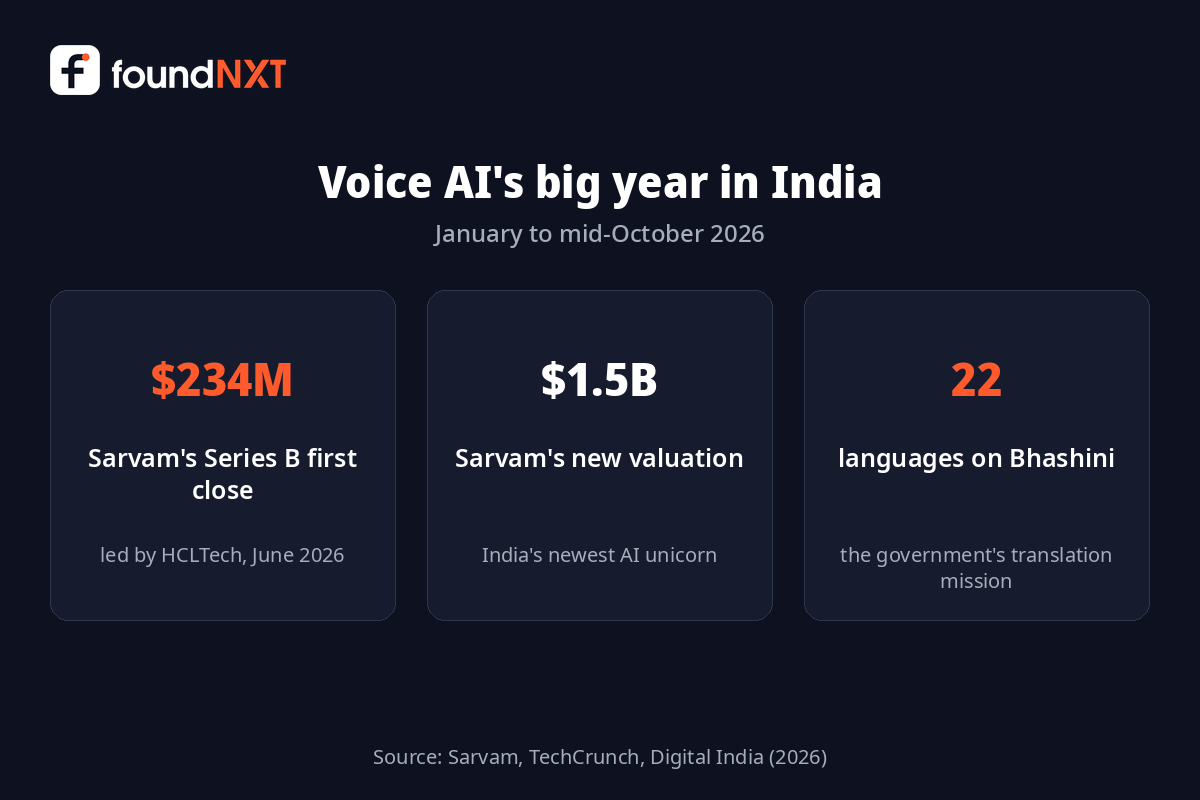
Between January and mid-October 2026, the biggest AI cheque in India went to a company most English-speaking users have never typed a prompt into. In June, Bengaluru-based Sarvam raised $234 million in the first close of its Series B at a $1.5 billion valuation, led by HCLTech with Bessemer Venture Partners, making it India’s newest AI unicorn. By October, the Economic Times was reporting talks of a $300 million top-up that could double that valuation. Sarvam’s bet is not a smarter chatbot for English speakers. It is AI that listens and speaks in India’s languages.
That bet tells you where the real Indian AI market is. This post explains why voice, not text, is how the next few hundred million Indians will use AI, who is building for it, and where the money is.
Why India skips the keyboard
Only about one in ten Indians speaks English comfortably. But India has roughly 500 million or more Indian-language internet users, a number the KPMG-Google study on Indian languages estimated years ago and cheap data has only grown since. For most of them, the keyboard is the hardest part of the internet. Typing Hindi or Tamil on a small screen is slow. Speaking is not.
India has seen this movie before. UPI won because paying became as easy as handing over cash. Voice is the same unlock for AI: a farmer in Madhya Pradesh does not want to write a question about crop prices, he wants to ask it, in his dialect, and hear an answer. Investors call this the Bharat market: users outside the English-speaking, metro, top-100-million slice of India.
India’s next 500 million users will not type their first question to an AI. They will say it out loud, in their own language.
The three layers being built
Government rails. Bhashini, the National Language Translation Mission, offers translation and speech models across 22 Indian languages as public infrastructure, and in March 2026 it was upgraded into a full Digital India BHASHINI Division. The IndiaAI Mission, launched in March 2024, funds homegrown models, and picked Sarvam among the teams building a sovereign Indian foundation model.
Open research. AI4Bharat, a lab at IIT Madras, builds the open datasets and models for Indian languages that everyone else stands on. Much of what Indian voice startups ship today traces back to its work.
Startups. Sarvam is the flagship: full-stack speech and language models, now with HCLTech putting in $150 million of its own money, a signal that big IT services wants voice AI for its clients. Krutrim, from the Ola group, is the other Indian AI unicorn. A layer below, voice-agent startups like Ringg AI sell AI phone agents to businesses, and are starting to close the gap with global leaders like ElevenLabs for Indian-language work, as the Financial Express reported in April 2026.
Where the money actually is
The customers paying for voice AI today are not consumers, they are businesses and governments. The biggest early buyers are in banking and financial services, where AI voice agents handle customer calls, reminders and collections in the customer’s own language, a job India once staffed in giant call centres. The Hindu BusinessLine documented this shift in April 2026: companies are replacing call-centre workflows with voice agents that can switch between Hindi, Tamil and English mid-call.
After BFSI come small businesses (an AI receptionist that never sleeps), government services (ask about a scheme, in your language), farming advisories and health triage. The pattern is the same everywhere: the interface that wins is the one that needs no literacy and no typing.

Important note: Voice-first is hard to monetise. Bharat users pay small amounts, dialect accuracy is still patchy, and every call costs compute. The winners will be companies that sell to businesses and governments first, where one client pays for ten thousand users.
What founders should take from this
The lesson of 2026 is that “AI for India” is not a translation feature bolted onto an English product. It is a different product, built voice-first, priced for thin margins and sold to whoever serves the masses. That is exactly the kind of shift we track across India’s deeptech wave in our overview of the 2026 deeptech surge, and it is where a growing share of the money went in this year’s funding data.
Where voice-first wins first
Not every product needs voice. The winning use cases share one trait: the user’s hands or literacy are the bottleneck. Five stand out.
- Collections and customer care in BFSI: high call volumes, scripted conversations, measurable savings.
- Government schemes: ask about eligibility and documents in your own language, no queue, no form.
- Farming advisories: weather, pest and price answers spoken over a basic phone connection.
- Health triage: first-level questions answered before a hospital visit, in the patient’s mother tongue.
- Small business front desks: an AI receptionist that takes bookings and answers calls around the clock.

The unsolved problem is code-mixing: real Indians do not speak pure Hindi or pure Tamil, they blend languages mid-sentence (“mera order kab aayega?”). The startup that handles that mess naturally, at low latency and low cost, owns the market. That is a data and engineering problem, and it is why the open work from AI4Bharat and the scale of Bhashini matter so much to everyone in this race.
Your turn: have you used a voice AI in an Indian language yet, and did it actually understand you? Tell us in the comments. And for one plain-English read like this every week, join the Weekly Founder Brief, foundNXT’s free newsletter. Sign up below.
Sources
- TechCrunch: Sarvam becomes India’s newest AI unicorn with $234 million round (Jun 2026)
- Sarvam: announcing the $300M Series B (Jun 2026)
- Economic Times: Sarvam in talks for $300M top-up, valuation may double to $3B (Oct 2026)
- Financial Express: voice AI startups narrow the gap, target SME demand (Apr 2026)
- The Hindu BusinessLine: the chatter-bots speaking up for India (Apr 2026)
- Digital India: BHASHINI Division powers AI at population scale (Mar 2026)
- KPMG-Google: Indian languages, defining India’s internet (2017)
FoundNXT publishes independent business intelligence, valuation frameworks, and startup teardowns. Nothing in this article constitutes financial, investment, legal, or tax advice. Company figures, market projections, and valuation metrics represent editorial estimates and regulatory filings. Always consult qualified legal counsel and certified financial advisors before executing investment rounds or financial agreements.