

📑 Table of Contents
- Loading headings…
Every big company starts with a small irritation. Someone gets tired of waiting, wasting money or being cheated, and quietly thinks, “There must be a better way.” Most people complain and move on. A few people write the complaint down and start building.
Two teenagers who dropped out of Stanford noticed how long it took to get groceries and decided to fix that. Today you can read about how Zepto burned billions to win quick commerce. The idea began with something every household understood: I forgot to buy milk, and I do not want to wait.
The lesson is simple. You do not need a clever invention. You need to notice a problem that many people feel every week and for which they are already spending time, money or stress. Here are 10 such problems around us, and the businesses that could grow out of them.
1. “Who will pick up the kids?”
The problem. In many cities, both parents work, and school ends long before office hours do. Grandparents may be far away. Parents scramble, call neighbours and feel guilty.
The business. A trusted after-school care service: pickup from school, snacks, homework help and play until parents return. Charge a monthly fee per child.
How to start small. Rent a clean room near one school, hire one or two verified caregivers and enrol ten families. Trust is everything here, so be open about background checks, safety rules and daily updates to parents. Check local rules on child care before you begin.
2. “My parents live alone in another city.”
The problem. Millions of young Indians have moved to other cities or countries while their parents stay at home. They worry about doctor visits, bills, small repairs and loneliness.
The business. A companion and errand service for senior citizens: regular visits, accompanying them to appointments, helping with paperwork and sending the family a weekly report.
How to start small. Begin in your own city with five clients. Hire kind, patient people instead of fast ones. Your product is peace of mind, so communicate often and honestly.
3. “My tailor never delivers on time.”
The problem. Everyone has a story about a blouse, a shirt or a school uniform that was promised for Friday and arrived the next week, or never.
The business. A tailoring coordinator that picks up fabric, matches it with a reliable tailor, tracks the deadline and delivers the finished clothes. You earn a commission or a service fee.
How to start small. Partner with three good tailors, promise a firm delivery date and make your first twenty customers happy. Add alterations and school uniforms in bulk later.

4. “Where do I find a plumber I can trust?”
The problem. Finding a reliable electrician, plumber, carpenter or painter is stressful. Prices change with the mood of the person who arrives, and quality is a gamble.
The business. A neighbourhood service network with verified workers, fixed price lists and a small guarantee on work done. You take a percentage of each job.
How to start small. Choose one area and one service, such as plumbing. Recruit five good plumbers, publish simple prices and answer customer calls yourself. The rule is clear: if the job goes wrong, you make it right.
5. “My kirana’s credit book is a mess.”
The problem. Small shopkeepers record customer credit in handwritten notebooks and keep stock in their heads. Sales leak away through forgotten dues and missing items. At the same time, they face fierce competition from fast-delivery apps, a fight we explored in Quick Commerce vs Kirana.
The business. A very simple mobile tool in the local language that records credit, sends polite reminders on WhatsApp and tells the owner when stock is low. Charge a small monthly subscription.
How to start small. Visit twenty shops with a basic prototype and watch how they use it. Skip fancy features. If the shopkeeper does not use it daily, it is not simple enough.
6. “Vegetables are cheap at the farm and costly in the city.”
The problem. Farmers often sell at low prices to middlemen, while city families pay a lot for produce that is not always fresh.
The business. A weekly farm-to-home box: fresh vegetables or fruit collected directly from a group of farmers and delivered to apartment complexes on a subscription.
How to start small. Start with one farmer cooperative and one apartment complex of 50 homes. Learn the hard parts early: wastage, timing and quality. The business works when your delivery day feels as predictable as the milk man.
7. “The internet is not in my language.”
The problem. Hundreds of millions of new internet users prefer to watch, learn and shop in their mother tongue, yet so much good information is only in English. We covered this shift in Building for Bharat and in our piece on vernacular content startups.
The business. Vernacular content: short videos or audio lessons on money, health, jobs, farming or government schemes in a regional language, supported by sponsorships, courses or a paid community.
How to start small. Pick one language and one topic. Publish three clear videos a week for three months and listen closely to the comments. Your audience will tell you what to build next.
8. “Compliance confuses me.”
The problem. New founders do not know which registrations they need, when to file what, or whom to trust. They delay, and then they pay penalties.
The business. A subscription service that handles registrations, reminders and filings for small companies at a fixed monthly price, with clear human help when needed.
How to start small. Partner with a qualified chartered accountant or company secretary, build a checklist based on our guide to DPIIT, GST and Startup India compliance basics and serve your first ten startups. Accuracy and trust come before speed.
9. “I just moved to a new city and I am lost.”
The problem. Students and young professionals move to a new city every year. They need a flat, a gas connection, Wi-Fi, a local SIM, a doctor and a decent meal, all in the first week.
The business. A settle-in service: a single package that helps newcomers find housing, handle paperwork and get connected, with a local guide on call.
How to start small. Pick one hub, such as a college area or an IT park. Build a list of reliable landlords, brokers and service providers, and charge a flat fee per newcomer. Referral commissions from partners can add to your income.
10. “I keep forgetting my parents’ medicines.”
The problem. Older people often take several medicines a day, and refills get missed. Families find out only when something goes wrong.
The business. A refill and reminder service: you track the prescription schedule, send reminders by call or WhatsApp and arrange delivery from a licensed pharmacy partner.
How to start small. Work with one pharmacy, serve twenty families and follow all pharmacy and data privacy rules strictly. Because this involves health, accuracy and trust matter more than speed. You are a helper, not a doctor.
How to spot your own everyday problem
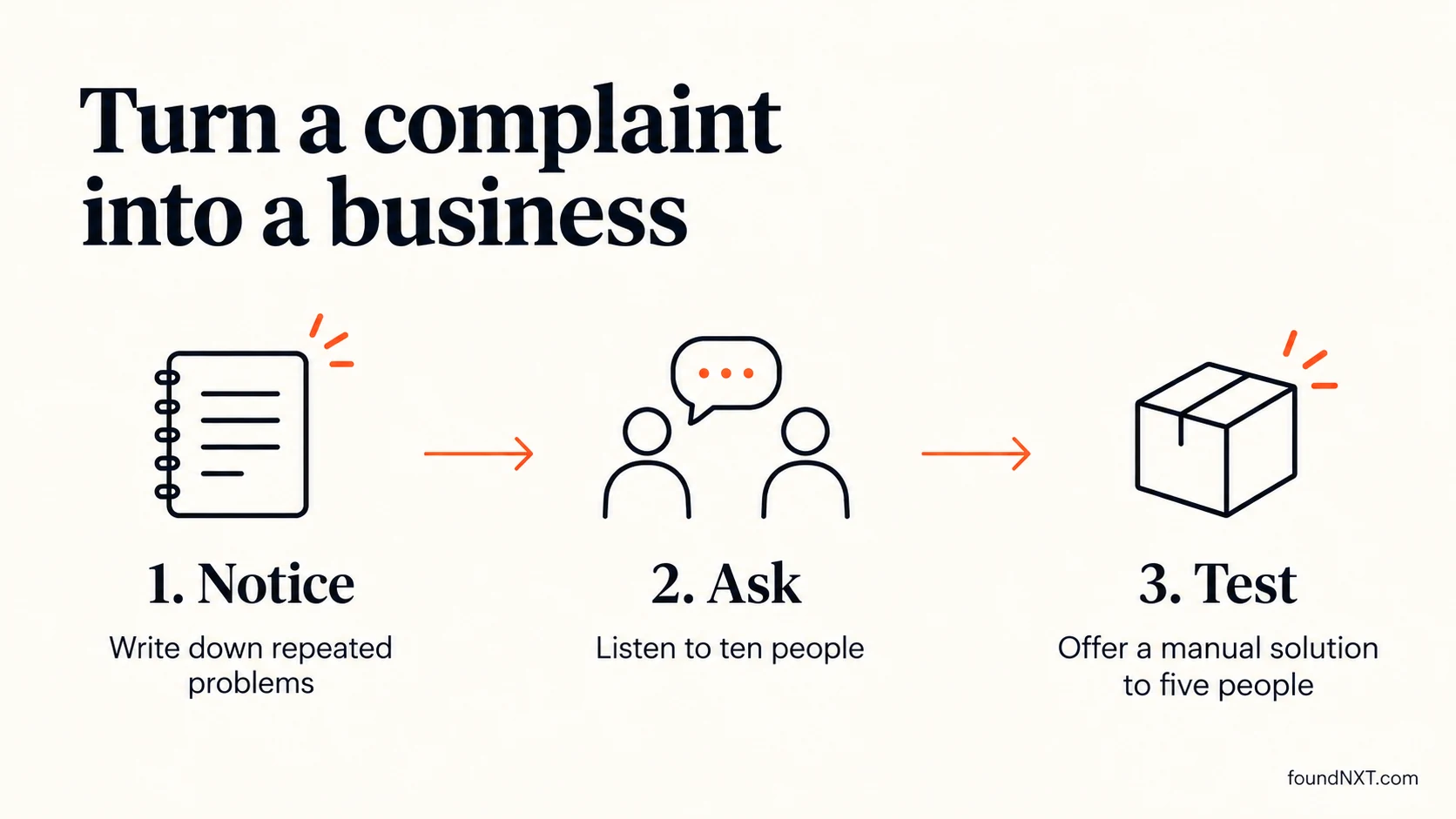
The ten ideas above are a starting point, but the real gold is in the problems you see yourself. Use a simple three-step habit.
Step 1: Notice. For two weeks, carry a small note on your phone. Every time you feel annoyed, delayed or overcharged, write it down. Do the same when you hear a friend or relative complain. By the end, you will have a surprising list.
Step 2: Ask. Choose the three problems that repeat the most. Ask ten people about each one: “How do you handle this today? How much do you pay? What bothers you most?” Listen without selling. If people light up and tell long stories, you have found a live problem.
Step 3: Test. Before you build anything, offer a manual version of the solution to five people. Our guide to validating your idea for Rs 0 walks you through it. If five people will pay, you have the start of a business.
Two warnings from the stories we have studied. First, a good problem does not guarantee a good business. Look at how Dunzo’s story ended and you will see that depending on one big backer or one big platform is risky. Second, if your first version is not working, do not hold on out of pride. These five signals tell you when it is time to pivot.
Every business in this list began as a complaint. Maybe yours is already sitting in your phone’s notes app, waiting for someone to take it seriously. This week, write down five things that annoyed you, ask one person about each, and see which one they care about too.