

📑 Table of Contents
- Loading headings…
In October 2026, the inaugural BinQle Talent Intelligence Report put a hard number on India’s AI hiring problem: demand for roughly 1.4 million AI professionals this year, against an available pool of about 400,000 – a gap of more than 3.5 times. Staffing firm TeamLease Digital, analysing 37,000 technology roles, reached the same conclusion from the other side: a 53% talent gap in Generative AI, with only about 16% of India’s IT professionals holding AI skills.
When demand outruns supply three to one, the market does something simple: it bids up the price of the people who have the skill. Here is what that bidding war looks like in 2026, who is winning it, and what it means whether you are hiring or being hired.
The gap, in plain numbers
- 1.4 million vs 400,000: projected AI talent demand vs available pool in India in 2026 (BinQle).
- 350,000: active job postings citing AI skills in a single 90-day window (Quess).
- 51%: the AI demand-supply gap inside Global Capability Centres (Zinnov).
- 16%: share of India’s IT professionals with AI skills (TeamLease Digital).
- Deepest shortages: AI deployment and engineering, governance and security roles – the jobs that turn demos into production systems (Quess).

What the war actually pays
The interesting twist in 2026 is who is doing the paying. Compensation data from Levels.fyi shows that no FAANG company makes the top ten highest-paying employers for software engineers in India anymore. The top of the table is now occupied by global product firms like Stripe, Airbnb and Databricks, by Global Capability Centres, and by well-funded AI startups.
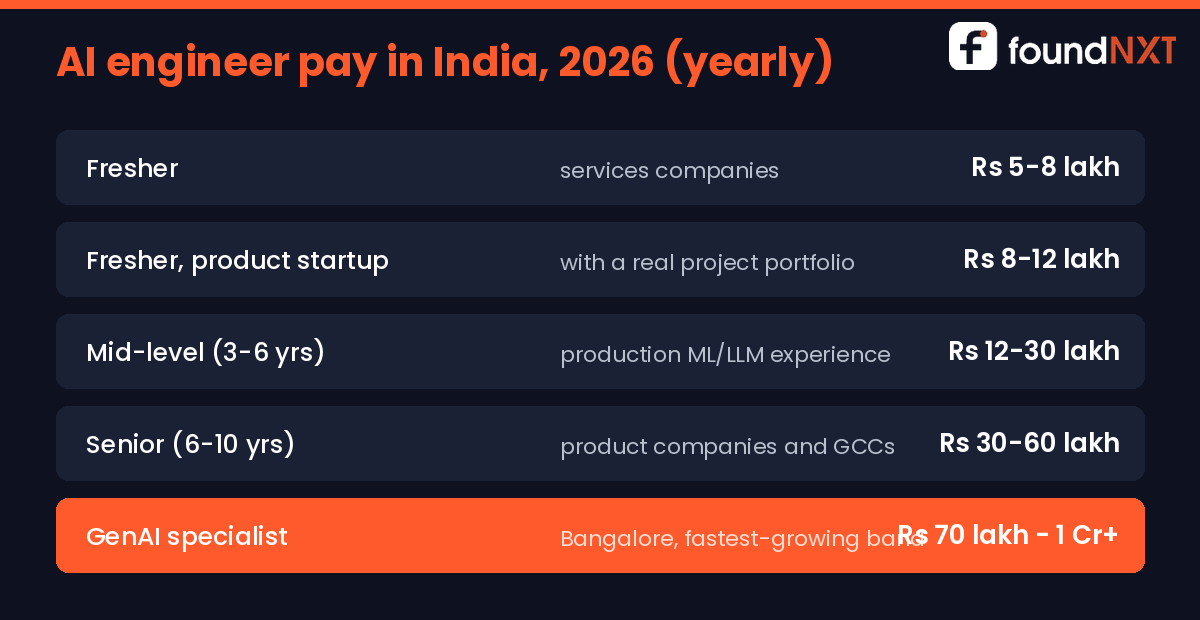
The salary bands tell the story. Broad 2026 estimates put AI engineers at:
- Freshers: ₹5-8 lakh at services companies; ₹8-12 lakh at product startups with a real portfolio.
- Mid-level (3-6 years): ₹12-30 lakh, with a huge spread by company type.
- Senior (6-10 years): ₹30-60 lakh at product companies and GCCs.
- GenAI specialists: ₹70 lakh to ₹1 crore and above in Bangalore – the fastest-growing band in the market, up 20-25% a year.
GCCs – the India offices of global companies – have become the aggressive middle: they pay a 10-25% premium over traditional IT services for comparable roles, rising to 40% for specialised AI skills, and they have cut fresher hiring from 42% to 30% of intake to chase experienced engineers instead.
Important: salary numbers in a hot market are ranges, not promises. The top offers – ₹70 lakh and above – are real but rare, concentrated in a few hundred roles at frontier teams. Plan your hiring budget or your career around the bands, not the outliers.
Why startups can suddenly outpay Big Tech
Two things changed. First, AI startups raised enormous rounds – as we covered in our look at where the money went in 2026 – and talent is where that capital goes first. Second, the skill that matters shifted: a five-person team that has actually shipped a GenAI product is worth more than a hundred engineers who have only maintained one. Big Tech’s advantage was never the logo; it was the pay cheque. When a funded startup or a GCC matches the cheque and offers more ownership, the logo stops winning.
One more number frames the stakes. India has over 5.4 million IT professionals, but the AI-ready slice is small and concentrated in specialist pools, mostly in tier-1 cities. The optimistic read: reports tracking learners note one in five now comes from a tier-2 city, competing on equal terms with metro peers. The talent war is fierce partly because the supply pipeline is widening – just not fast enough for 2026.
Positions with greater specialisation carry premiums that reflect not just scarcity, but the nature of the work itself.
CIEL Works analysis, ET GCC 2026
What this means for you
If you are a founder: assume you cannot outbid a GCC on salary alone. Compete on what they structurally cannot offer – real ownership of a product, equity that matters, and speed. Hire for the 3-5 year experience band where enterprise demand is fiercest only when the role truly needs it; for everything else, train. And budget for 10-16% attrition on your best people, because the market will come for them.
If you are an engineer: the leverage is yours, but the premium follows proof, not certificates. A deployed project beats a course completion every time. The market pays most for people who can take AI to production – deployment, governance and security are the widest gaps and the fastest salary growth.
Tracking India’s startup and AI shifts? The Weekly Founder Brief breaks down one big move every week in plain words. Subscribe on foundNXT.
Sources
- BinQle Talent Intelligence Report 2026 (via ET Enterprise AI)
- TeamLease Digital – AI skills gap report 2026
- Quess Corp – India AI Workforce Analysis Report
- Zinnov – GCC Salary Increase, Attrition and Hiring Trends 2026
- Financial Express – FAANG loses edge in high-paid tech jobs (Levels.fyi data)
- Storyboard18 – India GCCs offer up to 40% premium for AI talent
FoundNXT publishes independent business intelligence, valuation frameworks, and startup teardowns. Nothing in this article constitutes financial, investment, legal, or tax advice. Company figures, market projections, and valuation metrics represent editorial estimates and regulatory filings. Always consult qualified legal counsel and certified financial advisors before executing investment rounds or financial agreements.