📑 Table of Contents
- Loading headings…
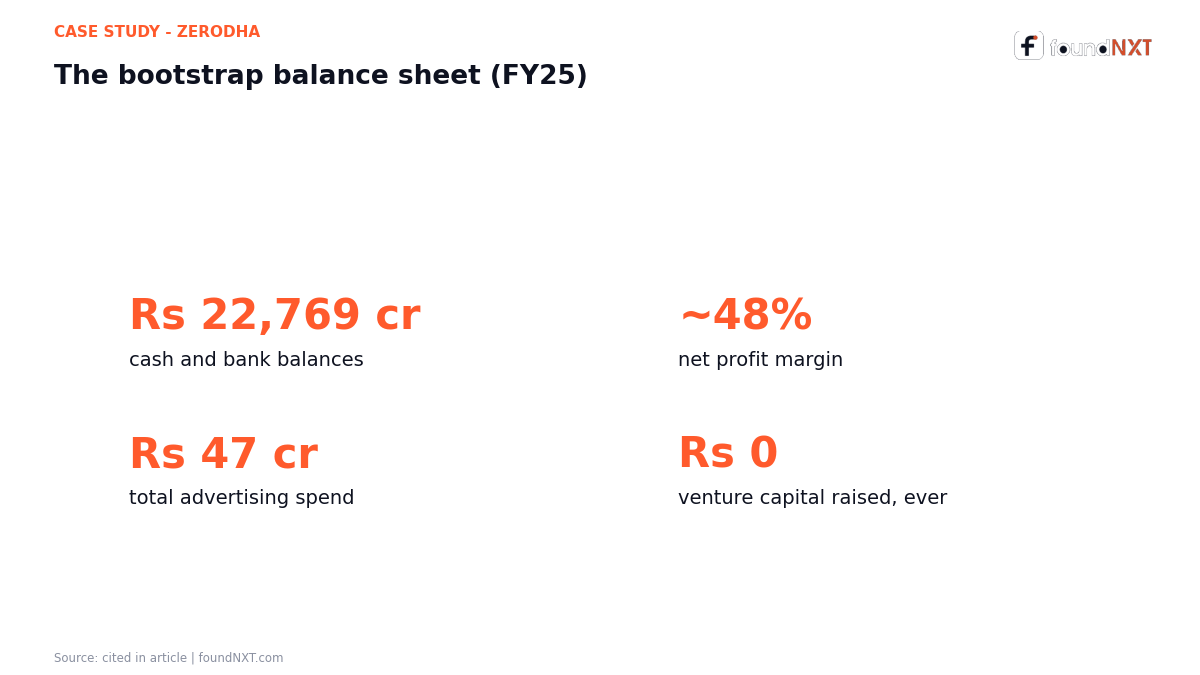
In a startup world obsessed with raising the next round, Zerodha is the counter-example that refuses to go away. In FY25, India’s largest stockbroker by revenue reported Rs 8,868 crore in revenue and Rs 4,237 crore in net profit – a net margin of roughly 48%, in a year its own founder called a slowdown. And it has done all of this without raising a single rupee of venture capital. Ever.
No term sheets. No board seats given away. No liquidation preferences. Just two brothers, a Bengaluru office, and fifteen years of boring, compounding discipline. This is how that happened, and what it means for you.
The problem Zerodha actually solved
In 2010, trading in India was expensive and intimidating. Full-service brokers charged percentage-based commissions, so an active trader could watch lakhs of rupees leak away in brokerage every year. Nithin Kamath, who had been trading since he was 17 and ran a sub-broking franchise, knew this pain first-hand.
Zerodha’s answer was radical for its time: flat-fee discount broking. Rs 20 or 0.03% per executed order, whichever is lower, and zero brokerage on equity delivery. The name itself – Zero + Rodha, the Sanskrit word for barrier – told you the pitch: no barriers between you and the market.
What most people miss is the timing. Zerodha did not just undercut on price. It rode three waves at once: Aadhaar-based eKYC made account opening nearly instant, cheap mobile data put a trading terminal in every pocket, and a young India was looking for alternatives to fixed deposits. Zerodha’s own tech stack, especially the Kite app launched in 2015, turned that opening into a runaway lead.
To feel how big that shift was, run the numbers the way a 2010-era trader would. A typical full-service broker charged around half a percent on delivery trades. Say you bought Rs 1,00,000 worth of shares and sold them a month later at Rs 1,10,000. Brokerage alone came to about Rs 500 on the buy and Rs 550 on the sell – Rs 1,050 gone before taxes, on a trade that made you Rs 10,000. That is more than a tenth of your profit handed to the broker.
Intraday traders bled faster. At 0.05% per side, a trader turning over Rs 5 lakh a day paid roughly Rs 500 daily – about Rs 10,000 a month, Rs 1.2 lakh a year – whether or not the trades made money. On Zerodha’s flat Rs 20 per executed order, the same month costs about Rs 800. A gap that large is not a discount; it is a different industry. Multiply it by a few million traders and you understand why the incumbents never recovered.

How do you grow without VC money?
Every other fintech unicorn answered the growth question with someone else’s money. Zerodha answered it with its own cash flow. The playbook had a few unglamorous rules:
- Be profitable from early on, and stay that way. Zerodha has been profitable for most of its existence. Profits funded the technology, the team and the rainy-day buffer – no investor required.
- Do not spend to acquire customers. In FY25, Zerodha spent about Rs 47 crore on advertising – loose change next to what funded startups burn on IPL sponsorships and cashback. Growth came from word of mouth, free education (Varsity, Zerodha’s legendary learning portal) and a product traders recommended to each other.
- Say no to bad revenue. Nithin Kamath has repeatedly said Zerodha refuses to nudge customers into trading more. No push notifications baiting you into F&O, no gamified dopamine loops. That costs revenue in the short run – and builds trust that compounds for decades.
- Keep the cap table clean. With no outside investors, the Kamath brothers answer to no one. When SEBI’s F&O crackdown hit volumes in FY25, they could absorb a 23% profit decline without a single panicked board call.
We fought hard to ensure that we don’t enable greed with Zerodha.
Nithin Kamath, co-founder and CEO, Zerodha
Notice what is missing from that list: a growth target. Funded companies plan the year around the metrics their next round needs. Zerodha plans around the customer. When the salary bill, the servers and the founders’ own income all come out of current profits, you make decisions in decades, not quarters – and you never have to choose between what is good for users and what is good for the cap table, because they are the same table.
The machine behind the margin
How does a company charging Rs 20 out-earn brokers charging twenty times more? The answer is cost structure, and it is worth studying line by line. Zerodha has no branch network, no dealers, no relationship managers and no sales targets. Everything – account opening, trading, learning, support – runs on software the company builds itself. Full-service brokers, by contrast, carried thousands of branches and sub-brokers, each taking a cut of every order routed through them.
The technology choices compound too. Kite, the trading platform, is built and maintained in-house, so Zerodha pays no per-user licence fees to outside vendors. Varsity doubles as marketing that costs almost nothing to distribute. Even the org chart is frugal: Kamath has said the company runs without the layers of vice presidents and senior vice presidents that inflate costs at funded rivals. Fewer people, paid better, with no empire-building between them and the customer.
The result is a business where most of each incremental rupee of revenue falls straight to the bottom line. A funded competitor can copy the Rs 20 price – many did – but copying a cost base built patiently over fifteen years is a very different problem.
The FY25 reality check
The bootstrap story is not a fairy tale, and FY25 proves it. Revenue fell 11.2% to Rs 8,868 crore from Rs 9,995 crore in FY24. Net profit dropped 23% to Rs 4,237 crore as SEBI’s curbs on F&O speculation cut trading volumes across the industry. Active clients slipped from 7.95 million in February to about 7 million by October 2025, and rival Groww pulled ahead with 12 million. In the first quarter of FY26, Kamath warned, brokerage revenue fell as much as 40%.
And yet: the company sits on Rs 22,769 crore in cash and bank balances. It paid its three directors Rs 228 crore in remuneration and still kept nearly half of every rupee of revenue as profit. A funded company with that P&L would be fielding angry investor calls. Zerodha published a blog post and carried on.
Important: Bootstrapping is not free of trade-offs. Zerodha grew slower than it could have, skipped adjacent markets for years, and its fortunes rise and fall with one industry – Indian capital markets. The model buys resilience, not speed.
The Rainmatter ripple effect
The global mirror: Robinhood took the other road
Zerodha’s story has an American twin that made the opposite choice at every fork. Robinhood brought zero-commission trading to the US with a slick app and a viral waitlist, much like Zerodha did in India – but it raised billions in venture capital to get there. Investors paying for hyper-growth needed revenue that zero commissions could not produce, and the answer was payment for order flow: routing customer orders to market makers for a fee, a model critics argued quietly taxed the very users the app claimed to free.
The incentives showed. Where Zerodha refused to nudge users into trading more, Robinhood was accused of gamifying risk – confetti animations, push notifications, options one tap away. The 2021 meme-stock mania ended with Robinhood restricting purchases of GameStop at the worst possible moment, a casualty of its own thin, debt-dependent liquidity. Meanwhile Charles Schwab, the incumbent, was forced to cut commissions to zero in 2019 – proof that Zerodha’s core insight was right on both sides of the world. The difference was who owned the company when the squeeze came.
The Rainmatter ripple effect
Here is the part of the story founders should study closely. Zerodha took its own profits and started Rainmatter, a fund that backs fintech startups – with patient capital and no pressure to exit. It incubated or backed companies like Smallcase, Sensibull, Ditto and GoldenPi. In other words, the bootstrapped company became the investor it never had. It also runs Rainmatter Health and supports public-interest projects through the Rainmatter Foundation. The bootstrap philosophy did not just build one company; it seeded an ecosystem.
There is a reason so many founders we cover – from the patient capital playbook in our guide to patient capital in India to the discipline in the 18-month runway math – keep coming back to Zerodha as the reference point. It is the proof of concept.
What founders should steal from Zerodha
- Charge from day one. Zerodha never gave the product away to buy growth. Real revenue from real customers is the most honest validation there is – something we drill into in where India’s startup money actually went.
- Let the product be the marketing. Varsity educates, Kite performs, users sell it for you. Education-led growth is slower but nearly free.
- Regulation can be a moat. Broking is a heavily licensed business. Zerodha treated compliance as a feature, and every new rule made life harder for undercapitalised challengers.
- Own your downside. When your costs are low and your balance sheet is fat, a 40% revenue drop is a bad quarter, not an existential crisis.
Zerodha is not arguing that VC is evil – Nithin Kamath himself says capital has its place. The argument is narrower and more useful: you probably need less of it than you think, and every rupee you don’t raise is a slice of your company and your peace of mind that you keep.
If you are a founder weighing a term sheet right now, steal this one question from the Zerodha playbook: what would this business look like if it had to live off its own revenue from day one? Sometimes the honest answer is “smaller, slower, but ours” – and sometimes it is “impossible, we genuinely need the capital”. Both answers are useful. The mistake is never asking.
Enjoyed this teardown? We break down one Indian startup story like this every week – the numbers, the mistakes, the lessons. Join the Weekly Founder Brief and get the next one in your inbox.
Sources
- Indian Startup News – Zerodha FY25 revenue and profit (Tracxn data)
- Mint – Nithin Kamath on becoming profitable without VC money
- Zerodha – company history, in its own words
- IIM Bangalore – “We fought hard to ensure that we don’t enable greed”
- Business Standard – NSE active clients FY25
- Reuters – How Robinhood makes most of its money (payment for order flow)
- Reuters – Charles Schwab ends commissions for stock trading (2019)
FoundNXT publishes independent business intelligence, valuation frameworks, and startup teardowns. Nothing in this article constitutes financial, investment, legal, or tax advice. Company figures, market projections, and valuation metrics represent editorial estimates and regulatory filings. Always consult qualified legal counsel and certified financial advisors before executing investment rounds or financial agreements.