

📑 Table of Contents
- Loading headings…
In 2022, Byju’s was India’s most valuable startup at 22 billion dollars, backed by the Chan Zuckerberg Initiative, Tiger Global, Sequoia and Prosus. In October 2024, its own founder admitted the company was “worth zero”. It is the largest startup collapse in Indian history – bigger than any failure we covered in why startups fail – and every founder should study it the way pilots study crash investigations.
The rise: a genuinely loved product
Byju Raveendran was a teacher from Azhikode, Kerala, who packed stadiums for math classes before he ever wrote a line of code. He founded Think and Learn in 2011 and launched Byju’s – The Learning App in 2015. The product was good: slick videos, gamified quizzes, adaptive learning. Two million downloads in three months. Parents loved it, investors piled in, and by the time COVID-19 shut schools, Byju’s was perfectly positioned. Over 100 million students used the platform at its peak.
Remember what those years felt like. Schools shut overnight, and every middle-class household with a smartphone became an edtech customer. Indian edtech startups raised billions of dollars across 2020 and 2021, and Byju’s was the biggest magnet of all, its valuation climbing from about 5 billion to 22 billion dollars in under three years. Everyone – founders, investors, even parents – behaved as if screens had permanently replaced classrooms.
Then came the mistake that turned a success into a catastrophe: Byju’s confused a pandemic spike for a permanent curve – and spent like the growth would never end.

The five fatal errors
1. The acquisition binge
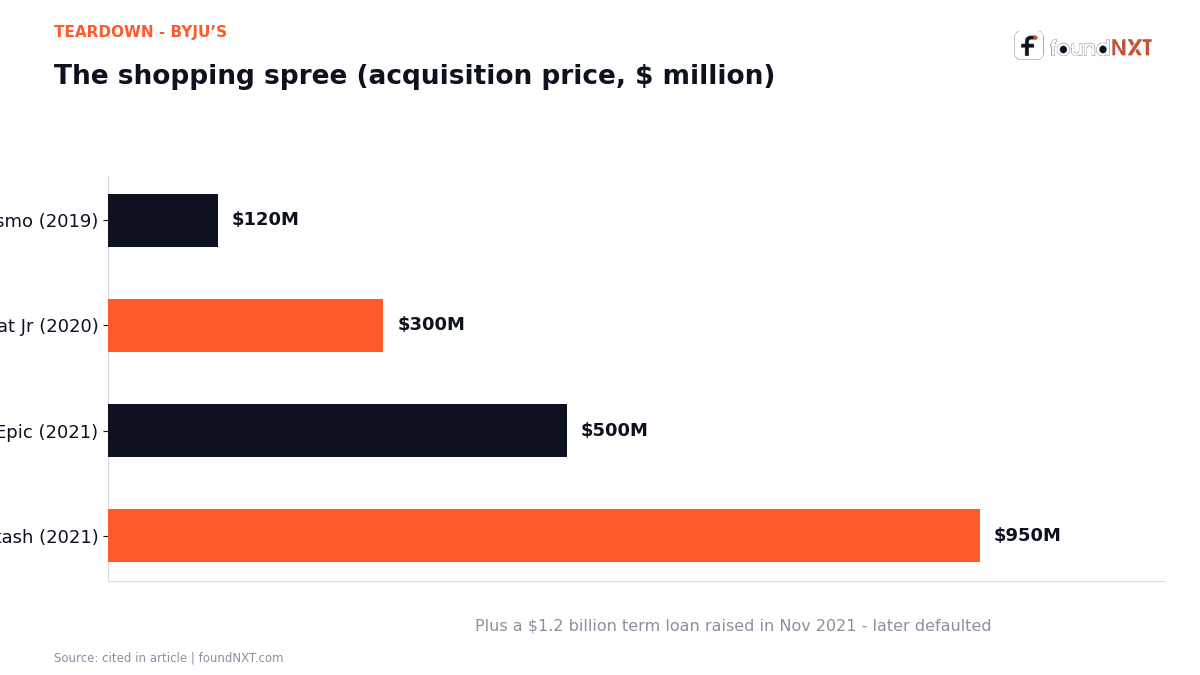
Between 2019 and 2021, Byju’s went shopping with other people’s money: Aakash for about 950 million dollars, Epic for 500 million, WhiteHat Jr for 300 million, Osmo for 120 million, plus Great Learning and Toppr. Some deals made strategic sense; together they created an unwieldy empire that was never properly integrated. Nine big acquisitions in 2022 alone, by the company’s own telling.
Add it up: the four headline deals alone – Aakash, Epic, WhiteHat Jr and Osmo – cost close to 1.9 billion dollars, nearly a third of everything the company had ever raised. The money went out at the exact moment the pandemic tailwind was about to reverse. And each acquisition arrived with its own team, codebase and sales culture to merge – integration costs that never show up in the press release.
2. Debt to fund growth
In November 2021, Byju’s raised a 1.2 billion dollar term loan – an enormous debt load for a company with no path to profitability. When growth stalled, that loan became a noose. The US unit defaulted and was pushed into Chapter 11 bankruptcy in February 2024.
Here is what a 1.2 billion dollar term loan means in practice. At the rates Byju’s agreed to, the annual interest bill alone ran to around a hundred million dollars – owed in cash, every year, whatever the business did. Equity investors wait for an exit that may never come; lenders get paid on schedule or they take the company. When revenue growth stalled in 2022, Byju’s could not service the loan, could not raise new equity to plug the gap, and could not sell assets fast enough. The US lenders eventually seized the American unit through the courts. Debt did not just fail to save the growth story – it shortened the company’s life.
3. Governance failure
Byju’s delayed its audited financials by over a year. Auditor Deloitte quit in June 2023, and three board members resigned the same month. When FY22 numbers finally appeared, the core business showed an operating loss of about 290 million dollars. Delayed audits are not an accounting problem; they are a trust problem – investors, employees and parents all read them as a warning.
Why do delayed audits matter so much? Because audited numbers are the only ground truth in a private company. Valuations are opinions and press releases are marketing, but an auditor’s signature is a promise that someone independent checked. When Byju’s long-delayed FY21 numbers finally arrived, they restated revenue sharply downward from what the company had earlier told the world. From that point on, every rupee the company claimed to earn was suspect, and partners began pricing in worst-case risk even where nothing was proven.
4. Toxic sales practices
To justify the valuation, Byju’s pushed aggressive sales targets. Stories piled up of salespeople pressuring middle-class parents into loans for courses their children did not need. The brand – built on a teacher’s credibility – curdled into a synonym for predatory sales.
The mechanics were simple and ugly. A salesperson would target a family earning Rs 30,000-50,000 a month, run a child through a “free” counselling session designed to manufacture guilt, and close a multi-year course costing Rs 50,000 or more – often financed through a third-party loan the parents barely understood they were signing. By the time refund complaints flooded consumer forums, the damage was structural, not reputational. Trust businesses die by a thousand cuts like this.
5. Burning goodwill with investors
When investors tried to intervene, the company fought them. In February 2024, shareholders led by Prosus voted to remove Raveendran as CEO; the company declared the vote invalid. The same year it launched a desperate rights issue at a 99% valuation cut. BlackRock had already marked its stake down to about 1 billion dollars. Insolvency proceedings followed in India and the US.
The speed of the unravelling deserves its own line. In March 2022 the company closed a round at 22 billion dollars. Within two years: the auditor gone, the board split, the CEO fighting his own shareholders, salaries unpaid, and a rights issue valuing the company at roughly 250 million dollars – about 1% of the peak. There may be no faster destruction of that much value in startup history.
The company is worth zero. What did I do wrong? I made a lot of mistakes.
Byju Raveendran, founder, October 2024 (Reuters)
The lessons, one by one
The global mirror: WeWork’s identical disease
If Byju’s arc feels familiar, it is because WeWork ran the same playbook in America. A charismatic founder, a valuation that hit 47 billion dollars on SoftBank’s cheques, breakneck expansion, governance red flags that everyone ignored while growth covered them – then one demand for accountability, in WeWork’s case a failed IPO filing, and the paper value evaporated. WeWork filed for bankruptcy in 2023; SoftBank wrote off over 14 billion dollars.
The deeper lesson both companies teach: governance is not paperwork. It is the immune system that stops small lies from becoming fatal ones. Byju’s delayed audits, WeWork’s self-dealing leases – in each case, sophisticated investors sat on the board, watched it happen and failed to stop it. When the market turned, the governance discount went to 100%.
The lessons, one by one
- Growth bought with debt is a bet, not a plan. Equity forgives; debt collects. Before you borrow against future growth, read when a loan actually beats giving away equity.
- Audit delays are a death spiral. The moment stakeholders cannot trust your numbers, every other problem becomes unsolvable.
- Acquisitions do not fix unit economics. Buying revenue is not the same as earning it. If the core engine leaks, adding engines makes it leak faster.
- Sales culture is brand. In education – a trust business – one coerced parent costs you a hundred future customers.
- Valuation is not validation. Twenty-two billion dollars of paper value could not survive one demand for accountability. The bridge rounds and down rounds playbook exists for companies that catch this early; Byju’s caught it too late.
Important: The human cost landed on the wrong people. Thousands of employees went unpaid for months, vendors were left holding dues, and parents who bought multi-year subscriptions watched the service crumble. Collapse mechanics always transfer pain downhill.
Where the wreckage stands
Byju’s is now in insolvency resolution in India – the case was admitted after a dispute over unpaid dues to the cricket board BCCI – with a resolution professional running what is left. The pieces are being sold off: the US units went through bankruptcy sales at cents on the dollar, and Aakash, the one genuinely good business in the pile, kept operating at arm’s length and drew buyer interest of its own. Raveendran still insists the company can be revived. The market has already answered.
The cruel irony is that the demand Byju’s rode was real – Indian parents do spend on education, and online learning did not die with the pandemic. Physics Wallah, which we cover in this same series, proved the model can work with discipline. Byju’s did not fail because edtech failed. It failed because speed, debt and governance rot compound faster than revenue.
Enjoyed this teardown? We break down one Indian startup story like this every week – the numbers, the mistakes, the lessons. Join the Weekly Founder Brief and get the next one in your inbox.
Sources
FoundNXT publishes independent business intelligence, valuation frameworks, and startup teardowns. Nothing in this article constitutes financial, investment, legal, or tax advice. Company figures, market projections, and valuation metrics represent editorial estimates and regulatory filings. Always consult qualified legal counsel and certified financial advisors before executing investment rounds or financial agreements.