

📑 Table of Contents
- Loading headings…
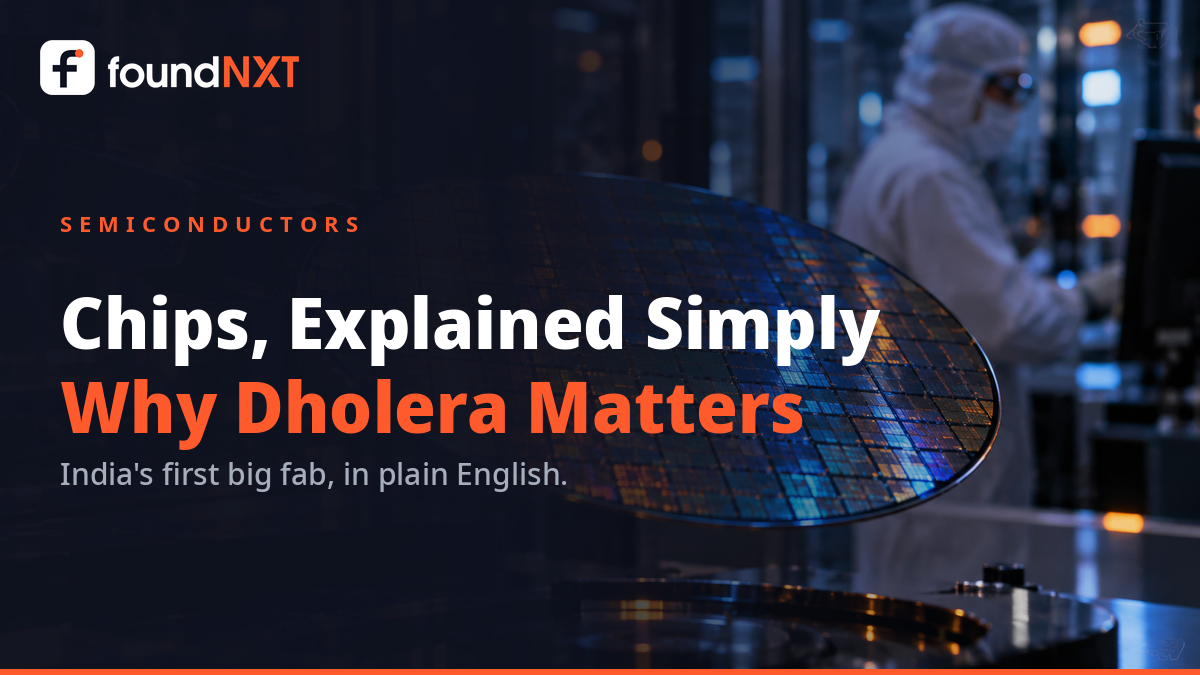
On Independence Day 2026, the Prime Minister told the country that India-made chips have started reaching the world. He was right, with a catch: as of early October 2026, five of the twelve semiconductor units approved under the India Semiconductor Mission are producing, but the biggest prize, Tata’s giant chip factory at Dholera in Gujarat, will not turn out its first wafer until 2028, later than first planned. This post explains, in plain language, what a fab actually is and why Dholera is worth the wait.
Chips in sixty seconds
A chip is a slice of silicon printed with billions of microscopic switches called transistors. The machine that prints them is a fab (short for fabrication plant), the most complex factory humans build: a single advanced fab costs more than an airport. After a fab prints the wafers, separate packaging plants (called ATMP or OSAT in India) cut the chips out, put them in protective shells with pins, and test them. You will read “nanometre” numbers like 90nm or 28nm: treat them as generations, like car models. Smaller means newer and faster, but most chips in the world, the ones in cars, power supplies, appliances and factory machines, do not need the newest generation at all.

What Dholera is, exactly
Dholera is India’s first serious attempt at a large commercial fab on home soil. Tata Electronics is building it with PSMC, a Taiwanese chipmaker, at a cost of about $11 billion (around Rs 91,000 crore). It will make the workhorse generations of chips, starting at 90 nanometres rather than the 28nm once discussed, Bloomberg reported in July 2026, with commercial production now expected around mid-2028 instead of end-2026.
Is the delay a failure? No. Building a fab means qualifying thousands of process steps before a single saleable wafer exists. For comparison, TSMC, the world’s best chipmaker, has faced multi-year delays on its new Arizona fabs. First-time countries slip; that is the rule, not the exception.
A fab is not a factory. It is the hardest thing human beings mass-produce.
Why a 2006-era chip still matters
The phone in your pocket runs on 3 or 4-nanometre chips. But your car, your ceiling fan regulator, your power meter and most factory robots run on old generations, and the world is desperately short of factories that make them. India’s carmakers, appliance brands and power companies import nearly all of these chips today, mostly from China, Taiwan and a handful of Western firms. Dholera is aimed exactly at that demand: boring, enormous and strategic. During COVID, a shortage of these same boring chips shut down car production lines across the world, including in India.
What India already produces
The headline chips of 2026 come from packaging, not fabs. Micron‘s plant at Sanand, Gujarat, which had its grand opening on 28 February 2026, packages and tests memory chips. Kaynes Semicon and CG Semi (a CG Power joint venture with Renesas and Stars Microelectronics) are also shipping from Sanand. And Tata is building a second giant at Jagiroad, Assam: a Rs 27,000 crore packaging plant planned to scale to 48 million chips a day. In all, the government has approved about a dozen units with committed investments near Rs 1.6 lakh crore.

Important note: packaging plants coming first is a feature, not a bug. They teach India the discipline of chip-grade manufacturing, cleanrooms, yields and quality systems, at a tenth of a fab’s cost. Every chip nation, from Taiwan to Vietnam, climbed this exact ladder.
The bottom line for founders
Dholera matters less for the chips it will print in 2028 and more for the ecosystem it forces into existence: chemical suppliers, equipment servicing, chip-design teams and trained engineers. That ecosystem is already pulling in startups, a theme we covered in Deeptech Rising. The government money behind the mission sits alongside the other schemes in our guide to government schemes founders ignore.
The chip journey in five steps
When you read that “India is making chips”, it helps to know which step is actually happening:

Today, India is strong at step one (a fifth of the world’s chip designers already work here for global firms) and is building steps three to five fast. Dholera is the attempt to own step two, the hardest one. That is why its 2028 date, however delayed, is the number the whole plan is judged by.
The global context makes the bet obvious. The US is spending over $50 billion on its CHIPS Act to bring fabs home. China spends far more. Every major economy concluded the same thing after the COVID chip shortage: you cannot run a modern economy on someone else’s silicon. India’s Rs 76,000 crore semiconductor programme is its entry fee into that club.
There is a human story here too. A fab the size of Dholera employs thousands directly and pulls entire supplier towns into existence around it: gases, chemicals, precision parts, maintenance crews. When Taiwan built its fabs in the 1980s, the suppliers that grew around them became world leaders in their own right. The real product of Dholera, in that sense, is not wafers. It is the ten thousand people who will know how to run a fab, a skill India has never had onshore before.
Your turn: did the Dholera timeline surprise you, or did you expect first chips sooner? Tell us in the comments. And for one plain-English read like this every week, join the Weekly Founder Brief, foundNXT’s free newsletter. Sign up below.
Sources
- Hindustan Times: where the Semiconductor Mission stands, 5 of 12 units producing (Sep 2026)
- Hindustan Times: first wafer from Dholera likely in 2028, says Vaishnaw (Sep 2026)
- Mint: Tata Electronics starts with older chip technology (Jul 2026)
- The New Indian Express: Dholera fab and Assam packaging plant on track (Sep 2026)
- Micron: grand opening of the Sanand facility (Feb 2026)
- Communications Today: India’s first chip shipments are real, not fabs (Sep 2026)
- PIB: approved semiconductor projects worth about Rs 1.6 lakh crore (Feb 2026)