
📑 Table of Contents
- Loading headings…

Between April and mid-October 2026, three quiet announcements told you where Indian deeptech goes after rockets and chips. The National Quantum Mission expanded its support to 17 startups. The new Rs 1 lakh crore RDI fund drew about 100 proposals at its technology board. And BIRAC, the biotech funder, closed in on 200 applications under the same framework. The next decade of Indian deeptech is being seeded right now, in quantum computing, biotechnology and advanced materials. Here is each bet, in plain English.
Bet one: quantum computing
A normal computer thinks in bits: zeros and ones. A quantum computer thinks in qubits, which can be zero and one at once, letting it attack problems, like simulating a new drug molecule or a new battery material, that would take today’s best machines longer than the age of the universe. India approved the National Quantum Mission in 2023 with Rs 6,003 crore over eight years, and it funds both research hubs and startups. The most visible startup is Bengaluru’s QpiAI, which has shown Kaveri, a 64-qubit superconducting processor. Others, like QNu Labs, work on quantum-safe communication: the mission targets a 2,000-kilometre quantum-secured network, and quantum fabrication facilities now run at IIT Bombay and IISc Bengaluru. Globally, IBM and Google are racing past a thousand qubits, so India is buying itself a seat at the table rather than the lead, which is the honest, sensible goal for now.

Bet two: biotech and the bioeconomy
If quantum is the glamorous bet, biotech is the big one. India’s bioeconomy, everything from vaccines and enzymes to biofuels and lab-grown proteins, was already worth roughly $165 billion in 2024, and the government wants it at $300 billion by 2030. The BioE3 policy of August 2024 (biotechnology for economy, environment and employment) set the mission: manufacture biologics, chemicals and materials in India instead of importing them. The startup proof points exist: affordable CAR-T cancer therapy from an IIT Bombay spinoff, tissue engineering at Pandorum Technologies, and a contract-research industry that already serves the world’s pharma giants. The nearly 200 BIRAC applications under RDI this year say the pipeline is filling.
Bet three: advanced materials
The quietest bet may matter most, because every other industry sits on top of materials. Battery materials decide whether India’s EV dream runs on imports: companies like Log9 Materials work on cell chemistry and Lohum on recycling lithium from old batteries. Semiconductor materials decide whether the chip mission stands: one of the two approved fabs is a silicon carbide plant, the material for power electronics in EVs and grids. And further out sit superconductors, composites and specialty chemicals, where a single breakthrough builds an industry. Materials startups rarely trend on social media; they also rarely die of competition, because a working material is a moat you can hold for decades.
Every industrial revolution was, at the bottom, a materials revolution. The next one will be no different.

Important note: these are ten-to-fifteen-year bets. Do not judge them by next quarter’s funding headlines. Judge them by milestones: a stable qubit count, a drug in trials, a material in a customer’s product. That is how deeptech actually reports progress.
How to read the next decade
Rockets proved India can build hard things, chips are proving it can manufacture them. Quantum, biotech and materials will decide whether it can invent them. The money is arriving in slow, patient forms, missions, grants and long loans, because these fields cannot be built any other way. For the funding backdrop, see where the money went in 2026, and for the current wave these bets follow, Deeptech Rising.
The three bets, in one line each
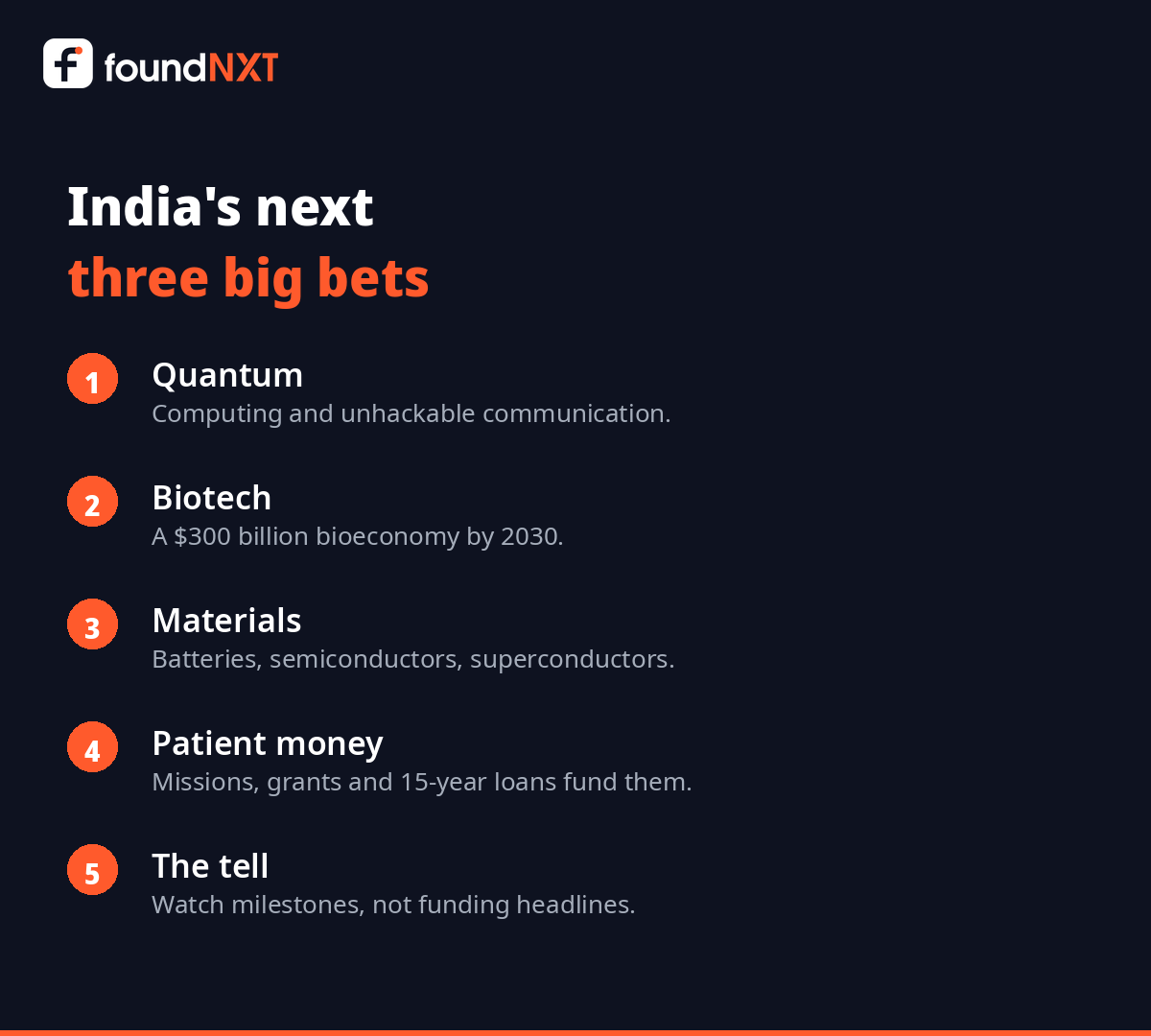
If you want to track these bets like an insider, ignore valuations and watch three dials: qubit counts that stay stable (not just big numbers on paper), drugs and therapies entering human trials, and materials shipping in a paying customer’s product. Each dial moves slowly, then suddenly. The founders building here are not chasing the next funding winter or summer; they are running a different race entirely, on the patient money described in the RDI numbers above.
What connects the three bets is that each has crossed from science project to funded national mission in the last three years. That is the pattern to notice: the Indian state has decided these are strategic industries, the way it decided space was in 1969 and IT services were in the 1990s. When that decision is made seriously, with missions, money and procurement behind it, industries get built. Not always on schedule, and never smoothly, but they get built.
There is a useful way to think about risk across the three. Quantum is the highest-variance bet: it could change computing, or it could remain a laboratory achievement for another decade, and nobody on Earth honestly knows which. Biotech is the most proven: India already runs a large vaccine and generics industry, so the question is upgrading it, not inventing it. Materials sit in between: certain demand, uncertain winners. A sensible deeptech portfolio, for the country or for an investor, holds all three rather than picking a favourite.
Your turn: quantum, biotech or materials: which one produces India’s next global champion? Tell us in the comments. And for one plain-English read like this every week, join the Weekly Founder Brief, foundNXT’s free newsletter. Sign up below.
Sources
- PIB: Quantum Mission expands startup support to 17 (Apr 2026)
- DST: startups selected under the National Quantum Mission
- National Quantum Mission: mission overview
- QpiAI: the Kaveri 64-qubit processor
- PIB: quantum fabrication facilities at IIT Bombay and IISc (Dec 2025)
- PIB: the first RDI call, with TDB and BIRAC numbers (Feb 2026)