📑 Table of Contents
- Loading headings…
In the first nine months of 2026, Indian AI startups raised more than $1.1 billion. Here is the uncomfortable truth behind that number: most of those companies do not own any AI. Their products run on models built by OpenAI, Google or Anthropic. Investors have a name for them – wrappers – and telling a good wrapper from a real AI company has become the core skill of AI investing.
If you are building or funding an AI product, this distinction decides valuations. Let’s make it simple.
Nearly every AI product is a wrapper in some technical sense. The real question is never “is it a wrapper?” but “what stops someone from replacing it?”
What a wrapper actually is
Think of a restaurant. A restaurant does not grow its own vegetables or raise its own chickens. It buys ingredients and adds a kitchen, a menu, service and ambience. Nobody complains that a restaurant is “just a wrapper” around a farm, because the value is obviously in everything around the ingredients.
An AI wrapper works the same way. The “ingredient” is a foundation model – a giant general-purpose brain like GPT or Gemini that you rent by the API call. The wrapper is everything you build around it: the interface, the prompts, the workflow, the integrations, the data. The question investors ask is how much of the meal is really yours.
Why investors suddenly care so much
Two reasons. First, the 2023-24 hype produced thousands of thin wrappers: a simple prompt over ChatGPT, a nice landing page, a $20 subscription. Most died when model providers improved their own products. Second, the feature risk: if your whole product is “ChatGPT, but for legal contracts,” what happens when ChatGPT adds a contracts button? Buyers and investors now test exactly this. As one M&A advisory put it, a product that a foundation-model provider could simply ship natively is treated as replaceable – and priced that way.
In India the stakes are higher because, as investors told Inc42, technology alone offers limited protection here – distribution becomes the moat. So the wrapper question decides who gets funded and who gets a polite pass.
The five tests investors actually run
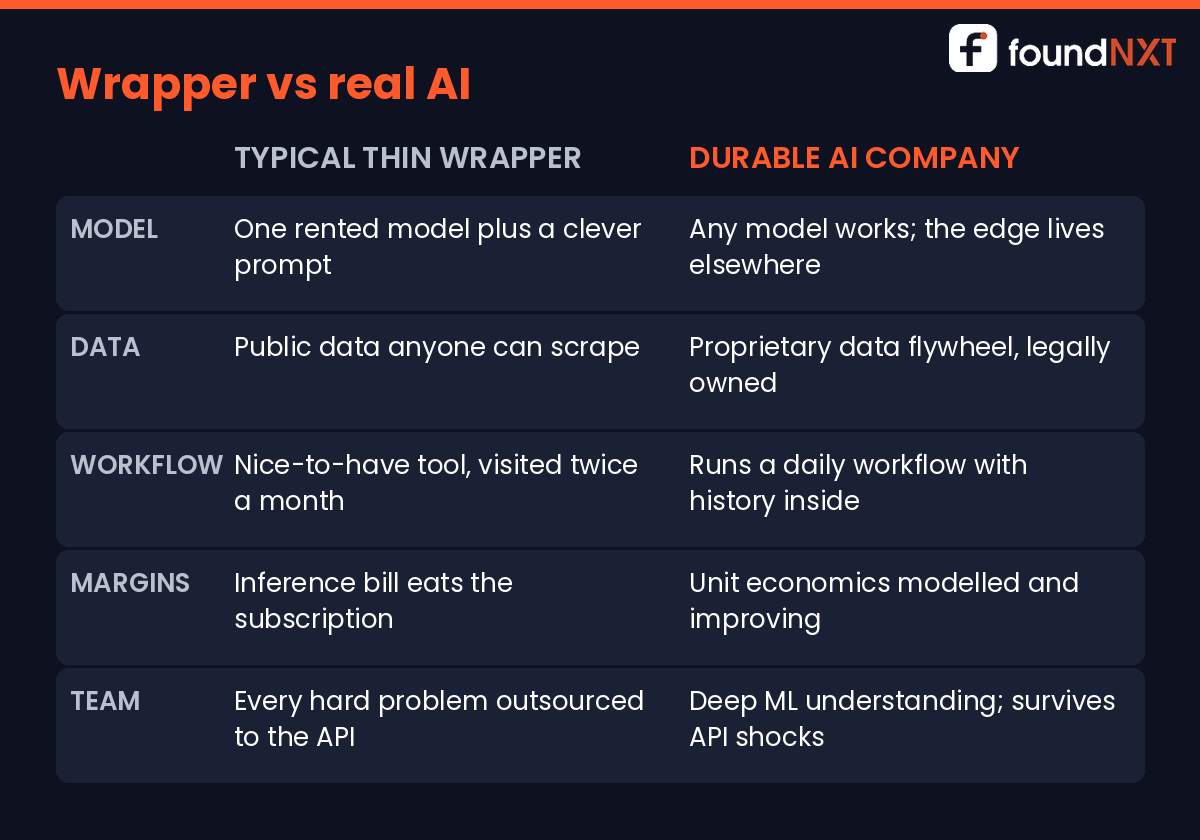
Technical due-diligence guides for AI deals (Kesho Partners, L40, BD Emerson and others) all circle the same five questions:
1. The replacement test. Could OpenAI, Google or a well-funded rival rebuild this in a year? If your edge is one clever prompt, the answer is yes. If your edge is a compounding data flywheel – every customer makes the product smarter for the next – the answer gets much harder.
2. The data rights test. Where did your training or tuning data come from, and do you have the legal right to use it? Proprietary data you collect with consent is a moat. Scraped data you do not own is a lawsuit waiting for a budget.
3. The workflow test. How deep does the product sit in the customer’s day? A chatbot you visit twice a month is easy to leave. A system that runs your invoices, support tickets or hiring pipeline – with your history inside – is painful to rip out. Buyers openly say they price retention and workflow depth, not the wrapper label.
4. The margin test. Every API call to a frontier model costs money. If your inference bill grows as fast as your revenue, you have built a toll booth on someone else’s road. Investors now model inference economics per customer before they sign a cheque.
5. The team test. Can this team actually build machine-learning systems, or is every hard problem outsourced to an API? Nobody expects a seed-stage startup to train models – but the team must understand its own stack deeply enough to survive a model provider changing prices or terms overnight.
Important note: “wrapper” is not an insult. Cursor, one of the fastest-growing developer tools ever, runs on other companies’ models. Harvey, the legal AI giant, started as a GPT wrapper. Both won on workflow depth and relentless product speed – not on owning a model.
Wrappers that won anyway
Cursor rents intelligence from OpenAI and Anthropic, but it owns the developer’s daily workflow so completely that switching feels like moving houses. Harvey went deep into one profession – law – with playbooks, templates and firm-specific data that a generic chatbot cannot match. And India’s Emergent hit $100 million in annual recurring revenue in eight months by owning one job – turning plain-English descriptions into working apps – end to end.
Notice the pattern: none of them won because of the model. They won because of everything around the model.

If you are pitching right now
Assume every investor you meet has a wrapper-detection checklist open in another tab. Preempt it: name your model dependency honestly, then show the flywheel, the retention numbers and the workflow depth that make it irrelevant. Founders who dodge the question look naive; founders who answer it look fundable. For the rest of what a 2026 investor expects, read Seed Round in 2026: What Investors Actually Want to See. And if the answer to “what stops someone from copying this?” is “nothing yet” – fix that before you raise, because weak moats are how startups fail.
Your turn: have you been called a wrapper in a pitch meeting? How did you answer? Tell us in the comments. For more investor-grade playbooks every week, join the Weekly Founder Brief, foundNXT’s free newsletter. Sign up below.
Sources
- Kesho Partners: The investor’s guide to AI technical due diligence
- L40: AI wrappers in M&A – do buyers actually pay for one?
- Refolk: The AI defensibility read – moat, wrapper, or feature
- Moqa Studio: Real AI or a wrapper – how to tell during diligence
- BD Emerson: AI due diligence in M&A
- Inc42: Indian AI startup funding surges 265% YoY in Q3 2026
FoundNXT publishes independent business intelligence, valuation frameworks, and startup teardowns. Nothing in this article constitutes financial, investment, legal, or tax advice. Company figures, market projections, and valuation metrics represent editorial estimates and regulatory filings. Always consult qualified legal counsel and certified financial advisors before executing investment rounds or financial agreements.