

📑 Table of Contents
- Loading headings…
In 2026, training a frontier AI model from scratch costs between $50 million and $500 million, according to industry cost guides published this year. Using the same class of model through an API costs between $0.50 and $15 per million tokens – roughly the price of a cup of chai for a day of heavy use. Between those two numbers sits one of the most expensive decisions a startup founder can make: do we build our own AI model, or rent someone else’s?
This post lays out the three real options, what each one costs in 2026, and the questions that tell you which camp your startup belongs in.
The three real options
Forget the jargon for a moment. Every startup using AI is doing one of three things:
- Rent (API): you call OpenAI, Anthropic, Google or an Indian provider over the internet and pay per use. You own nothing; you can be live in a week.
- Customise (fine-tuning or RAG): you take an existing open or commercial model and adapt it to your data – either by teaching it your style (fine-tuning) or by letting it look up your documents at answer time (RAG).
- Build (train from scratch): you gather data, rent a GPU cluster, hire a research team and train your own model. You own everything – including the bills.
What each option actually costs in 2026
Here is what current cost guides put on the price tag of each path:
- Train a frontier model from scratch: $50 million to $500 million+, plus 18 to 36 months and a team of 50 to 200 ML engineers.
- Full fine-tune of a mid-size open model: $2,000 to $50,000 per run; a serious enterprise fine-tuning project runs $50,000 to $200,000 once you count data labelling and evaluation, which eat 35 to 50% of the budget.
- A lightweight LoRA fine-tune: $50 to $500 in compute for a single run.
- A RAG system for a small business: $18,000 to $45,000 to build, versus $22,000 to $55,000 for a comparable fine-tuning setup.
- Pure API usage: $0.50 to $15 per million input tokens, with no infrastructure to own.
One distinction trips up even technical founders: RAG is not fine-tuning. RAG keeps the model as it is and hands it your documents to read before it answers – right when your product needs reliable access to your own data. Fine-tuning changes the model itself, teaching it a style, a format or a skill. Most startups that say “we need a custom model” need the first, not the second.

Important: the compute bill is usually the smallest line. Data curation, engineering time, evaluation and retraining are where AI budgets actually go. Any estimate that prices only GPU hours is missing most of the cost.
When building your own model actually makes sense
There are real reasons to own a model. India’s two best-known attempts show both of them. Sarvam AI, selected under the IndiaAI Mission to build a homegrown foundation model, is betting on Indian languages and data sovereignty – a case where the model itself is the product. Krutrim, from Ola’s Bhavish Aggarwal, raised at a unicorn valuation on a similar premise: an Indian model for Indian users. For both, the model is not a cost centre supporting an app. It is the company.
The pattern holds globally too. Building makes sense when at least one of these is true: the model is your product; you have data nobody else can get; regulation forbids sending your data to an outside API; or your usage is so massive that per-token fees exceed the cost of owning infrastructure. If none of those apply, building is usually a very expensive way to rent.
The path to “make” runs through “buy” now. You need a large model first – to validate the use case, to generate training data, to prove the value. The sequence is always: general-purpose model, proven value, then maybe own and specialise.
Five questions that settle it for most startups
- Is the model the product, or a feature? A feature should almost never be trained from scratch.
- Do you have proprietary data that creates the advantage? If yes, fine-tuning or RAG usually captures it without a $50M bet.
- What is your monthly volume? Below roughly 100,000 interactions a month, a frontier API is usually the cheapest system to run.
- Can you hire the team? A serious build needs dozens of scarce ML engineers – and they are the most contested hires in India right now.
- What does being wrong cost? An API bill can be switched off. A half-trained model is a write-off.
The bottom line
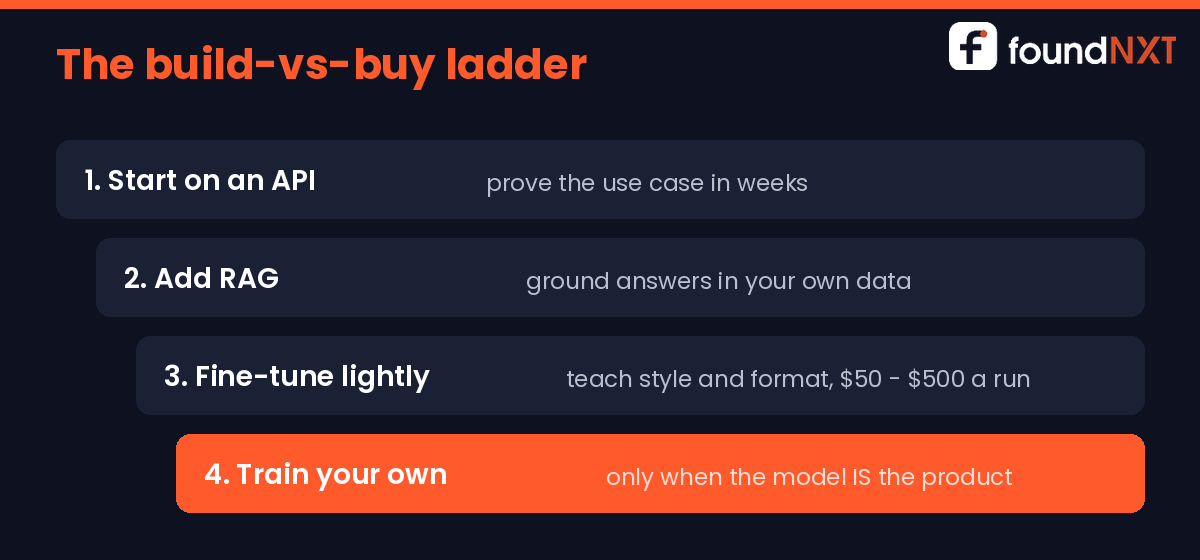
For most startups in 2026, the answer is boring and correct: start on an API, add RAG or a light fine-tune when you hit its limits, and treat “train our own model” as a decision you earn with revenue and data, not one you make in a pitch deck. The founders who get this right spend their scarce crores on distribution and customers – and let the model providers fight over who rents them intelligence cheapest.
Get one decision like this decoded every week. The Weekly Founder Brief breaks down the numbers behind startup and AI moves in plain words. Subscribe on foundNXT.
Sources
FoundNXT publishes independent business intelligence, valuation frameworks, and startup teardowns. Nothing in this article constitutes financial, investment, legal, or tax advice. Company figures, market projections, and valuation metrics represent editorial estimates and regulatory filings. Always consult qualified legal counsel and certified financial advisors before executing investment rounds or financial agreements.