

📑 Table of Contents
- Loading headings…
For a decade, ambitious Indian startups did the same thing: incorporate in Delaware or Singapore, raise in dollars, dream of Nasdaq. In 2026 the traffic is running the other way. Mint’s analysis of EY data counts nearly 20 Indian tech startups shifting, or preparing to shift, their headquarters back to India, with 13 already done or mid-process. The move has a name: the reverse flip.
What a reverse flip actually is
A “flip” is when an Indian-founded company puts a foreign holding company on top, usually to raise global capital or list overseas. A reverse flip dismantles that structure and merges everything back into the Indian entity, typically through a share swap where foreign investors exchange shares in the overseas holdco for shares in the Indian company. The process usually takes three to six months, and new fast-track merger rules have made it significantly quicker than the old court-driven route.
Who has come home

PhonePe started the modern wave in 2022, paying a reported ₹8,000 crore in taxes to move from Singapore. Groww flipped from the US and became the first Indian startup to go public after a US-to-India move. Razorpay completed its flip in 2025 at a tax cost of about ₹1,245 crore, with an IPO expected within 18-24 months. Zepto has moved its holding company back, and Flipkart is mid-flip from Singapore ahead of its long-awaited listing.
Why the math changed
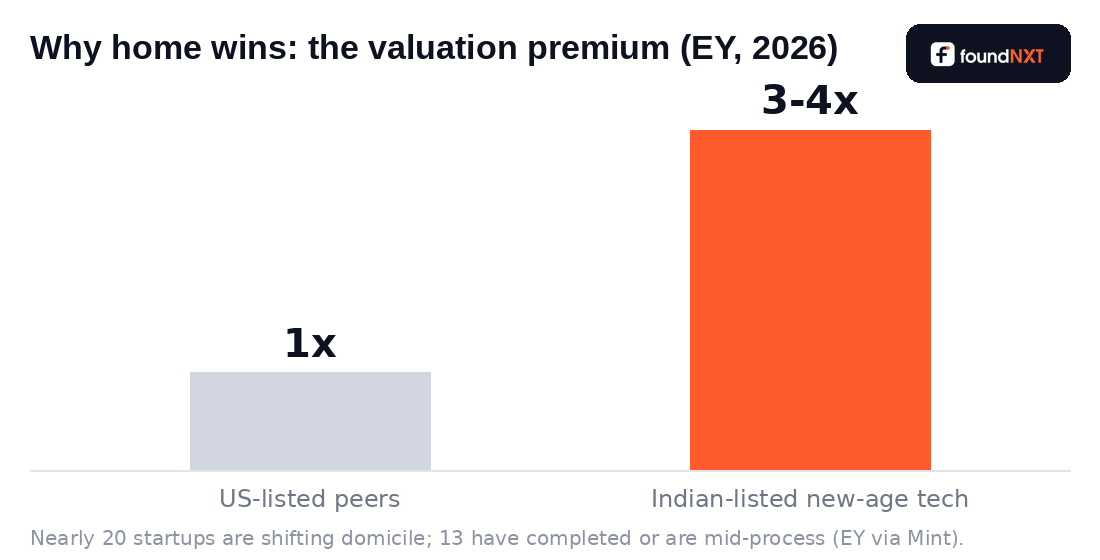
- Valuations: Indian-listed new-age tech trades at roughly 3-4 times the multiples of US-listed peers, per EY.
- Liquidity: domestic institutions and retail now absorb billion-dollar tech IPOs; US markets barely look at companies valued under $50 billion.
- Comprehension: Indian investors understand UPI-led scale and local distribution better than global funds ever did. Zomato’s post-IPO run and Nykaa’s steady valuation made the point.
- Regulation: Indian rules now favour domestic structures for payments, data and listings, while the overseas-structure advantages have faded.
None of the companies’ plans for flipping their domicile are changing. Everybody is going ahead with the flips no matter when they debut.
Prashant Singhal, Partner and India Markets Leader, EY
The costs nobody puts in the deck
A reverse flip is not free. Share swaps can trigger capital gains tax for existing investors, as PhonePe’s ₹8,000 crore bill showed. Companies can also lose the ability to carry forward past losses against future profits. And a flip consumes months of management bandwidth right when the company is preparing to be public.
Important: flipping home makes sense if your business, customers and eventual IPO are Indian. If your revenue is global and your listing will be in New York, a reverse flip adds tax and complexity for nothing. This is a destination decision, not a patriotism test. Model the taxes and the loss carry-forward question with your advisors before you move.
For early-stage founders, the lesson is simpler: the default has flipped too. Incorporating in India from day one now costs you little and may save you a nine-figure tax bill later. If you are still structuring for a future raise, read what seed investors want in 2026 and our 2026 IPO wave before you sign anything offshore.
Worked example: why a ₹1,245 crore tax bill can be rational
Razorpay paid roughly ₹1,245 crore in taxes to complete its flip. That sounds insane until you run the listing math, simplified here for illustration. Say a company would list in the US at a $3 billion valuation. Indian markets, pricing the same business at 3-4 times richer multiples, might support something dramatically higher. Even a one-turn difference in the multiple is worth billions of dollars of market value, which dwarfs a ₹1,000+ crore one-time tax cost. PhonePe’s investors accepted a reported ₹8,000 crore bill on the same logic. The flip is not an expense; it is a re-rating trade.
Why they flipped out in the first place
The original flips were not betrayal; they were the only option on the menu. Through the 2010s, US venture funds wrote cheques into Delaware C-corps by default, ESOPs were cleaner under US law, and India taxed and regulated foreign structures in ways that scared investors. Singapore offered a middle path with tax treaties and predictable courts. Three things dismantled that logic: India rewrote the rules (fast-track mergers, startup-friendly tax changes, deeper capital markets), US markets stopped rewarding mid-cap tech, and Indian public investors developed a taste for exactly the UPI-and-logistics stories foreign investors undervalued. The global parallel runs the other way too: companies like Wise chose London over New York for the same reason, list where you are understood.
Tracking India’s IPO pipeline? The Weekly Founder Brief breaks down one big move every week in plain words. Subscribe on foundNXT.
Sources
- Mint – Startups keep bringing headquarters home (EY data)
- TechCrunch – Groww set to be first startup to list after US-to-India move
- The Hindu BusinessLine – Razorpay completes reverse flip
- Moneycontrol – Razorpay’s ₹1,245 crore tax bill, IPO timeline
- The Economic Times – Reverse flipping gathers steam: what to know
FoundNXT publishes independent business intelligence, valuation frameworks, and startup teardowns. Nothing in this article constitutes financial, investment, legal, or tax advice. Company figures, market projections, and valuation metrics represent editorial estimates and regulatory filings. Always consult qualified legal counsel and certified financial advisors before executing investment rounds or financial agreements.