

📑 Table of Contents
- Loading headings…
For twenty years, the Indian startup story had three pin codes: Bengaluru, Delhi NCR and Mumbai. Everything else was a footnote. That is changing faster than most founders realise. A March 2026 Tracxn report counts more than 68,000 startups headquartered beyond India’s key startup hubs, which together raised about $3.2 billion across roughly 2,200 funding rounds between 2016 and 2025. Seed funding in these emerging ecosystems has grown more than 6 times over the decade.
These are not lifestyle businesses. Tracxn’s data shows 102 acquisitions and 33 IPOs from non-metro startups over the same period, and two of them, CarDekho (Jaipur) and Molbio Diagnostics (Goa), have crossed the billion-dollar valuation mark. The question is no longer whether a tier-2 city can produce a unicorn. It is which city produces the next one.
The case for the tier-2 founder
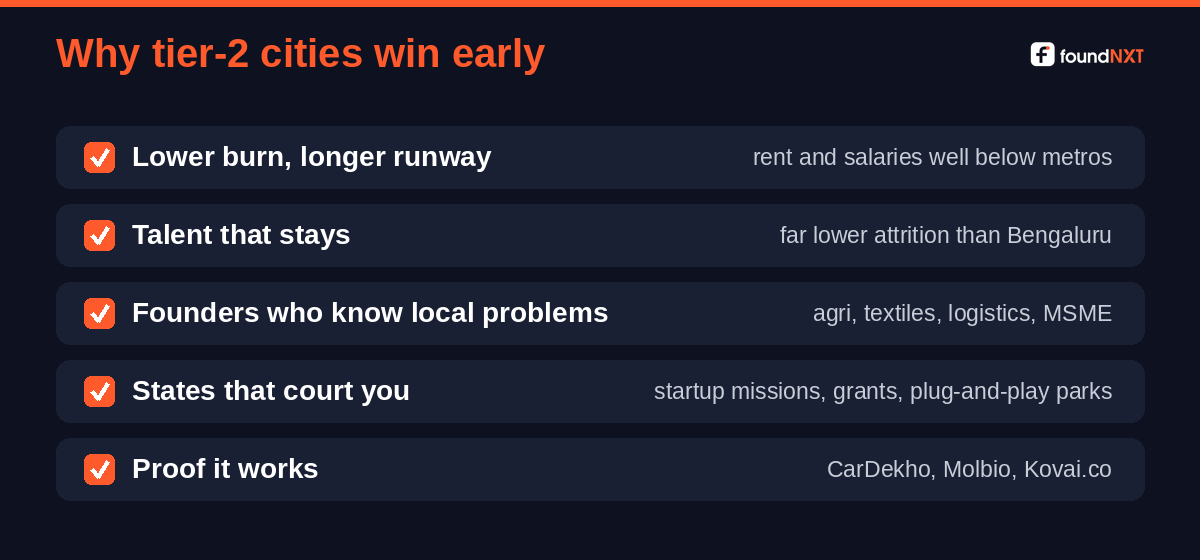
The maths starts with burn. Office rent, salaries and living costs in Coimbatore, Indore or Kochi run well below metro rates, which means the same seed cheque buys a much longer runway. If you have read our 18-month runway math, you know survival is a function of months, not millions.
Then there is talent. Attrition in Bengaluru’s hot job market can gut a young company; in tier-2 cities, good engineers and operators stay for years. And founders in these cities often understand problems that metro founders never see: textile supply chains in Coimbatore, agri logistics in Indore, MSME finance in Surat.
The proof is on the ground. Kovai.co, bootstrapped out of Coimbatore, crossed $10 million in annual recurring revenue, employs more than 290 people across Coimbatore and London, and serves over 2,500 enterprise clients worldwide, without a rupee of venture capital. Its CEO Saravana Kumar now openly talks about turning Coimbatore into a SaaS hub.

Where the next wave is forming
Tracxn’s report makes an important point: this is not a uniform spread. Growth is clustering in a handful of regional nodes.
- Jaipur: the strongest non-metro ecosystem, home to CarDekho and a deep bench of funded startups, as Inc42’s Jaipur funding list shows.
- Coimbatore: a SaaS and manufacturing-tech cluster anchored by bootstrapped successes like Kovai.co.
- Indore and Surat: consumer and commerce startups riding local demand.
- Kochi and Lucknow: rising nodes backed by active state startup missions.
Cities such as Jaipur, Surat, Indore, Coimbatore, Kochi, and Lucknow account for a disproportionate share of venture creation.
Tracxn, Startup Growth Beyond India’s Key Startup Hubs report, March 2026
Sectorally, these ecosystems lean toward edtech, internet-first media, fashion tech and online grocery, businesses that match regional consumption and need less capital than deeptech. That demand-led pattern is a feature, not a bug: it produces companies with real revenue early.
What is still hard
Be honest about the gaps. Late-stage capital barely leaves the metros. Non-hub startups account for just 8.6% of national funding rounds, and mega rounds remain concentrated in the big three hubs. Angel networks are thinner, senior hires are harder, and your first enterprise customer may still expect a Bengaluru address.
Important: a tier-2 base is a weapon only if your market does not need you elsewhere. If your customers, talent pool or regulators sit in one metro, the cheaper rent is a trap, not an edge. Choose the city after you choose the problem, not before.
The playbook for building from a smaller city
- Pick a problem your city understands. Coimbatore knows manufacturing; Indore knows trading; build where the knowledge is.
- Use the cost edge deliberately. Lower burn is permission to experiment longer, not an excuse to grow slower.
- Raise from metro funds remotely. Post-2021, seed investors take calls from anywhere; read our notes on raising in a concentrated market.
- Take the free money. State startup missions and central schemes actively favour non-metro founders; we mapped them in Free Government Money.
- Plug into networks. Communities like SaaSBoomi and Headstart now run active chapters in tier-2 cities, which closes most of the network gap.
The next unicorn from Coimbatore will not look like an accident. It will look like the logical result of cheaper burn, stickier teams and founders who finally stopped moving to Bengaluru to be taken seriously.
Building outside the metros? The Weekly Founder Brief breaks down one big move in Indian startups every week, in plain words. Subscribe on foundNXT.
Sources
- Tracxn – Startup Growth Beyond India’s Key Startup Hubs (March 2026)
- Fortune India – 68,000 startups beyond major hubs, funding remains concentrated
- Storyboard18 – 2,200 deals, $3.2 billion raised by regional startups
- Inc42 – Top 30 funded startups in Jaipur (2026)
- Kovai.co – CEO insights, bootstrapped SaaS from Coimbatore
FoundNXT publishes independent business intelligence, valuation frameworks, and startup teardowns. Nothing in this article constitutes financial, investment, legal, or tax advice. Company figures, market projections, and valuation metrics represent editorial estimates and regulatory filings. Always consult qualified legal counsel and certified financial advisors before executing investment rounds or financial agreements.