

📑 Table of Contents
- Loading headings…
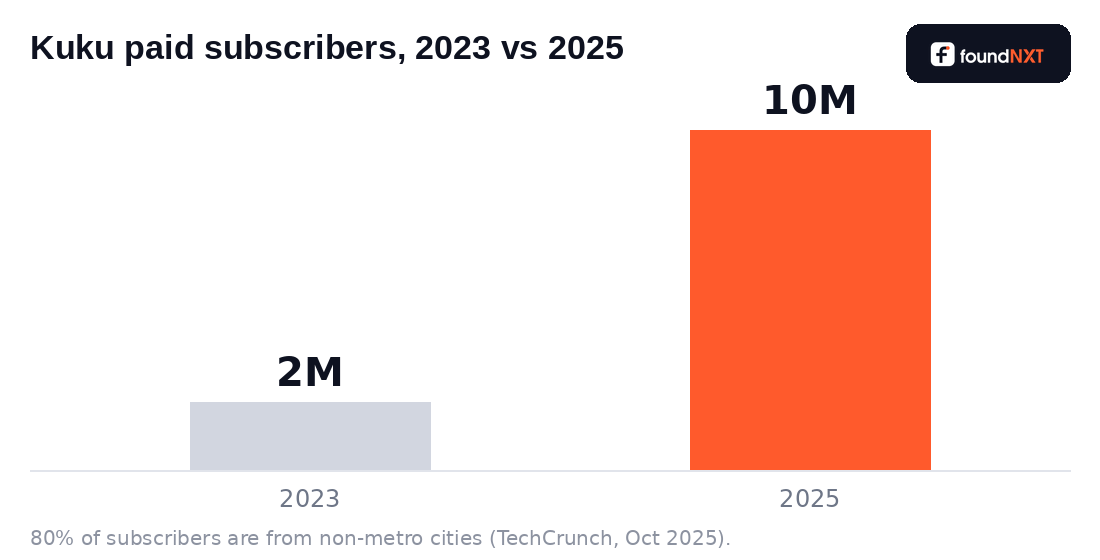
In October 2025, a Bengaluru startup most metro investors had never used raised $85 million at a roughly $500 million valuation. Kuku’s Series C, led by Granite Asia, is the loudest signal yet of where Indian consumer internet is heading: content in Indian languages, paid for by small-town users. Kuku now has 10 million paying subscribers, up from 2 million in 2023, and about 80% of them live outside the metros.
The market beneath the metros
The raw ingredients have been assembling for years. India has close to a billion internet subscribers and around 700 million smartphone users, with some of the cheapest data in the world. Prime Minister Narendra Modi has remarked that 1GB of data in India costs less than a cup of tea. UPI made a ₹29 subscription payable in two taps. Put cheap data, easy payments and a half-billion new rural users together, and you get a paying audience that did not exist five years ago.
1GB of data in India costs less than a cup of tea.
Prime Minister Narendra Modi, on India’s data affordability
The formats that are winning
This is not just “YouTube, but in Hindi.” New formats are being built for this audience:
- Audio series: Kuku FM’s original game, long stories told in episodes across eight-plus languages.
- Microdramas: vertical, bite-sized serial fiction designed for phones. Kuku TV leans on it, and even Meta has launched a microdrama series for Indian Gen Z.
- Regional OTT: STAGE raised $12.5 million to expand its Haryanvi, Rajasthani and Bhojpuri content play.
- Devotional: apps like Kuku Bhakti turn faith content into a subscription product.

Why the economics finally work
Two shifts made the model viable. First, the creator base moved to small towns: more than half of Kuku’s roughly 10,000 creators are from non-metro cities, and the company pays out about ₹40 crore a month to them. Second, AI cut production costs: Kuku runs a generative AI studio for translation, scripts, titles and thumbnails, while humans still perform the actual shows. Cheap supply plus a paying audience equals a business.
Important: vernacular ARPU is still thin, and content is a hits business. Subscriber growth is real, but churn in price-sensitive markets is brutal, and global giants are circling the same users. The winners will be platforms that own a language and a format deeply, not those that spray content across all of them.
The founder takeaway
The first consumer wave was English-first and ad-funded. This one is language-first and subscription-funded, and it compounds with everything else we track: the voice-first Bharat shift and the AI tooling that lets small teams produce at studio scale. If you are building consumer in India and your roadmap assumes English users, you are fishing in the smaller pond.
Worked example: the unit economics of a ₹99 subscriber
How does a business built on ₹99-month subscribers from small towns make money? Look at the shape of Kuku’s model, simplified for illustration. Ten million paying users at low price points still produce hundreds of crores of annual subscription revenue. Costs split three ways: creator payouts (about ₹40 crore a month across roughly 10,000 creators), technology, and marketing. AI compresses the middle: Kuku’s generative studio handles translation, scripts, titles and thumbnails, so one show ships in eight-plus languages without eight production teams. And the supply side is structurally cheap because more than half the creators are themselves from small towns, recording from home studios. The result is a content business with SaaS-like gross margins serving users global platforms cannot monetise with ads alone.
The global parallel, and why India is different
Hollywood’s version of this bet was Quibi: premium short-form video for phones, which raised $1.75 billion and shut down within a year. China’s version was microdramas, which became a multi-billion-dollar industry and exported the format worldwide through apps like ReelShort. India is following the Chinese path, not the American one, for three reasons: data is nearly free, UPI micropayments actually work at ₹29-99 price points, and the audience prefers fiction in its own language over subtitled Hollywood. Even Meta has acknowledged the shift by launching a microdrama series aimed at Indian Gen Z. When the world’s largest social company copies your format, the wave is real.
Tracking India’s consumer internet? The Weekly Founder Brief breaks down one big move every week in plain words. Subscribe on foundNXT.
Sources
FoundNXT publishes independent business intelligence, valuation frameworks, and startup teardowns. Nothing in this article constitutes financial, investment, legal, or tax advice. Company figures, market projections, and valuation metrics represent editorial estimates and regulatory filings. Always consult qualified legal counsel and certified financial advisors before executing investment rounds or financial agreements.