
📑 Table of Contents
- Loading headings…
Two nineteen-year-olds drop out of Stanford, move to Mumbai, and start delivering groceries in 10 minutes. Four years later, their company Zepto is worth 7 billion dollars, does Rs 11,110 crore in annual turnover, and is marching toward an IPO. It is also losing money on a heroic scale. Zepto is the purest example in India today of a strategy as old as Amazon: burn billions to own a market before anyone else can.
The insight: 10 minutes changes behaviour
Aadit Palicha and Kaivalya Vohra started Zepto in 2021, during lockdown, after their first grocery startup KiranaKart stalled. Their insight was not that people want groceries online – everyone knew that. It was that speed is a habit-forming drug. When your dosa batter arrives in 10 minutes, you stop planning grocery runs. You order small, often, impulsively. Order frequency explodes, and with it the value of each customer.
The machinery behind that promise is the dark store: small warehouses placed inside neighbourhoods, stocking 6,000-odd high-velocity items, staffed by pickers who pack an order in under two minutes. No walk-in customers. Just inventory, algorithms and riders.
Here is the unit math that decides everything. A dark store costs roughly Rs 40-60 lakh to set up and carries heavy monthly fixed costs – rent, pickers, electricity, wastage. Say a store earns a 20-25% gross margin on an average basket of Rs 500-600: every order contributes maybe Rs 100-150 before delivery and overheads. At 300 orders a day, that contribution cannot cover the store’s fixed costs, let alone the riders. At 1,200 orders a day, the same store comfortably pays for itself and starts paying back its setup cost. Same store, same staff, same rent – the only variable is density. That is why Zepto, Blinkit and Instamart fight street by street instead of city by city.

The numbers: growth that costs a fortune
Zepto’s FY25 turnover hit Rs 11,110 crore, up 150% from Rs 4,454 crore in FY24. In FY24 it lost Rs 1,248 crore – spending Rs 1.29 to earn every rupee – though Palicha says losses have roughly halved since, on better unit economics, higher fill rates and stronger contribution margins. The company claims around 3 billion dollars in annualised gross order value.
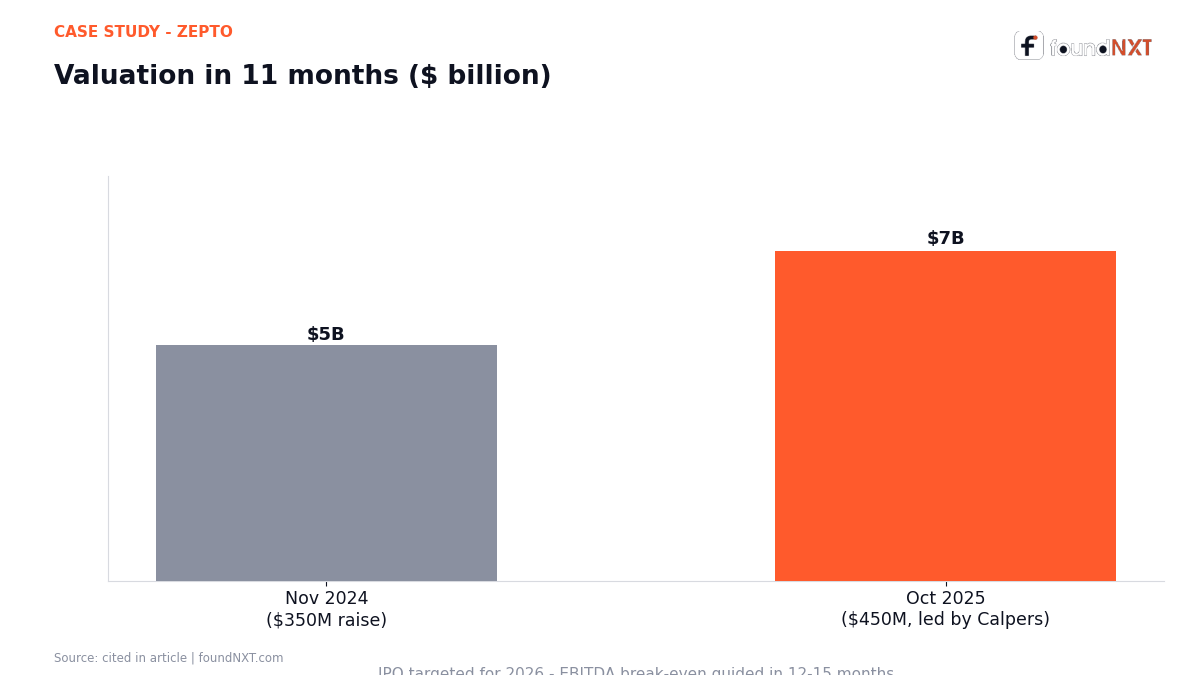
To fund the land grab, Zepto raised relentlessly: 350 million dollars in November 2024 at a 5 billion dollar valuation, then 450 million dollars in October 2025 at 7 billion, in a round that drew in Calpers – one of America’s largest pension funds writing a cheque to a 23-year-old’s grocery startup. An IPO is targeted for 2026, with EBITDA break-even guided 12-15 months out.
Lay the cheques end to end and the pace is striking: about 60 million dollars in 2021, 200 million in early 2022, then 665 million in June 2024 at a 3.6 billion valuation, 350 million that November at 5 billion, and 450 million in October 2025 at 7 billion. That is roughly 1.7 billion dollars raised in about four years – nearly all of it converted into dark stores, inventory and discounts.
Zepto is not a grocery company that is fast. It is a logistics and density company that happens to sell groceries.
The bull case, in one line
Why the burn can be rational – and when it isn’t
The global mirror: quick commerce’s graveyard
The founders: young was the edge, not the risk
Palicha and Vohra were still teenagers when Zepto launched, and investors initially treated their age as a risk to underwrite. It turned out to be the strategy. They had no memory of “how retail is done”, so they questioned everything: why two-day delivery, why two-hour slots, why not ten minutes? They also had nothing to protect – no careers, no reputation to lose – so they could bet the company on speed while incumbents were still running pilot programs.
The discipline underneath the story is easy to miss. KiranaKart, their first attempt, stalled because the economics did not work; instead of pushing harder on a broken model, they shut it down and rebuilt around the one thing customers responded to. Most founders twice their age never learn to do that.
The global mirror: quick commerce’s graveyard
If Zepto’s burn makes you nervous, it should – the global quick commerce industry is a graveyard. Getir, the Turkish pioneer once valued at nearly 12 billion dollars, pulled out of the US, UK and Europe in 2024 after its losses became unfundable. GoPuff, America’s answer, went through repeated layoffs and warehouse closures and saw its valuation slashed from 15 billion dollars. Europe’s instant-delivery darlings – Gorillas, Flink, Jokr – were sold, merged or shut down.
Why does India look different? Density and labour. Indian cities pack more households into a delivery radius than almost anywhere in the West, and rider costs are a fraction of American or European wages. The same dark-store math that bankrupts a company in Berlin can work in Bandra. That does not make Zepto safe – it makes India one of the few markets where the model has a fair chance, which is exactly why the capital keeps coming.
Why the burn can be rational – and when it isn’t
Quick commerce is a density game. A dark store loses money at 300 orders a day and prints money at 1,200. Every rupee of burn buys density – more stores, more customers per store, better delivery economics – and density, once won, is brutally hard for a competitor to take away. Blinkit (Zomato) and Swiggy Instamart know this too, which is why all three keep pouring cash into the same neighbourhoods. Blinkit’s net order value hit Rs 22,731 crore in FY25 and Instamart’s gross order value Rs 14,600 crore – bigger than Zepto, but Zepto is the only independent of the three.
The three-way fight matters because quick commerce is no longer a side bet for anyone. Blinkit is now Zomato’s main growth engine and the reason its stock re-rated. Swiggy listed in late 2024 with Instamart at the centre of its story. Amazon has entered with “Now” pilots and Flipkart launched Minutes. When the country’s largest internet companies all chase the same habit, the prize is bigger than groceries: whoever owns the 10-minute habit owns the front door to Indian e-commerce.
The risk is equally simple: if the capital tap closes before density matures, the whole machine stalls. We have watched that movie – it is how most startups die, and it is exactly what happened to Dunzo, the pioneer Zepto displaced. The difference between “burning to win” and “burning to die” is whether unit economics improve faster than cash runs out – the same math in the 18-month runway framework.
Watch the metric that settles the argument: contribution margin per order, after variable costs but before overheads. Zepto says that number has been climbing steadily, which is what “the burn is working” means in accounting terms. If it stalls while cash dwindles, the story flips from Amazon to Getir very quickly. That single line in the IPO prospectus will tell you which movie you are watching.
Important: “Burning billions won quick commerce” describes the market, not a guarantee. Zepto has won a seat at the table. Whether the seat pays for itself gets decided between now and the IPO.
What founders should take from Zepto
- Speed of iteration beats pedigree. Two teenagers out-executed Swiggy and Zomato for two years because they shipped faster and obsessed over one metric: delivery time.
- Pick markets where scale fixes the economics. If your costs fall as you grow, aggressive burn is an investment. If they don’t, it is a bonfire – the first question in where the money actually went.
- Own the narrative with numbers. Palicha publishes GOV, loss reduction and store economics openly. That transparency is fundraising strategy – it kept the rounds coming when the market turned selective.
- Category creation beats category entry. Zepto did not fight the kiranas or the supermarkets; it made “10 minutes” the category and made everyone else answer to it.
- Raise before you need to. Zepto stacked capital while its numbers were improving, not after they turned. By the time the market got selective, it already had the war chest – and the option to keep burning on its own terms.
Zepto’s founders like to say they are still in the first half. True or not, the next eighteen months – narrowing losses, an IPO filing, public-market scrutiny of every dark store – will decide whether “burn billions to own the market” joins Amazon in the strategy hall of fame or Getir in the graveyard.
Enjoyed this case study? We break down one Indian startup story like this every week – the numbers, the strategy, the lessons. Join the Weekly Founder Brief and get the next one in your inbox.
Sources
- Entrackr – Zepto revenue soars 2.5x to Rs 11,110 Cr in FY25
- Reuters – Zepto raises 450 million dollars at 7 billion valuation
- TechCrunch – Zepto’s raise as Indian quick commerce heats up
- Financial Express – Zepto revenue soars 149% in FY25
- Reuters – Getir pulls out of Europe and the US (2024)
- CNBC – Gopuff cuts workforce, closes warehouses
FoundNXT publishes independent business intelligence, valuation frameworks, and startup teardowns. Nothing in this article constitutes financial, investment, legal, or tax advice. Company figures, market projections, and valuation metrics represent editorial estimates and regulatory filings. Always consult qualified legal counsel and certified financial advisors before executing investment rounds or financial agreements.