

📑 Table of Contents
- Loading headings…
Think of a Tuesday evening in Coimbatore. A 26-year-old named Karthik closes his laptop after another long day at a job he does not love. He has Rs 30,000 in savings, a phone with decent data, and a nagging thought: “What if I just started something?”
Then the doubts arrive, as they always do. I do not have crores. I do not have a team. I do not even have a proper idea.
Here is the good news we keep seeing in the stories we cover on FoundNXT. Many of India’s most admired companies did not begin with big money. Zoho grew from a small town in Tamil Nadu without venture funding, and Zerodha became a billion-dollar business without VC money. Money helps, but it is rarely the first thing a business needs. The first thing it needs is a real customer with a real problem.
So here are 25 ideas you can start with very little cash in 2027. We have grouped them so you can find the one that fits your skills. Each one comes with a rough starting cost (approximate, so adjust for your city), a plain-language picture of how it works, and a first step you can take this week.

Group 1: Ideas you can run from a laptop
1. Social media and content for local businesses (Rs 5,000 to 20,000). Walk down any market street and look at the shops’ Instagram pages. Many are dead or missing. A dentist, a gym, a tailor, a bakery: all of them need someone to post regularly. Use AI tools to draft captions and ideas, then add your own local taste and photos. Your first step is to offer one free month to one shop you already know and keep the results as proof.
2. WhatsApp Business setup service (Rs 3,000 to 10,000). Most small shopkeepers use WhatsApp every day but have never set up a catalogue, quick replies or order labels. You can do that in an hour. Charge a one-time setup fee and a small monthly fee for support. Your first step is to learn the WhatsApp Business app inside out and set up your own sample catalogue.
3. Bookkeeping and GST filing helper (Rs 10,000 to 30,000). If you have an accounting background, small businesses will happily pay for peace of mind. Many founders freeze when compliance appears, which is why our guide to DPIIT, GST and Startup India basics gets so much attention. Start with five clients on fixed monthly fees. Always work within the rules and, where needed, partner with a qualified professional.
4. Resume, LinkedIn and interview coaching (Rs 2,000 to 8,000). Every year, millions of young Indians apply for jobs with weak resumes. If you have worked in hiring, in a big company, or in a hot field like data or sales, you can help. Charge per resume or per coaching session. Your first step is to rewrite three friends’ resumes for free and ask for a testimonial.
5. Video editing for creators (Rs 20,000 to 60,000). YouTubers and reel creators burn out on editing. If you can cut a clean video, add subtitles and create thumbnails, you have a steady stream of paying clients. Start by editing a few sample videos of creators you admire and sending them as a polite pitch.
6. Niche online tutoring or small cohort classes (Rs 5,000 to 15,000). Do not try to be the next big edtech. Choose a narrow subject: spoken English for shopkeepers, Excel for accountants, board-exam physics for one syllabus. Small groups of 10 to 20 students, taught live, can bring in solid monthly income. Our story on Physics Wallah shows that teaching can be a profitable business when the focus is clear.
7. Virtual assistant for overseas founders (Rs 0 to 10,000). Busy founders in the US, UK and Gulf need inbox management, scheduling and research done at a fair price. If you are organized and reply fast, you are already halfway there. Create a simple profile on a freelancing site and pitch ten founders a day for two weeks.
8. Simple websites for small businesses (Rs 10,000 to 25,000). A clinic, a coaching class or a home baker needs a clean site with a phone number, photos and a map. With WordPress and a good theme you can build one in a weekend. Charge a setup fee plus a yearly maintenance fee. Your first step is to build a sample site for an imaginary business to show people.
Group 2: Ideas you can run from your kitchen or spare room
9. Home-cooked tiffin or meal prep (Rs 15,000 to 40,000). Office workers and students living away from home miss real food. A small kitchen, a few steady customers and good word of mouth can fill a month’s orders quickly. Start with 10 customers in one residential block or hostel area. Food licence rules apply, so register with FSSAI as required.
10. A single-product food brand (Rs 20,000 to 60,000). Instead of a full restaurant, pick one thing and do it brilliantly: millet cookies, protein ladoos, regional sweets, healthy chutney powders. Sell through WhatsApp groups first, then local stores, then online. A narrow product is easier to cook, easier to price and easier for people to remember.
11. Handmade candles, soaps and gifts (Rs 10,000 to 30,000). Festivals, weddings and corporate gifting are busy seasons. Start with a small range and invest in nice packaging, because packaging is what people photograph and share. Keep your costs in a simple sheet so you know your real profit on each item.
12. Refurbished electronics reseller (Rs 30,000 to 80,000). Many people want a decent laptop or phone for far less than a new one. You buy used devices, clean them, test them and sell with a short warranty. Trust is the whole game here: show honest photos, list defects and give a clear return policy.
13. Plant nursery and balcony garden kits (Rs 10,000 to 30,000). City flats are full of empty balconies. Sell ready-to-grow kits with soil, seeds and a printed care card, and offer a monthly top-up pack. You can source plants and pots from wholesale nurseries and add value through advice.
14. Print-on-demand merchandise (Rs 2,000 to 10,000). Design t-shirts, mugs or notebooks for a niche audience, such as cricket fans of one team, doctors, coders or dog lovers. A print partner handles production and shipping, so you hold no stock. Your job is to know the audience and make designs they would proudly wear.
15. Regional foods and spices sold online (Rs 20,000 to 50,000). Think of the pickles, masalas and snacks your grandmother’s village is famous for. People living in other cities and countries pay well for these tastes of home. To sell without depending on the big marketplaces, read our explainer on ONDC and selling without Amazon or Flipkart.
16. Pet treats and home grooming (Rs 15,000 to 40,000). Pet parents spend freely on animals they treat like family. Baked treats, a grooming kit and a scooter are enough to begin. Start in one neighbourhood, treat the animals gently and ask every happy customer for a referral.
Group 3: Ideas rooted in your neighbourhood
17. Laundry and ironing pickup (Rs 15,000 to 40,000). Busy families and working professionals will pay for convenience. Partner with a good local laundry, handle pickup and delivery, and make your promise reliable: same day or next day, every time. Reliability is what builds a loyal base.
18. Local errands and delivery service (Rs 10,000 to 30,000). People always need something picked up: documents, medicines, forgotten tiffin boxes. This is the idea behind the app that once taught urban India to ask for anything, and the fall of Dunzo is a useful lesson in how hard it is to scale this on borrowed money. At a small, local scale with a couple of riders, it can work well.
19. After-school activity classes (Rs 10,000 to 30,000). Parents are searching for chess, coding, art, abacus and robotics classes. Rent a room in the evenings, keep batches small and share progress updates with parents. Consistency matters more than fancy equipment.
20. Small event decoration and planning (Rs 20,000 to 60,000). Birthdays, baby showers, housewarmings and small corporate events all need decorations and coordination. Begin with balloons, backdrops and lighting kits. Take great photos of every event, because your portfolio is your best advertisement.
21. Appliance and mobile repair (Rs 20,000 to 70,000). AC servicing, washing machine repair and phone screen replacement are everyday needs. Skilled technicians are always in demand. If you can build a reputation for turning up on time and charging fairly, you will never be short of work.
Group 4: Ideas for the digital and AI era
22. A niche newsletter or community (Rs 0 to 5,000). Pick a topic you know well, such as startup jobs in Chennai, Indian stock basics or coding for beginners. Write one useful email a week. Once you have a few hundred loyal readers, sponsorships, paid communities and events follow. Think of it as a slower business that pays off over time.
23. Templates and digital products (Rs 0 to 5,000). Budget trackers, content calendars, pitch deck templates and invoice formats all sell well. You make them once and sell them many times. Start with a template you built for your own use and found helpful.
24. AI automation for small businesses (Rs 5,000 to 25,000). Many owners know that AI exists but do not know how to use it. You can set up simple systems for them: automatic replies, invoice reading, report generation, lead tracking. Charge a project fee plus monthly support. Your first step is to automate one boring task in your own life and document how.
25. Local experiences and heritage walks (Rs 5,000 to 20,000). Tourists and even locals love stories about the streets they pass every day. A food walk in your old city, a temple architecture tour or a textile trail can become a tidy business. Design one great two-hour experience and test it with ten guests.
How to pick the right idea (and not waste your savings)
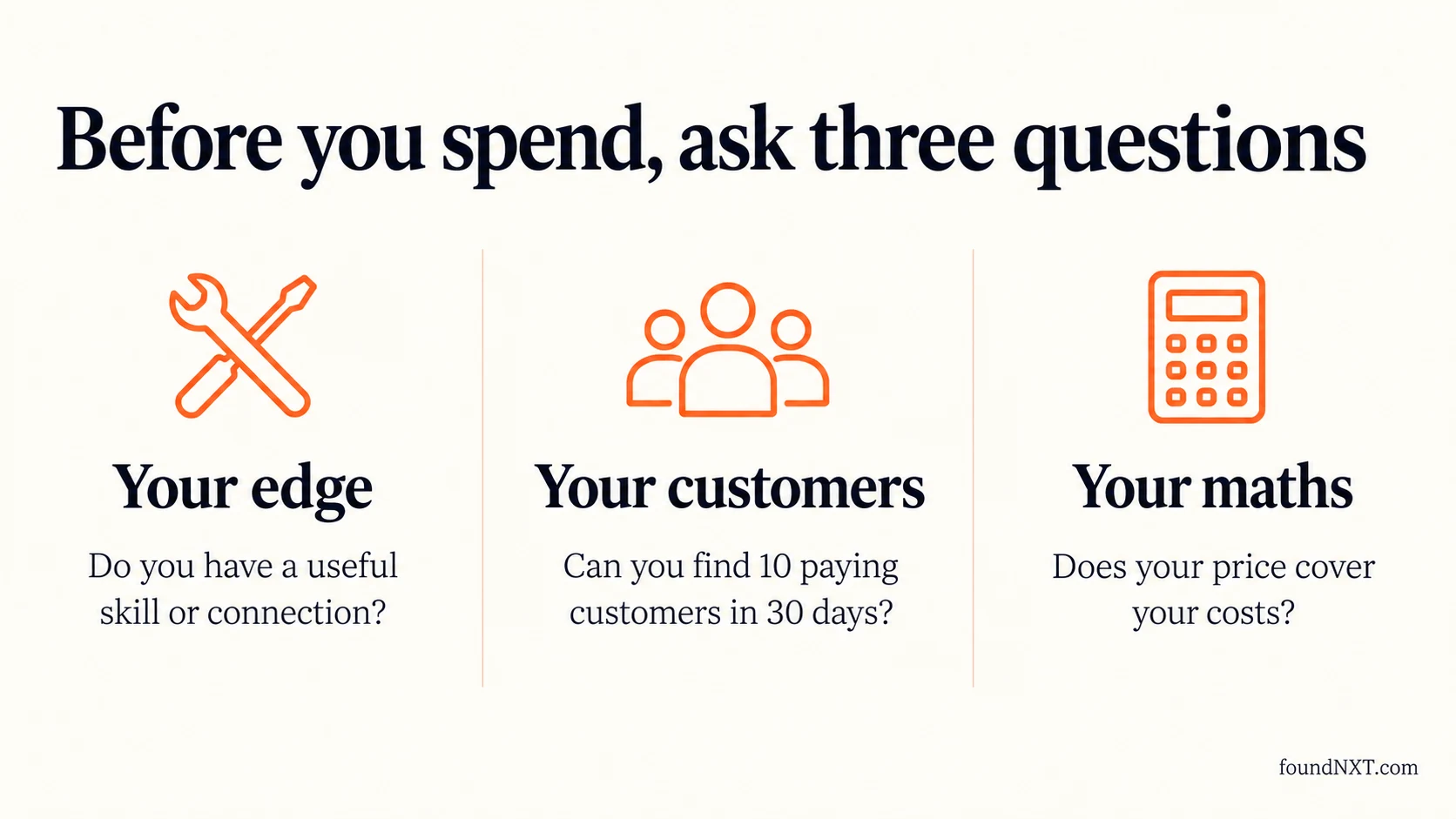
Do not choose from the list by looking for the biggest number. Choose with three questions:
- Do I already have a skill or a connection that gives me an edge? The best low-investment business is usually the one where you start a step ahead.
- Can I find 10 paying customers within 30 days? If you cannot, change the idea before you spend anything. Our guide on validating your idea for Rs 0 shows exactly how.
- Does the maths work at my price? Many first-time founders charge too little and quietly lose money. Read why Indian founders undercharge before you quote your first customer.
Once you have your first few customers, learn where your first 100 customers actually come from. When you are ready to make it official, follow our no-fluff checklist for the first 90 days after incorporation. If things are not working after a fair try, these five signals will tell you when to pivot. And if you are building in a smaller city, take heart from our piece on why the next unicorn may come from Coimbatore.
One last thing. Small businesses are demanding, and the early months can be lonely. Protect your health from day one, because burnout is a business risk too.
Karthik did not quit his job the next morning. He picked idea number one, offered to run a local bakery’s Instagram free for a month, and watched what happened. Six weeks later, the bakery paid him Rs 8,000 a month, and two of its neighbours asked for the same. That is how most real businesses begin: small, specific and slightly scary.
So which idea will you test first? Pick one, tell one person about it today, and take the first step this week.
Karthik is an illustrative character, and all costs are rough ballparks.