

📑 Table of Contents
- Loading headings…
A smaller location does not have to mean a smaller market
A business based in a small town does not have to sell only to people on the next street. Some services can be delivered remotely. Some products can reach customers through reliable shipping. Some local skills become more valuable when you connect them to a buyer who struggles to find consistent quality.
That is the opportunity behind “big-city margins”. It does not mean a small-town business automatically earns more, or that lower rent guarantees profit. Transport, unreliable power, specialist hiring, returns and customer acquisition can erase a location advantage quickly.
The useful question is more specific: what can you deliver well from your town, and who outside your immediate area values it? This guide explores eight models, a worked margin example and a practical test plan. The examples are hypothetical, not reported success stories or forecasts for 2027.
The practical takeaway: Build around a real advantage: a skill, supplier relationship, production cluster or dependable delivery process. “Costs are lower here” is not enough if customers cannot trust the result.
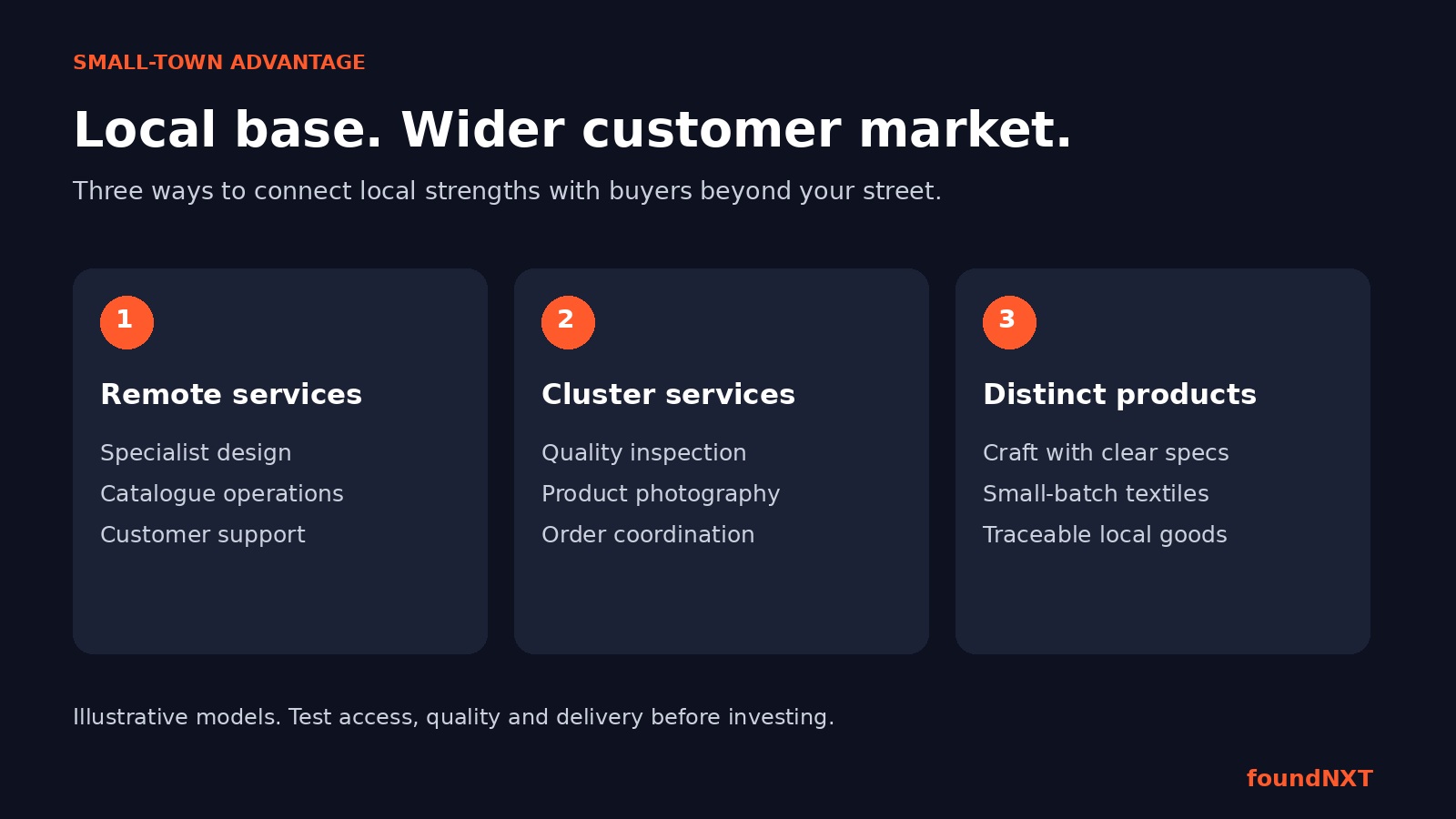
1. Remote design and presentation services
A small team can create sales decks, catalogues or technical illustrations for businesses elsewhere. You do not need a metro office to deliver a well-structured presentation. You do need reliable internet, clear English or the customer’s working language, good briefs and dependable review times.
Imagine a designer in a Tamil Nadu town creating product catalogues for industrial suppliers. A similar model could work for a designer in a smaller European city serving manufacturers nationally. Start with one industry so you learn its products. Your advantage is subject knowledge and consistency, not being the cheapest designer available.
2. Catalogue operations for regional manufacturers
Manufacturers may have strong products but uneven product records, photographs or online listings. Offer a defined service that turns approved specifications into a tidy catalogue and keeps it current. Work close to the source so you can resolve missing information instead of guessing.
A hypothetical textile supplier might need size charts, colour naming and image organisation. A metal-parts workshop might need a structured specification sheet. The repeat business is maintaining accurate records as products change. Avoid taking responsibility for claims such as safety certification unless you can check the original supporting documents.
3. Quality inspection and order coordination
When buyers source from a production cluster, distance can create uncertainty. A knowledgeable local operator could check goods against an agreed checklist, photograph packaging and coordinate dispatch. This is a trust business, not simply a courier service.
Start in a product category you understand, such as garments or simple homeware. Agree sampling limits, what counts as a defect and who makes acceptance decisions. Do not claim a full certification or guarantee that a sample check removes all risk. Liability terms and suitable insurance need professional review before larger contracts.
4. Product photography near the source
A photographer close to workshops can offer consistent catalogue shots without every maker shipping samples to a big city. A fixed setup for a narrow product category can make delivery more predictable. Accurate colour, scale and finish are especially important when customers cannot inspect the item in person.
A hypothetical craft cluster could use one shared studio day for several makers. Begin with a sample shoot, agreed file specifications and permission to use the pictures. Count travel, retouching and reshoots. A premium-looking portfolio matters only if your work reliably represents the actual product.
5. Specialised remote customer support
A trained team can handle approved customer questions, appointment coordination or onboarding from outside a metro. Start with a narrow business type and working-hour commitment. Build a response library and a clear route for complaints or questions the team cannot answer.
For an Indian service business, local-language familiarity may help. For overseas clients, time-zone overlap and communication quality matter. Check data access, employment arrangements and applicable cross-border requirements before agreeing to work. Do not sell twenty-four-hour availability when your backup plan is one tired founder.
6. Small-batch products with strong specifications
Distinct local products can serve wider buyers when quality is consistent. Think carefully specified home textiles, craft accessories or non-food gift products. Start with a small range and test whether customers value the design, materials and reliability at the delivered price.
Do not build the plan around a vague “authentic local” story. Show dimensions, care instructions, materials and accurate photos. Order samples, test packaging and record defects. Overseas sales add customs, tax and product-rule questions, so prove the domestic model first unless you already understand export operations.
7. Maintenance services for local businesses
A town may have schools, shops, offices and workshops that need dependable maintenance. A specialist service for computers, refrigeration or other equipment can be valuable when downtime is costly. Choose equipment you are trained to handle and define safety limits.
The scalable part is scheduled checks, spare-parts planning and a record of past faults. A maintenance contract should state response times, exclusions and parts charges. Do not promise unlimited repairs for a fixed fee before you know the likely failure pattern. Travel time can consume the apparent margin.
8. Skill training tied to a real task
Teach a practical skill with a clear deliverable: spreadsheet reporting, product photography or basic business communication. A local classroom can combine with remote sessions, but the course needs a real learning outcome and useful practice. Avoid vague promises of guaranteed jobs or high earnings.
Begin with a small paid cohort and assess what learners can actually do at the end. If training businesses, build lessons around their own approved workflows. To grow beyond the founder, you need lesson plans, trainer checks and support. A polished certificate is not a substitute for a skill the learner can use.
Understand the difference between margin and profit
“High margin” is often used loosely. For planning, first separate revenue from direct delivery costs. The amount left is contribution towards overhead, founder pay and other expenses. It is not automatically money you can withdraw.
Consider a hypothetical catalogue service completing ten jobs at ₹3,000 each. Revenue is ₹30,000. Direct costs of ₹1,200 per job total ₹12,000, leaving ₹18,000 contribution. After ₹10,000 for founder labour and ₹5,000 overhead, ₹3,000 remains before tax, interest and unexpected costs. These are teaching assumptions, not local market rates.
Now imagine clients pay late or two jobs need free rework. Cash available and profit can both look worse. Quote based on the complete delivery cost, including travel, software, packaging, failed deliveries and sales time where relevant. Compare the delivered price and service with the alternatives the buyer already uses.

Check the operating conditions before investing
Spend a week testing the conditions your service depends on. Is the internet reliable at the hours overseas customers need you? Is there a realistic power backup? Can you receive samples and dispatch orders safely? Can someone cover a delivery if you are sick?
For a product business, get actual courier quotes to three likely destinations and send a test package. Measure damage, delivery time and the full cost rather than assuming the advertised base rate is enough. For a service business, run a remote handover with a trial client and note every point of confusion.
Local hiring can be an advantage, but do not assume the skills you need are readily available or inexpensive. Test a small paid assignment and budget for training. Low salaries do not compensate for a process that produces repeated errors.
Get the basic compliance questions answered
Requirements depend on your activity, legal structure and where you sell. Food, electrical work, education involving children and cross-border services can bring very different obligations. Ask a qualified local adviser which registrations, licences, tax rules, contracts and insurance apply before taking on work that creates those risks.
For eligible Indian enterprises, the official Udyam portal says MSME registration is free, online and based on self-declaration. Do not confuse Udyam registration with every licence or tax obligation your activity may need. Use the official portal and verify your own eligibility and applicable requirements.
The SBA startup-cost guide offers a general cost-planning checklist. It is useful for thinking through expenses, but it is not Indian legal or tax guidance.
A four-week test before renting a bigger space
Week one: list what your location actually gives you, such as access to makers, language skills, technical experience or supplier relationships. Pick one buyer group and interview potential customers about a task they already pay to solve. Ask about delivery problems and switching concerns, not whether they “like” your idea.
Week two: build a sample and get real cost quotes. For services, prepare a fixed scope and a review checklist. For products, prepare packaging, photographs and a return-cost estimate. The SBA market-research guide is a useful framework for understanding customers and competitors.
Week three: sell a small pilot at an agreed price. Deliver it with close supervision and record time, corrections and cash collection. Week four: ask whether the buyer would repeat, what they would change and what made them hesitate. Use that evidence to improve the offer. If the only demand comes from friends doing you a favour, keep testing before committing to rent or equipment.
Before you accept the first order
- A real local skill or supplier advantage.
- A tested delivery route to the buyer.
- Pricing that includes rework, travel and overhead.
- The activity’s registration, tax and safety requirements are checked.
Start with evidence from a small paid job. Expand when the process earns trust, not when the idea sounds impressive.
Start small without thinking only locally
The strongest small-town business is not necessarily the one that copies a metro company. It may connect a local strength with a wider buyer more carefully than a distant competitor can. A good specification sheet, honest delivery date and clear complaint process can matter more than an impressive office address.
For more ideas, read 10 Business Ideas Born from Everyday Problems and 25 Low-Investment Business Ideas for 2027.
What useful skill or production strength does your town already have? Tell us what it is and who might buy it in the comments. Follow the Weekly Founder Brief on FoundNXT for more practical ways to test a business before making a large commitment.