
📑 Table of Contents
- Loading headings…
India added 41.1 million demat accounts in FY25 – the highest ever in a single year – taking the total to 192.4 million. Roughly 120 million Indians now invest in markets. That gold rush has a fierce three-way fight at its centre: Groww, the VC-backed volume king; Zerodha, the bootstrapped profit machine; and Upstox, the Tiger Global-backed challenger. Three companies, three completely different theories of how to win. This teardown compares them on the only scoreboard that matters: active clients, market share and money made.
A decade ago, none of this existed. In 2015 India had about 25 million demat accounts, mostly dormant, and trading meant calling a broker or visiting a branch. Three forces blew that up: cheap data after Jio’s 2016 launch, Aadhaar-based eKYC that cut account opening from days to minutes, and a pandemic that gave a bored, salaried generation both the time and the spare cash to try stocks. The broking wars are really a war over who captures the next 100 million Indians doing the same thing.
The scoreboard (FY25, NSE data)
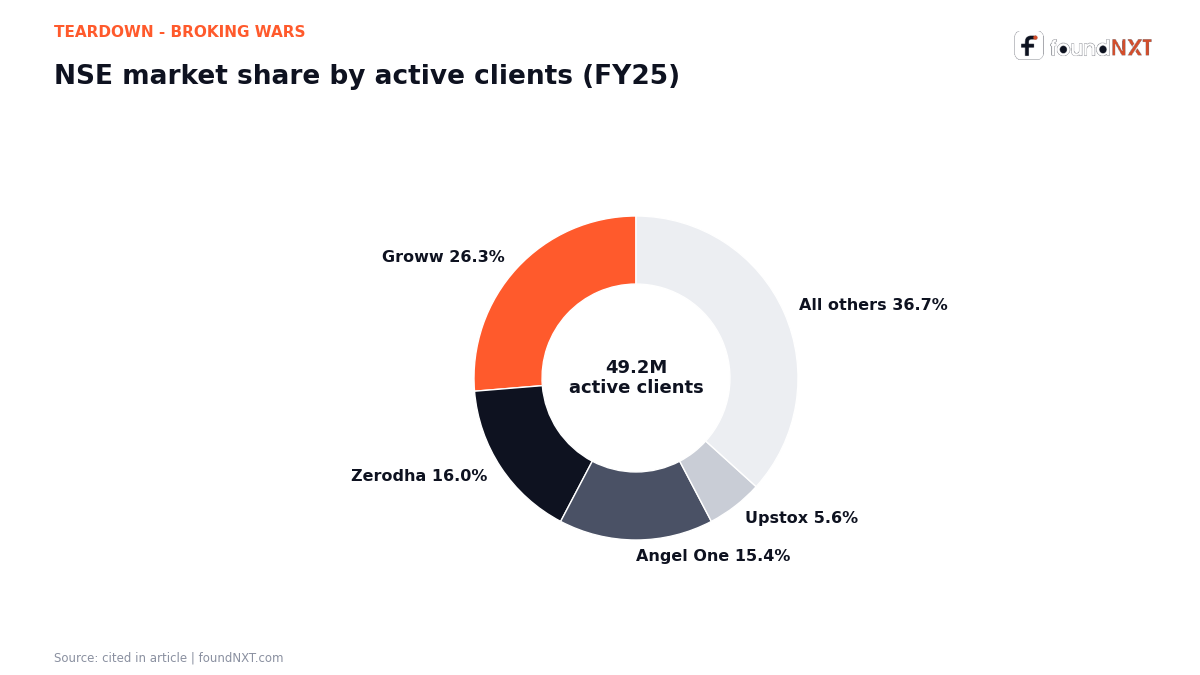
First, a definition: NSE counts an active client as someone who traded at least once in 12 months. India’s active client base grew 21% in FY25 to 49.2 million.
- Groww: 12.92 million active clients (+35.5%), market share up to 26.3% – the clear number one
- Zerodha: 7.89 million (+8.3%), share down to 16.0% – the former leader
- Angel One: 7.58 million (+24%), closing in on Zerodha
- Upstox: 2.75 million (+9.2%), share 5.6%
The top four discount brokers – Groww, Zerodha, Angel One and Upstox – now control 63.3% of the market. Full-service incumbents like ICICI Securities and HDFC Securities are fighting for the scraps.
Here is the worked example that explains why “number one” depends on your metric. Imagine 1,00,000 typical users on each platform. On Groww, a large share are mutual fund SIP investors who generate almost no brokerage – the broker earns only a few hundred rupees a year from the active slice. On Zerodha, the same 1,00,000 skew toward traders placing F&O or intraday orders at Rs 20 a leg, dozens of times a month; each active trader can be worth thousands of rupees a year in brokerage. Run that across millions of clients and the paradox resolves itself: Zerodha’s roughly 8 million clients produced Rs 8,868 crore of FY25 revenue, while Groww’s nearly 13 million produced far less per head. Groww monetises later – loans, credit, margin funding – betting that its beginner funnel matures into everything.

Groww: the growth-at-scale machine
Groww’s bet was simplicity. Founded in 2016 by four ex-Flipkart executives, it started with mutual funds – the least intimidating product for first-time investors – and designed an app so clean that opening it felt closer to UPI than to a trading terminal. When those mutual fund users graduated to stocks, Groww was already installed on their phones. Cross-sell did the rest.
The model needed venture capital and lots of it – Groww raised hundreds of millions from Tiger Global, Sequoia, Ribbit and others. The payoff arrived in November 2025, when Groww listed on the stock exchanges. Its first public quarter after listing: Rs 471 crore net profit on Rs 1,019 crore revenue. Growth is slowing as the base gets huge, but the funnel from first-time investor to active trader keeps filling.
The listing itself was a milestone for Indian startups: Groww’s parent raised about 754 million dollars and the stock debuted at a premium, valuing the company near 9 billion dollars. It also flipped the usual VC script – early backers like Ribbit and Sequoia saw real public-market returns from an Indian fintech, which is exactly the exit evidence that brings the next wave of capital into the sector.
Zerodha: the profitable contrarian
Zerodha invented discount broking in India and held the crown for a decade. Its strategy is the mirror image of Groww’s: no external funding, no growth-at-all-costs, no chasing passive users. It targets serious traders, charges nothing for delivery and Rs 20 for intraday/F&O, and monetises so efficiently that even in a bad year it keeps nearly half its revenue as profit – Rs 4,237 crore net profit in FY25, more than ten times Groww’s quarterly run-rate annualised.
The cost of that purity showed up in FY25: SEBI’s crackdown on F&O speculation hit Zerodha’s trader-heavy base hardest. Revenue fell 11%, active clients slipped below 8 million, and Groww blew past. Zerodha’s answer was characteristically calm – it sits on Rs 22,769 crore of cash and answers to no board. (We did a full teardown: Zerodha: a billion-dollar business with zero VC money.)
The SEBI crackdown needs a footnote because it changed the industry’s math. In late 2024, SEBI tightened index derivatives rules – bigger contract sizes, fewer weekly expiries, upfront margin requirements – explicitly to cool retail F&O speculation after its own study found that about 9 in 10 individual F&O traders lose money. Industry-wide F&O volumes fell sharply through 2025. For Groww, whose users mostly run SIPs, the hit was glancing. For Zerodha, where traders generate the bulk of brokerage, it was structural: the single biggest revenue lever got permanently smaller. Regulation did not just move the leaderboard; it changed what the leaderboard measures.
Groww is winning the count of investors. Zerodha is winning the count of money. Upstox is fighting to matter in both counts.
The broking wars, in one line
Upstox: the well-funded third man
Upstox (earlier RKSV) has serious backers – Tiger Global and Ratan Tata among them – and a genuinely good trading product. But the FY25 numbers are unforgiving: 2.75 million active clients and 9.2% growth, the slowest of the top four. It is squeezed from both sides – Groww owns the beginner funnel, Zerodha owns the serious trader, and Angel One is out-hustling it in the middle. Its playbook has leaned on aggressive marketing (including IPL sponsorships) and cashback-led acquisition, expensive habits when the funding market turned selective, as we mapped in where India’s startup money went. The strategic question for Upstox is no longer “how fast can we grow” but “what are we the best at”.
Important: Active-client counts are not revenue. A crore of dormant Groww users is worth less than a lakh of daily Zerodha traders. When you compare these companies, always ask which metric each one chooses to advertise.
What the war teaches founders
The global mirror: America’s fee war wrote this script first
India’s broking wars replay America’s, ten years behind. Robinhood did the Groww move – a beautiful app, zero commissions, a generation of first-time investors – and raced past 20 million accounts. Charles Schwab and the incumbents were forced to cut commissions to zero in 2019, exactly as ICICI Direct and HDFC Securities were pushed toward discount pricing here. And the profit pattern rhymes: the money in zero-commission broking was never the commission. In the US it is payment for order flow and margin lending; in India it is F&O brokerage and, increasingly, credit products built on top of the investing relationship.
The cautionary chapter is shared too. When the 2021 meme-stock frenzy cooled, Robinhood’s active traders and revenue fell far faster than the diversified incumbents’ – a preview of what SEBI’s F&O curbs just did to Zerodha’s trader-heavy book. Distribution wins the users; product mix decides who survives the cycle.
What the war teaches founders
- Distribution beats features. Groww did not have better trading tools than Zerodha; it had a better front door. The beginner funnel decided the war.
- Both extremes can win. Hyper-funded growth (Groww) and zero-funded profit (Zerodha) both produced giant outcomes. The dangerous place is the middle – funded enough to burn, not differentiated enough to win. That is the concentrated funding market in one lesson.
- Regulation reshapes leaderboards. One SEBI circular moved billions of rupees of revenue. In licensed businesses, regulatory risk is business-model risk.
- Choose your metric honestly. Users, revenue or profit – each company here optimised for one and sacrificed the others. Know which one you are actually building for, and design your runway around it.
None of the three stories is finished. Groww must prove its millions of SIP users can be monetised without becoming the pushy app they left banks to escape. Zerodha must find its next engine in a world with fewer F&O trades. Upstox must pick a lane. The next scoreboard – FY26 revenue and profits – will be more interesting than the client counts.
Enjoyed this teardown? We break down one Indian startup story like this every week – the numbers, the strategy, the lessons. Join the Weekly Founder Brief and get the next one in your inbox.
Sources
- Business Standard – NSE active clients FY25; Groww cements lead
- NDTV Profit – Groww extends lead over Zerodha
- Indian Startup News – Zerodha FY25 financials
- Storyboard18 – Broker client trends, August 2025
- Reuters – Groww’s parent lists at 12% premium after 754 million dollar IPO
- Reuters – Charles Schwab ends commissions for stock trading (2019)
FoundNXT publishes independent business intelligence, valuation frameworks, and startup teardowns. Nothing in this article constitutes financial, investment, legal, or tax advice. Company figures, market projections, and valuation metrics represent editorial estimates and regulatory filings. Always consult qualified legal counsel and certified financial advisors before executing investment rounds or financial agreements.